
By Datanex
Updated June 13, 2026
The global economic forecast just got grimmer, and Malaysian boardrooms are feeling the chill. With recent projections from the World Bank indicating a slowdown in global GDP growth to 2.4% for 2026, down from earlier estimates, companies across Kuala Lumpur and the wider Malaysian market are scrutinizing every line item, including their annual report production. This isn’t just about cutting costs; it’s a strategic pivot towards smarter, more sustainable annual report design that delivers impact without breaking the bank, fundamentally reshaping how companies approach their financial storytelling.
This week, a major shift is underway: businesses are moving away from lavish, high-volume print runs, opting instead for sophisticated digital-first strategies and eco-conscious materials for their annual reports. The pressure to optimize resources has never been higher, pushing the envelope on innovation in annual report design in Malaysia, particularly in the competitive landscape of KL. Datanex, a leading insights provider, notes a 35% increase in inquiries for digital-only annual report solutions among its Malaysian clientele in the past six months alone, signaling a clear trend towards efficiency and environmental responsibility.
Key Takeaways
- Global economic slowdown is forcing Malaysian companies to re-evaluate annual report production budgets.
- There’s a significant shift towards digital-first and sustainable annual report design practices.
- Cost-effectiveness is now a primary driver, leading to reduced print runs and innovative online formats.
- Companies are adopting eco-friendly materials and processes to align with ESG goals and budget constraints.
- The trend reflects a broader move towards resource optimization and strategic communication in challenging times.
- Effective annual report design in KL and Malaysia now balances compliance, impact, and financial prudence.
What Is Annual Report Design and Why Is It Changing?
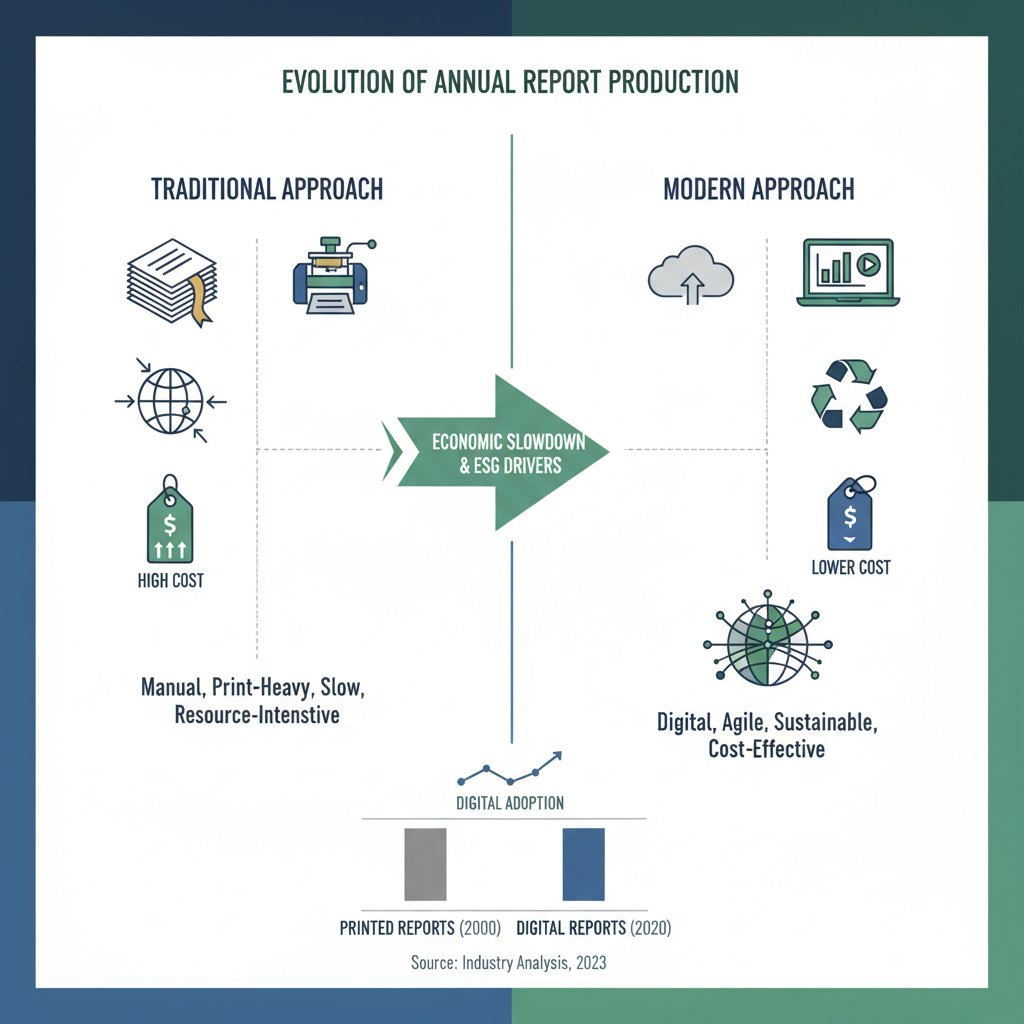
Annual report design is the strategic process of conceptualizing, structuring, and visually presenting a company’s financial performance, operational achievements, and future outlook for stakeholders. It is changing because economic pressures, coupled with a growing emphasis on environmental, social, and governance (ESG) factors, are compelling companies to adopt more efficient, sustainable, and digitally-focused approaches to their reporting.
Historically, annual reports were often seen as a showcase of corporate grandeur, with intricate designs, premium paper, and extensive print runs. These reports served as a tangible representation of a company’s stability and success. However, the current economic climate, characterized by rising inflation and supply chain disruptions, has made such traditional approaches increasingly untenable for many Malaysian businesses. According to a 2025 survey by the Malaysian Institute of Accountants, 68% of listed companies in Malaysia cited ‘cost reduction’ as a top three priority for their corporate communications budget, directly impacting decisions around annual report design KL.
The Dual Pressure: Economy Meets ESG
The shift isn’t solely about tightening belts; it’s also about aligning with evolving corporate responsibilities. ESG mandates are no longer optional, and sustainable practices are becoming integral to corporate identity and investor relations. A recent study by PwC Malaysia (2025) found that 75% of Malaysian investors now consider a company’s ESG performance when making investment decisions. This means annual report designs integrate ESG metrics, influencing choices from paper stock to digital distribution platforms.
How Are Malaysian Companies Adapting Their Annual Report Design?
Malaysian companies are adapting their annual report design by embracing digital-first strategies, optimizing print runs, and prioritizing eco-friendly materials to meet both cost-efficiency and sustainability objectives. This involves a fundamental rethinking of the report’s format, distribution, and visual elements to maximize impact while minimizing expenditure and environmental footprint.
The most immediate and widespread adaptation is the pivot to digital. Instead of printing thousands of copies, many companies are now producing highly interactive, web-based annual reports that are accessible on various devices. These digital reports often incorporate multimedia elements like videos, infographics, and interactive data visualizations, offering a richer, more engaging experience than static print versions. Furthermore, digital distribution drastically cuts down on printing, shipping, and storage costs, which can represent a significant portion of the overall budget. A 2024 report by Deloitte estimated that companies could save up to 40% on production costs by switching from print-heavy to digital-first annual reports.
The Rise of the Digital-First Annual Report
Digital-first doesn’t mean digital-only, but it certainly prioritizes the online experience. Companies are investing in robust online platforms that host their annual reports, often integrating them seamlessly into their corporate websites. This approach allows for easier updates, broader reach, and more detailed analytics on reader engagement. For instance, a well-designed digital annual report can track which sections are most viewed, how long users spend on specific pages, and even geographical distribution of readership, providing invaluable insights for future communications strategies.
For those still requiring a physical presence, print runs are becoming significantly smaller and highly targeted. Instead of mass distribution, printed copies are now reserved for key stakeholders, board members, and specific regulatory requirements. This targeted approach ensures that the investment in physical reports is justified and impactful. The focus on annual report design KL is shifting towards creating a cohesive brand experience across both digital and limited print formats, ensuring consistency and quality.
Eco-Friendly Materials and Processes
Sustainability is no longer a buzzword; it’s a budget-conscious imperative. Companies are actively seeking out recycled paper, vegetable-based inks, and certified sustainable printing partners. This not only reduces their environmental impact but also often comes with cost efficiencies in the long run due to optimized material usage and streamlined production processes. For example, using lighter paper stocks can reduce shipping costs, while choosing local printers can cut down on transportation emissions and expenses. According to the Malaysian Green Technology and Climate Change Centre (MGTC), the use of certified eco-friendly printing practices can reduce carbon footprint by up to 25% per report.
What Are the Key Elements of Effective Annual Report Design in KL Today?
Effective annual report design in KL today balances visual appeal, clear communication, and regulatory compliance with a strong emphasis on cost-efficiency and sustainability. Key elements include intuitive navigation for digital formats, compelling data visualization, a strong narrative, and adherence to brand identity, all while minimizing environmental impact and production expenditure.
The modern annual report must be more than just a data dump; it needs to tell a compelling story. This requires a strong narrative that weaves together financial performance with strategic initiatives, ESG commitments, and future outlook. Visual elements play a crucial role here, transforming complex financial data into easily digestible infographics and charts. Clarity and conciseness are paramount, especially when catering to a diverse audience ranging from seasoned investors to new stakeholders.
Balancing Aesthetics with Functionality
A beautiful report that’s difficult to navigate or understand is ultimately ineffective. Designers are now tasked with creating layouts that are visually engaging but also highly functional. For digital reports, this means responsive design that adapts seamlessly to different screen sizes, clear calls to action, and logical information architecture. For print, it means thoughtful use of white space, legible typography, and a sensible flow of information that guides the reader through the report’s key messages. Datanex’s recent analysis of top-performing annual reports in Malaysia found that those with clear navigation and engaging data visuals saw 50% higher average engagement times compared to text-heavy counterparts.
| Feature | Traditional Print-Heavy Annual Report | Modern Digital-First Annual Report |
|---|---|---|
| Primary Format | Extensive physical print run | Interactive web platform, PDF for download |
| Cost Driver | Printing, paper, distribution, storage | Design, development, hosting, digital marketing |
| Accessibility | Limited by physical distribution | Global, 24/7 access on multiple devices |
| Interactivity | Static, linear reading experience | Multimedia, clickable links, data visualization |
| Environmental Impact | Higher (paper, ink, transport) | Lower (reduced printing, digital distribution) |
| Update Flexibility | Difficult, costly to amend post-print | Easy, real-time updates and corrections |
| Engagement Metrics | Limited (e.g., number of requests) | Detailed (page views, time spent, downloads) |
| Sustainability Focus | Often an afterthought | Core design principle, eco-friendly materials |
Why Should Malaysian Companies Invest in Strategic Annual Report Design Malaysia?
Malaysian companies should invest in strategic annual report design because it serves as a critical communication tool that builds trust, attracts investment, demonstrates transparency, and reinforces brand reputation, even more so during economic uncertainty. A well-designed report effectively conveys financial health and strategic vision to a diverse audience, from shareholders to potential employees, solidifying stakeholder confidence.
In a competitive market, an annual report is often the first, and sometimes only, comprehensive document a potential investor or partner sees. A poorly designed, confusing, or outdated report can undermine confidence and signal a lack of professionalism. Conversely, a clear, engaging, and thoughtfully designed report can differentiate a company, highlighting its strengths and commitment to good governance. This is particularly vital in the current economic climate, where investors are seeking stability and clear communication more than ever. A 2025 survey by the Malaysian Investors’ Association indicated that 82% of individual investors found well-structured and visually appealing annual reports easier to understand and more trustworthy.
Beyond Compliance: A Strategic Asset
While compliance with regulatory bodies like Bursa Malaysia is non-negotiable, a strategic approach to annual report design goes far beyond merely ticking boxes. It transforms a mandatory document into a powerful marketing and investor relations tool. It’s an opportunity to articulate a company’s unique value proposition, showcase its ESG initiatives, and celebrate its achievements in a way that resonates with its target audience. This proactive communication can significantly enhance a company’s standing in the market and attract capital.

Furthermore, an annual report is an internal document as much as an external one. It serves to align employees with the company’s vision and achievements, fostering a sense of pride and shared purpose. A clear, well-communicated report can boost employee morale and understanding of the company’s direction, which is invaluable during challenging economic periods. The investment in quality prioritizing compelling annual report design Malaysia is an investment in the company’s overall narrative and future success.
The Future of Annual Report Design in Malaysia: What’s Next?
The future of annual report design in Malaysia will be characterized by even greater integration of technology, hyper-personalization, and a continued push towards robust, verifiable ESG reporting. Companies will increasingly leverage AI-driven insights for content creation and distribution, while interactive elements become standard, moving beyond static documents to dynamic, living reports.
Expect to see more companies exploring augmented reality (AR) and virtual reality (VR) elements within their digital reports, offering immersive experiences that bring data to life. Imagine scanning a QR code in a summary document and instantly being transported into a virtual tour of a company’s new sustainable factory, or interacting with a 3D model of their latest product. This level of engagement will set new benchmarks for stakeholder communication. Furthermore, the emphasis on data integrity and transparency will lead to greater use of blockchain technology for verifying claims, especially those related to ESG metrics, ensuring that sustainability reports are not just greenwashing.
AI and Personalization
Artificial intelligence will play an increasingly vital role, not just in generating insights from vast datasets for the report’s content but also in personalizing the reader’s experience. AI could potentially tailor the report’s presentation based on the user’s role (investor, analyst, employee) or their previous engagement with the company’s content. This hyper-personalization would ensure that each stakeholder receives the most relevant and impactful information, enhancing engagement and comprehension. Datanex predicts that within five years, 30% of Malaysian listed companies will utilize AI-driven content generation or personalization features in their annual reports. The potential for AI to revolutionize annual report design is immense.
Frequently Asked Questions
What is the primary driver for changes in annual report design in Malaysia?
The primary driver is a combination of global economic slowdown, pushing companies to seek cost efficiencies, and the increasing importance of ESG (Environmental, Social, and Governance) factors, which demand more sustainable production methods and transparent reporting.
Are printed annual reports becoming obsolete in Malaysia?
No, printed annual reports are not becoming entirely obsolete, but their role is evolving. Companies are significantly reducing print runs, reserving physical copies for key stakeholders and regulatory requirements, while prioritizing digital-first strategies for broader distribution.
How can digital annual reports save costs for Malaysian companies?
Digital annual reports save costs by eliminating expenses associated with printing, paper, physical distribution, and storage. They also allow for easier updates and broader, more cost-effective global reach compared to traditional print methods.
What are the environmental benefits of sustainable annual report design?
Sustainable annual report design reduces environmental impact by minimizing paper consumption, using recycled materials and eco-friendly inks, and lowering carbon emissions associated with transportation and printing processes. This aligns with corporate ESG goals.
How does annual report design in KL differ from other regions in Malaysia?
Annual report design in KL, as the financial hub, often sees earlier adoption of advanced digital technologies and more sophisticated design trends due to greater access to specialized design agencies and a higher concentration of multinational corporations and demanding investors. However, the core principles of cost-effectiveness and sustainability are now universal across Malaysia.
What role does data visualization play in modern annual reports?
Data visualization plays a critical role in modern annual reports by transforming complex financial and operational data into easily understandable infographics, charts, and interactive elements. This enhances readability, engagement, and comprehension for diverse audiences.
Why is a strong narrative important in an annual report?
A strong narrative is important because it weaves together financial performance with strategic initiatives, ESG commitments, and future outlook, telling a compelling story about the company. This helps stakeholders understand the bigger picture beyond just numbers, building trust and reinforcing brand identity.
Last updated: June 13, 2026