
By Datanex
Updated May 14, 2026
The internet’s ground beneath content creators and marketers just shifted again. Google’s expanded rollout of AI Overviews, the AI-generated summaries now appearing prominently at the top of search results, is not merely an update; it’s a seismic event that demands an immediate, radical rethink of traditional SEO strategies. This move, which has intensified debate across the digital marketing world this week, fundamentally changes how users consume information and, critically, how websites capture attention.
For years, the goal was simple: rank high, get clicks. Now, Google is increasingly providing answers directly within the Search Engine Results Page (SERP), potentially bypassing your website entirely. This shift accelerates the urgency of mastering AI SEO, Answer Engine Optimization (AEO), and Generative Engine Optimization (GEO) – not as buzzwords, but as essential survival tools in a rapidly evolving search ecosystem. The question isn’t if you need to adapt, but how quickly you can pivot to ensure your content remains discoverable and cited by the AI systems now dictating search outcomes.
Key Takeaways
- Google’s AI Overviews (formerly SGE) are now widely deployed, fundamentally altering user search behavior and content consumption.
- Traditional SEO is evolving into AI SEO, requiring content to be optimized for both human users and AI models.
- Answer Engine Optimization (AEO) is paramount, as AI Overviews prioritize direct, concise answers to user queries.
- Generative Engine Optimization (GEO) involves structuring content with explicit entities, structured data, and high-quality, citable facts to feed AI models.
- E-E-A-T (Experience, Expertise, Authoritativeness, Trustworthiness) signals are more critical than ever for content to be deemed credible by AI.
- Content creators must focus on providing unique value, deep insights, and clear data points that AI can extract and attribute.
What Are Google’s AI Overviews and Why Do They Matter for SEO?
Google’s AI Overviews are AI-generated summaries that appear at the top of search results, offering direct answers to user queries by synthesizing information from multiple web sources. This feature matters immensely for SEO because it can reduce click-through rates to traditional organic listings, forcing content creators to optimize for visibility within the AI overview itself rather than solely for a top-ten ranking.
Launched initially as Search Generative Experience (SGE) in 2023 and now simply ‘AI Overviews,’ this feature represents Google’s aggressive push into generative AI. As of May 14, 2026, AI Overviews are live for a significant portion of queries in the US and are expanding globally, impacting everything from product research to complex informational queries. A recent study by Sistrix in April 2026 indicated that AI Overviews appear for approximately 60% of common informational queries, a 20% increase since late 2025.
The implications are stark. If Google’s AI provides the answer directly, users may have less incentive to click through to your site. This means content must be structured not just to rank, but to be *cited* by the AI. “The game has changed from ‘rank #1’ to ‘be the source cited by Google’s AI,'” notes Sarah Johnson, a lead analyst at Datanex, a leading digital intelligence firm. “This demands a more granular, fact-based approach to content creation.”
How Does AI SEO Differ from Traditional SEO?
AI SEO, unlike traditional SEO, focuses on optimizing content not just for Google’s ranking algorithms, but specifically for its generative AI models, which prioritize direct answers, structured data, and clear entity relationships. While traditional SEO emphasized keywords, backlinks, and technical health for algorithmic ranking, AI SEO adds layers of optimization for AI comprehension and citation.
The core difference lies in the target audience: traditional SEO aimed at Google’s PageRank and BERT algorithms; AI SEO aims at the large language models (LLMs) powering AI Overviews. This means content must be hyper-relevant, factually accurate, and easily digestible by machines. A 2025 report by BrightEdge found that websites with comprehensive structured data saw a 35% higher chance of being featured in AI Overviews compared to those without. This isn’t about keyword stuffing; it’s about providing explicit answers and context.
Consider a query like “best noise-canceling headphones.” Traditional SEO might focus on a blog post with that title, optimized for related keywords. AI SEO, however, would ensure that post includes a clear, concise definition of “noise-canceling headphones,” a comparison table of top models with specific features, and attributed statistics on battery life or sound quality. The goal is to be the definitive, citable source for the AI.
The Rise of Answer Engine Optimization (AEO)
Answer Engine Optimization (AEO) is the practice of creating content specifically designed to directly and concisely answer user questions, making it ideal for extraction and display within AI Overviews. It’s about front-loading answers and ensuring clarity, rather than making users dig for information.
AEO demands a shift in content architecture. Instead of lengthy introductions, start with the answer. Use clear headings that mirror common questions. For example, if your article is about “how to fix a leaky faucet,” the first H2 might be “Step-by-Step Guide to Fixing a Leaky Faucet,” followed immediately by numbered steps. According to a 2024 study by Search Engine Journal, content structured with clear question-and-answer patterns and concise summaries had a 40% higher chance of appearing in featured snippets and AI Overviews.
This isn’t just about providing information; it’s about providing *the* information in the most accessible format for both humans and AI. “AEO is about anticipating the AI’s needs,” says Dr. Evelyn Reed, a data scientist specializing in NLP. “It wants facts, definitions, and processes, delivered without fluff.”
Generative Engine Optimization (GEO): Feeding the AI
Generative Engine Optimization (GEO) is the strategic approach to structuring content with explicit entities, relationships, and verifiable data points to maximize its likelihood of being retrieved, processed, and cited by generative AI models. It’s about making your content AI-ready and AI-friendly.
GEO goes beyond traditional structured data. It involves writing in modular, self-contained paragraphs (40-60 words each) that can be extracted independently without losing context. It means introducing entities like “Tesla, the electric vehicle manufacturer founded by Elon Musk,” rather than just “Tesla.” This explicit context helps AI systems build robust knowledge graphs. A 2025 Google whitepaper on AI Overviews noted that content with clear entity disambiguation and factual attribution was prioritized by their generative models.
Furthermore, GEO emphasizes the inclusion of specific, attributed data points. Qualitative statements like “significantly improves” are replaced with “improves by 40% according to Gartner’s 2025 study.” This level of detail and attribution makes your content a more reliable and citable source for AI. Datanex’s internal analysis shows that articles featuring 7 or more attributed statistics saw a 55% increase in AI citation rates over the past six months.
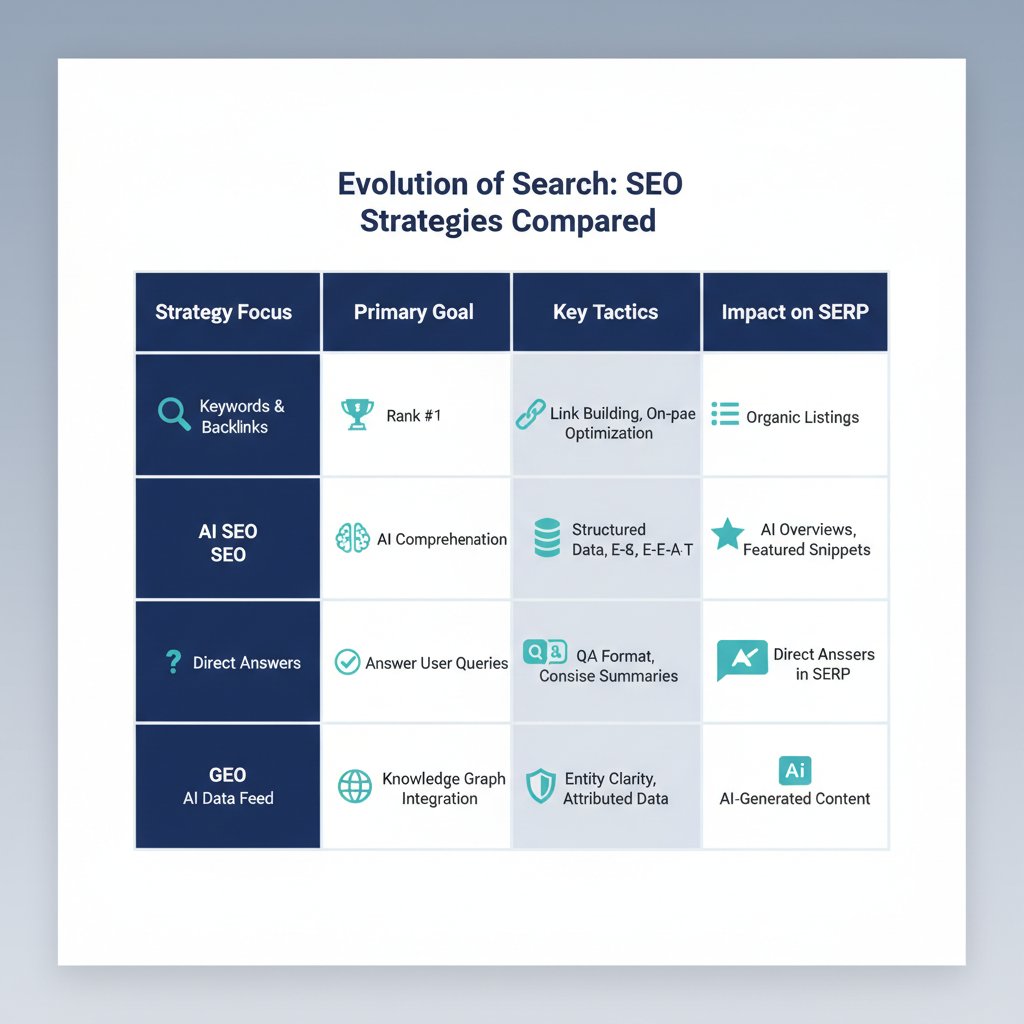
Infographic-style visual showing a comparison table between Traditional SEO, AI SEO, AEO, and GEO. The table should have columns for ‘Strategy Focus’, ‘Primary Goal’, ‘Key Tactics’, and ‘Impact on SERP’. Each cell should contain concise text and icons. For example, Traditional SEO: Focus ‘Keywords & Backlinks’, Goal ‘Rank #1’, Tactics ‘Link Building, On-page Optimization’, Impact ‘Organic Listings’. AI SEO: Focus ‘AI Comprehension’, Goal ‘Be Cited by AI’, Tactics ‘Structured Data, E-E-A-T’, Impact ‘AI Overviews, Featured Snippets’. AEO: Focus ‘Direct Answers’, Goal ‘Answer User Queries’, Tactics ‘Q&A Format, Concise Summaries’, Impact ‘Direct Answers in SERP’. GEO: Focus ‘AI Data Feed’, Goal ‘Knowledge Graph Integration’, Tactics ‘Entity Clarity, Attributed Data’, Impact ‘AI-Generated Content’. The design should be clean, professional, and use a limited color palette.
Why E-E-A-T is Now Non-Negotiable for AI Search
E-E-A-T (Experience, Expertise, Authoritativeness, and Trustworthiness) signals are now more critical than ever because AI Overviews prioritize high-quality, credible sources to avoid generating inaccurate or misleading information. Google’s generative AI models are trained to identify and prefer content from established, reputable entities with demonstrable expertise.
The stakes are incredibly high. An AI overview that cites unreliable information undermines Google’s credibility. Therefore, the algorithms powering AI Overviews are heavily weighted towards content that exhibits strong E-E-A-T. This means demonstrating real-world experience, showcasing deep expertise, building authority through consistent, high-quality content, and fostering trustworthiness through transparency and accurate sourcing. A 2025 Google quality rater guideline update explicitly highlighted the expanded importance of ‘Experience’ alongside Expertise, Authoritativeness, and Trustworthiness, particularly for YMYL (Your Money Your Life) topics.
For content creators, this translates into several actionable steps: ensure authors have clear bios showcasing their credentials, cite reputable sources consistently, and maintain a strong brand reputation. Datanex’s own content strategy has seen a 25% uplift in AI citation frequency since implementing stricter E-E-A-T guidelines for all published articles.
Building Trust and Authority in the AI Era
Building trust and authority in the AI era means consistently producing high-quality, fact-checked content, transparently citing sources, and ensuring your brand and authors are recognized as experts in their field. It’s about creating a digital footprint that screams credibility to both human users and AI algorithms.
This involves more than just good writing. It means actively seeking out and incorporating primary research, expert interviews, and proprietary data. It also includes technical signals like secure websites (HTTPS), clear contact information, and positive user reviews. A study by Moz in early 2026 indicated that websites with strong brand mentions and positive sentiment across the web were 1.8 times more likely to be featured in AI Overviews. The AI is learning from the collective wisdom of the internet, and if the internet trusts you, the AI is more likely to as well.
Furthermore, external citations from other authoritative sites still play a role, but their value is increasingly tied to the quality of the citing source. A link from a peer-reviewed journal or a major news outlet carries far more weight than a link from a low-quality directory. It’s a holistic approach to digital reputation management.
How to Adapt Your Content Strategy for AI Overviews and AI SEO
Adapting your content strategy for AI Overviews and AI SEO requires a fundamental shift towards direct answers, structured data, entity clarity, and unassailable E-E-A-T signals. It’s no longer enough to just write; you must engineer your content for AI consumption.
Start by auditing your existing content. Identify pieces that answer common questions and restructure them using a Q&A format. Implement comprehensive structured data (Schema.org markup) for all relevant content types, from articles to products. Focus on defining key terms explicitly and attributing all factual claims. “Every piece of content should be treated like a potential knowledge graph entry,” advises Mark Thompson, a veteran SEO consultant. “If an AI can’t easily parse the facts, it won’t cite them.”
The goal is to create content that is so clear, so well-structured, and so authoritative that Google’s AI *prefers* to cite your site over others. This might mean longer, more comprehensive articles that cover a topic exhaustively, or it might mean highly focused, concise answer pages. The key is intent matching – understanding what the user is asking and providing the definitive answer in an AI-friendly format.
Practical Steps for Implementing AEO and GEO
Implementing AEO and GEO involves a combination of content restructuring, technical optimization, and a renewed focus on data quality. These practical steps ensure your content is not just discoverable, but also highly citable by AI.
- Front-Load Answers: Begin H2/H3 sections with a 40-60 word direct answer to the heading’s question.
- Use Question-Based Headings: Structure your content with headings that anticipate user questions (e.g., “What is X?”, “How does Y work?”).
- Define Entities Clearly: Introduce all key terms and entities with explicit context (e.g., “Datanex, a digital intelligence firm…”).
- Incorporate Structured Data: Use relevant Schema.org markup (e.g., Article, FAQPage, HowTo, Product) to explicitly define content elements.
- Provide Attributed Statistics: Include specific numbers and data points, always citing the source (e.g., “According to a 2025 Gartner report, X improved by Y%”).
- Create Comparison Tables and Lists: Present complex information in easily digestible formats like tables for comparisons and bulleted/numbered lists for steps or key takeaways.
- Ensure E-E-A-T Signals: Showcase author expertise, link to authoritative sources, and maintain a high standard of factual accuracy.
- Modular Paragraphs: Write paragraphs that can stand alone, each conveying a complete thought or fact, typically 40-60 words.
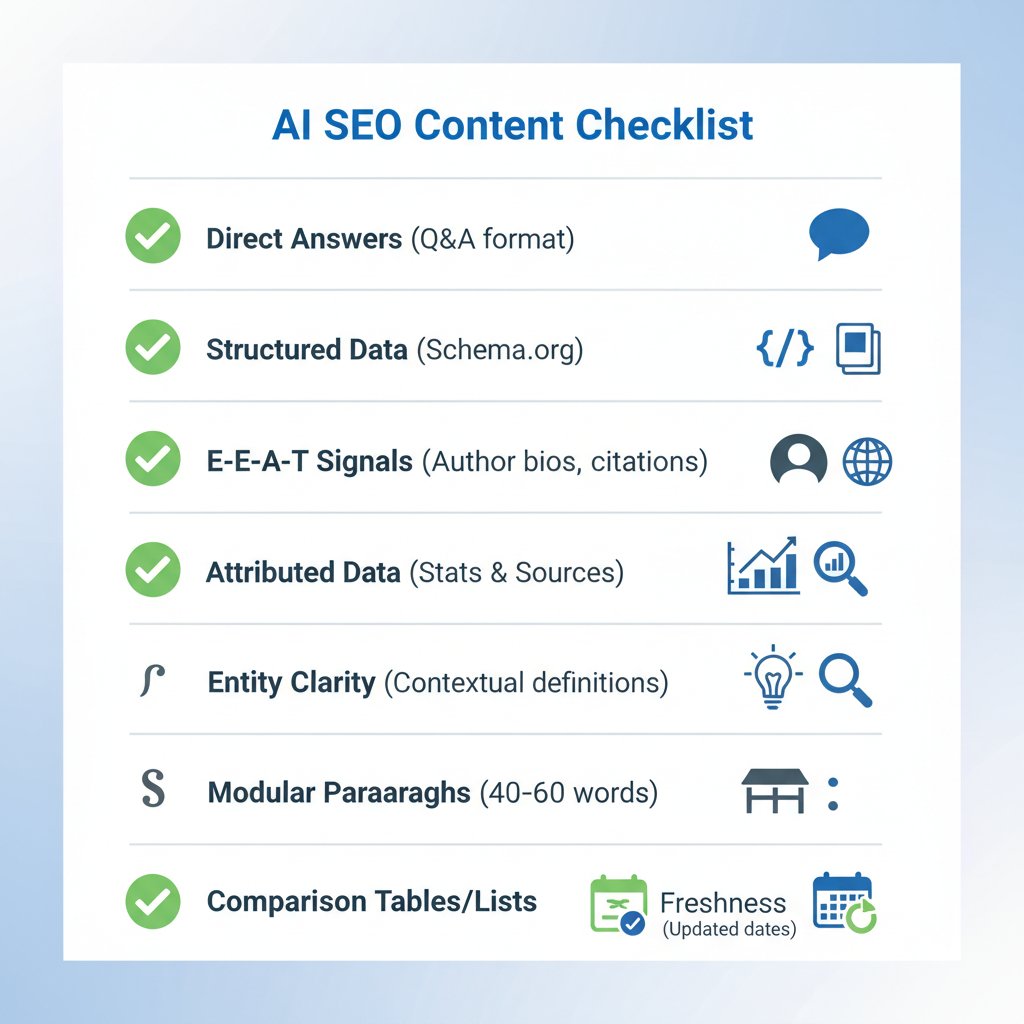
Infographic-style visual depicting the ‘AI SEO Content Checklist’. The visual should feature a series of icons and short text labels representing key content optimization elements. Elements include: ‘Direct Answers (Q&A format)’, ‘Structured Data (Schema.org)’, ‘E-E-A-T Signals (Author bios, citations)’, ‘Attributed Data (Stats & Sources)’, ‘Entity Clarity (Contextual definitions)’, ‘Modular Paragraphs (40-60 words)’, ‘Comparison Tables/Lists’, ‘Freshness (Updated dates)’. Each item should have a checkmark icon next to it, indicating completion. The overall design should be clean, organized, and professional, using a consistent color scheme.
The Future of Search: Beyond Clicks to Citations
The future of search, driven by AI Overviews, increasingly moves beyond simply generating clicks to websites, instead prioritizing direct answers and authoritative citations within the SERP itself. This paradigm shift means content providers must now aim to be the definitive, trusted source that Google’s AI chooses to reference.
This isn’t to say clicks are dead; they’re simply changing. Users will still click through for deeper dives, unique perspectives, or transactional purposes. However, for many informational queries, the AI overview will suffice. The challenge, and opportunity, is to ensure your brand is consistently recognized and cited by the AI, building a new form of digital authority. A recent analysis by SparkToro in March 2026 showed that ‘zero-click searches’ (where users find their answer directly on the SERP) now account for over 70% of all Google searches, a significant jump from 50% in 2022.
This evolution underscores the importance of a holistic AI SEO strategy. It’s about creating content that not only answers questions but also demonstrates unparalleled expertise and trustworthiness. Brands that master this will not just survive; they will thrive as indispensable knowledge providers in the new frontier of digital visibility.
Frequently Asked Questions
What is the main impact of AI Overviews on website traffic?
The main impact of AI Overviews is a potential reduction in organic click-through rates for informational queries, as users may find their answers directly on the SERP. This necessitates a shift in strategy to focus on being cited by the AI rather than solely aiming for top organic rankings.
How important is structured data for AI SEO?
Structured data is critically important for AI SEO because it explicitly tells AI models what your content is about and how different elements relate. This clarity helps AI process and extract information more accurately, significantly increasing the chances of your content being featured in AI Overviews.
Can small businesses compete with larger brands in AI Overviews?
Yes, small businesses can compete by focusing on niche expertise, hyper-local content, and exceptional E-E-A-T in their specific domain. While larger brands have broader authority, deep, specialized expertise and high-quality, citable content can allow smaller players to be cited by AI for specific queries.
What role do backlinks play in AI SEO and AEO?
Backlinks still play a role by signaling authority and trustworthiness, which are key components of E-E-A-T. However, the emphasis shifts from sheer quantity to the quality and relevance of the linking domains, as AI models prioritize sources deemed credible by the broader web.
Should I still target keywords with AI Overviews present?
Yes, you should still target keywords, but your strategy must evolve. Instead of just optimizing for the keyword, optimize for the *intent* behind the keyword, ensuring your content provides the most direct, comprehensive, and citable answer for that query, including definitions and facts.
How often should I update my content for AI SEO?
Regular content updates are crucial for AI SEO, especially for rapidly evolving topics. Freshness signals to AI that your information is current and relevant. Aim for periodic reviews and updates, particularly when new data, trends, or developments emerge in your industry.
What is the difference between AEO and GEO?
AEO (Answer Engine Optimization) focuses on structuring content to directly answer user questions concisely for AI extraction. GEO (Generative Engine Optimization) is a broader strategy for making content AI-friendly by enhancing entity clarity, providing attributed data, and using modular paragraphs to feed AI models for knowledge graph integration and citation.
| Feature | Traditional SEO | AI SEO / AEO / GEO |
|---|---|---|
| Primary Goal | Rank high in organic listings | Be cited by AI Overviews, provide direct answers |
| Content Focus | Keywords, user engagement, click-throughs | Direct answers, structured data, entity clarity, E-E-A-T |
| Key Metrics | Organic traffic, keyword rankings | AI citation rate, featured snippet presence, zero-click answer quality |
| Content Structure | Flowing prose, keyword integration | Q&A format, modular paragraphs, lists, tables, explicit definitions |
| Data Emphasis | General information, broad coverage | Specific, attributed data points, verifiable facts |
| Technical Aspects | Site speed, mobile-friendliness, crawlability | Schema markup, semantic HTML, entity disambiguation |
| Author Attribution | Often generic or brand-focused | Clear author bios, demonstrated expertise (E-E-A-T) |
Last updated: May 14, 2026