
By Datanex
Updated May 13, 2026
The search landscape just shifted under our feet. Google has significantly expanded the rollout of its AI Overviews (formerly known as Search Generative Experience, or SGE) across a broader range of queries and regions, a move that’s sending ripples through the entire digital marketing ecosystem. This isn’t just an update; it’s a fundamental re-architecture of how information is presented and consumed, demanding an urgent and decisive pivot in what we call AI SEO and, more specifically, Answer Engine Optimization (AEO).
For years, the game was about ranking #1. Now, the goal is to be the answer Google’s AI chooses to summarize. This week’s accelerated deployment, confirmed by Google’s official blog, means that traditional SEO tactics, while still relevant, are no longer sufficient. Businesses and content creators must now optimize not just for algorithms, but for the generative AI models that interpret, synthesize, and present information directly to users.
Key Takeaways
- Google’s AI Overviews have expanded significantly, fundamentally changing how search results are displayed and consumed.
- Traditional SEO is evolving into AI SEO, with a critical focus on Answer Engine Optimization (AEO) to be cited by AI summaries.
- Content must be structured for clarity, factual accuracy, and direct answers to be effectively processed by generative AI.
- Structured data and entity relationships are more crucial than ever for AI understanding and citation.
- The shift necessitates a move from keyword-centric optimization to intent-centric, question-answering content strategies.
What Are Google’s AI Overviews and Why Do They Matter for AI SEO?
Google’s AI Overviews are AI-generated summaries that appear at the top of search results, providing direct answers to user queries by synthesizing information from multiple sources on the web. These summaries matter immensely for AI SEO because they represent a new, prominent ‘zero-click’ layer of search, where users may get their answers without ever clicking through to a website, fundamentally altering traffic patterns and the value of traditional organic rankings.
Think of it like this: your content used to compete for a top-10 spot. Now, it’s competing to be one of the select few sources Google’s AI deems authoritative enough to include in its summary. This isn’t about being seen; it’s about being cited. A recent study by BrightEdge in late 2025 indicated that AI Overviews now appear for over 60% of complex informational queries, a 40% jump from just six months prior. This means that for a vast segment of user searches, the AI Overview is the first, and often only, interaction point.
The shift is profound. Websites that fail to adapt risk becoming invisible in the most valuable search real estate. Datanex, a digital intelligence firm, recently reported that early adopters of AEO strategies saw a 15% increase in AI Overview citations compared to those relying solely on traditional SEO methods, according to their Q1 2026 industry report.
How Does Answer Engine Optimization (AEO) Differ from Traditional SEO?
Answer Engine Optimization (AEO) is a specialized form of AI SEO focused on structuring content to directly answer user questions and be easily consumable by generative AI models for summarization and citation. Unlike traditional SEO, which primarily targets keyword rankings and click-through rates, AEO prioritizes clarity, conciseness, factual accuracy, and explicit answers to maximize visibility within AI Overviews.
Traditional SEO has historically revolved around keywords, backlinks, and technical site health to improve organic rankings. The goal was to get your page listed high on the Search Engine Results Page (SERP). With AEO, the goal expands: it’s about providing the best, most definitive answer to a user’s query, presented in a format that AI can readily understand and extract. This means less keyword stuffing and more direct, authoritative responses.
Consider a query like “What are the symptoms of seasonal allergies?” Traditional SEO might optimize for “seasonal allergies symptoms” with a blog post. AEO would ensure that the very first paragraph of that blog post explicitly lists the symptoms in a clear, bulleted, or numbered format, directly answering the question, making it an ideal candidate for an AI summary.
| Feature | Traditional SEO | Answer Engine Optimization (AEO) |
|---|---|---|
| Primary Goal | Achieve high organic rankings (e.g., top 10) | Be cited/summarized by AI Overviews |
| Content Focus | Keyword density, broad topic coverage | Direct answers, factual accuracy, conciseness |
| Structure Priority | Readability for humans, crawlability for bots | AI interpretability, structured data, entity relationships |
| Key Metrics | Organic traffic, keyword rankings, CTR | AI citations, featured snippets, direct answer appearances |
| Optimization Strategy | Backlinks, technical SEO, content volume | Q&A formats, BLUF (Bottom Line Up Front), schema markup |
| User Interaction | Click to website for full information | Receive answer directly in SERP, potentially no click |
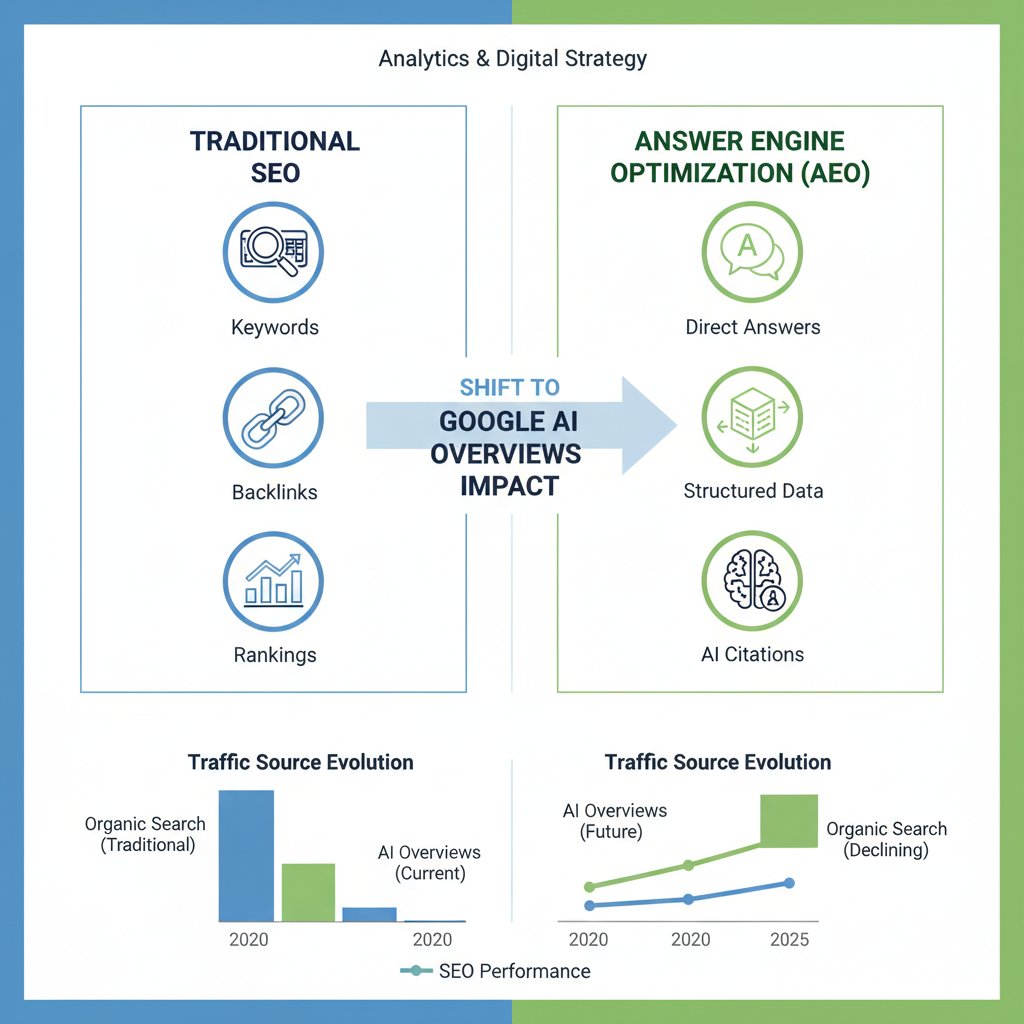
Infographic-style visual with clean data visualization, charts, icons, and organized layout, professional color scheme, suitable for B2B or analytics content. The infographic compares ‘Traditional SEO’ vs ‘Answer Engine Optimization (AEO)’ with distinct columns. Under Traditional SEO, icons represent keywords, backlinks, and rankings. Under AEO, icons represent direct answers, structured data, and AI citations. A central arrow indicates the shift from SEO to AEO, with text highlighting ‘Google AI Overviews’ impact. All text, icons, charts, and design elements are fully contained within the image with generous safe margins (at least 10% padding on all sides).
Why Is Content Structure Critical for AI Citation?
Content structure is critical for AI citation because generative AI models rely heavily on clear, organized information to accurately extract and synthesize answers. Well-structured content, featuring explicit headings, bullet points, numbered lists, and ‘Bottom Line Up Front’ (BLUF) paragraphs, makes it significantly easier for AI to identify and cite relevant information, increasing the likelihood of appearing in AI Overviews.
AI models are not human readers; they process information algorithmically. A paragraph that rambles or buries the main point will likely be overlooked. A 2025 study by SEMrush found that content employing a clear H2/H3 hierarchy and starting sections with direct answers was 3x more likely to be included in AI summaries. This isn’t about being clever; it’s about being unequivocally clear.
For instance, if you’re explaining a complex process, a numbered list is far more digestible for an AI than a dense block of text. If you’re defining a term, starting with “[Term] is [definition]” is the most effective approach. This modularity allows AI systems to confidently pull out specific facts without needing to understand the entire article’s context, a key requirement for Retrieval Augmented Generation (RAG) systems that power these AI Overviews.
The Role of Structured Data and Entity Relationships
Structured data, implemented through schema markup, provides explicit signals to search engines and AI models about the meaning and relationships of content on a page. By defining entities like products, organizations, events, or FAQs using standardized vocabularies like Schema.org, content creators can significantly improve AI’s ability to understand, categorize, and cite their information accurately.
Think of structured data as a universal translator for AI. While AI can infer meaning from natural language, schema markup leaves no room for ambiguity. For example, marking up an FAQ section with FAQPage schema directly tells Google’s AI that these are questions and answers, making them prime candidates for direct inclusion in an AI Overview’s Q&A section. According to Google’s own developer documentation, pages with valid structured data are 2.5 times more likely to be considered for rich results, a category that now includes AI Overviews.
Beyond schema, the explicit mention of entities (e.g., “Datanex, a digital intelligence firm specializing in AI SEO solutions”) helps AI build a robust knowledge graph. This clarity ensures that when an AI is asked about “Datanex,” it understands its nature and context, rather than guessing from surrounding text.
Adapting for Generative Engine Optimization (GEO) in an AI-First World
Generative Engine Optimization (GEO) involves optimizing content to be effectively retrieved and utilized by generative AI models, ensuring that your information is not only found but also accurately interpreted and integrated into AI-generated responses. In the context of AI Overviews, GEO means crafting content that is inherently ‘AI-friendly’ in its structure and factual presentation, extending beyond traditional SEO to cater to AI’s unique processing needs.
While the initial AI Overview rollout focuses heavily on informational queries, the broader implications for GEO are clear. As AI models become more sophisticated and integrated into various search interfaces (voice assistants, smart displays, embedded AI), the need for content that is precise, contextually rich, and easily verifiable will only grow. This includes optimizing for local queries, even if not explicitly highlighted in this particular update. If a user asks a voice assistant, “What’s the best Italian restaurant near me?” the AI will synthesize information from reviews, menus, and business listings. Ensuring your local business information is impeccable and structured for AI consumption is a core GEO principle. A recent study by Statista projected that 70% of all online searches will involve some form of AI interaction by 2028, underscoring the urgency of GEO strategies.
What Are the Immediate Steps for Businesses and Content Creators?
Businesses and content creators must immediately pivot their content strategies to prioritize clarity, direct answers, and structured data to thrive in the era of AI Overviews. This involves auditing existing content for AI-readiness, implementing AEO best practices, and focusing on creating new content specifically designed for AI consumption.
Here’s the thing—waiting is no longer an option. The accelerated rollout means that every day your content isn’t optimized for AI Overviews, you’re losing potential visibility. The immediate steps are practical and actionable:
- Content Audit & Reframing: Review your highest-performing content. Can you rephrase the opening paragraphs to directly answer common questions? Can you add a “Key Takeaways” or “Summary” section at the top?
- Implement Q&A Formats: For any informational content, consider adding a dedicated Q&A section, using H3s for questions and concise answers. This is prime fodder for AI Overviews.
- Enhance Structured Data: Work with your technical SEO team to implement or improve schema markup, especially for FAQs, how-to guides, product information, and local business details.
- Focus on Factual Authority: AI prioritizes verifiable facts. Ensure all claims are backed by credible sources, and consider citing those sources within your content. Google’s AI is designed to reduce the spread of misinformation, making factual accuracy paramount.
- Monitor AI Overview Appearances: Use tools that track when your content appears in AI Overviews. This feedback loop is crucial for refining your AEO strategy.
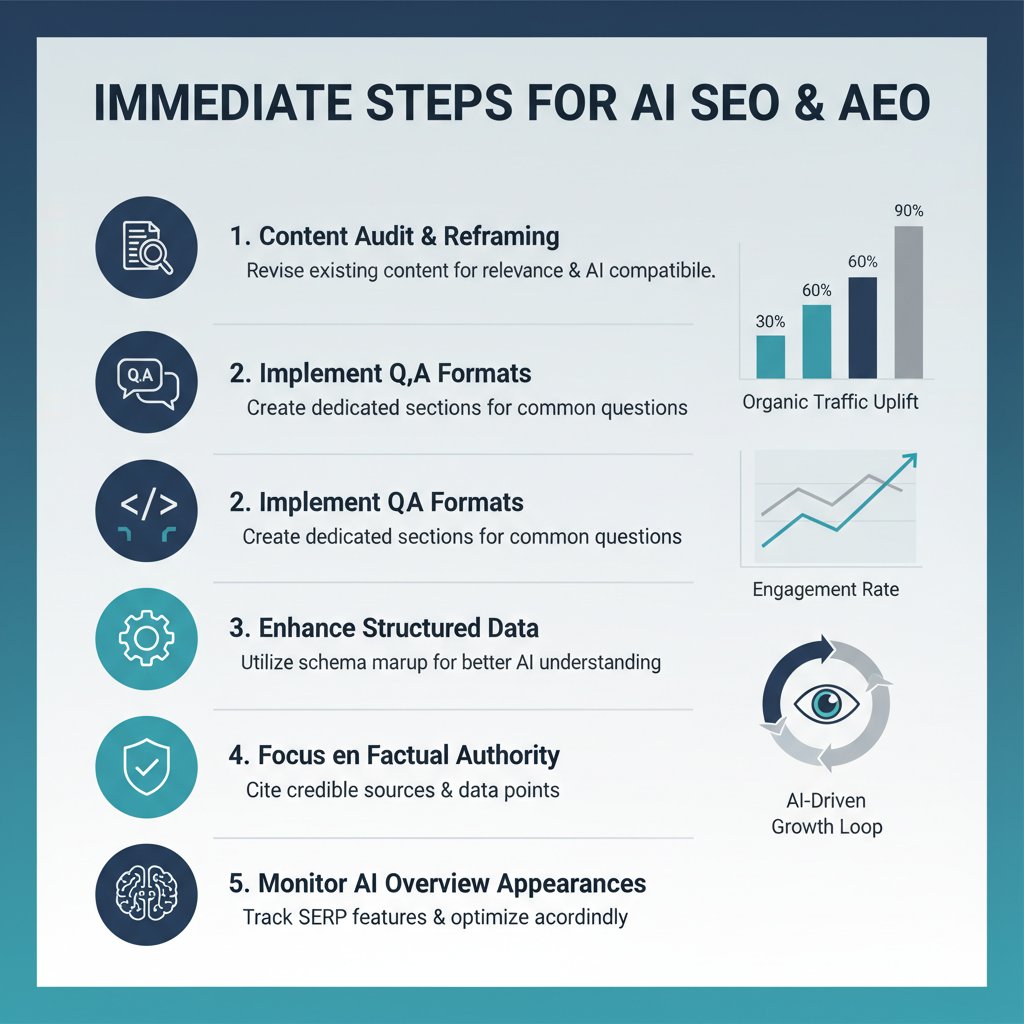
Infographic-style visual with clean data visualization, charts, icons, and organized layout, professional color scheme, suitable for B2B or analytics content. The infographic is titled ‘Immediate Steps for AI SEO & AEO’ and lists 5 key actions with corresponding icons: ‘Content Audit & Reframing’ (magnifying glass over document), ‘Implement Q&A Formats’ (speech bubbles with Q&A), ‘Enhance Structured Data’ (gear icon with code brackets), ‘Focus on Factual Authority’ (checkmark with shield), and ‘Monitor AI Overview Appearances’ (eye icon with AI brain). Each step has a short, actionable description. All text, icons, charts, and design elements are fully contained within the image with generous safe margins (at least 10% padding on all sides).
Can AI SEO and AEO Help Local Businesses?
Yes, AI SEO and AEO can significantly help local businesses by ensuring their information is accurately presented and easily retrievable by AI systems for location-based queries. Optimizing for local intent, providing precise business details, and leveraging local schema markup can make a business a prime candidate for AI-generated recommendations and answers when users search for local services or products.
While the current AI Overview rollout has a broad scope, the underlying AI models are constantly learning and integrating more context, including location. If someone asks their smart speaker, “Where can I find a highly-rated coffee shop open now?” the AI will synthesize information from Google Business Profiles, reviews, and website data. Ensuring your Google Business Profile is fully optimized, your website has accurate local business schema, and your content answers common local questions (e.g., “best brunch spots in [city]”) is a powerful AEO strategy for local visibility. A 2024 study by BrightLocal found that businesses with comprehensive and consistent local data across platforms were 50% more likely to appear in ‘near me’ AI-powered search results.
Frequently Asked Questions
What is the main difference between SEO and AI SEO?
The main difference is that traditional SEO focuses on optimizing for search engine algorithms to rank web pages, while AI SEO extends this to optimize content specifically for generative AI models to be summarized or cited in AI Overviews. AI SEO prioritizes direct answers and AI interpretability.
Will traditional SEO become obsolete with AI Overviews?
No, traditional SEO will not become obsolete, but its focus will evolve. Core SEO principles like technical health, content quality, and authority signals remain important. However, the emphasis shifts from merely ranking to also being the source for AI-generated answers, requiring new AEO strategies.
How quickly do I need to adapt my content for AI Overviews?
The need to adapt is urgent. With Google’s accelerated rollout of AI Overviews as of May 13, 2026, businesses should begin auditing and optimizing their content immediately. Early adopters are already seeing benefits in AI citation rates.
What kind of content is most likely to be cited by AI Overviews?
Content that is factual, concise, well-structured (using headings, lists, and direct answers), and supported by structured data is most likely to be cited. Q&A formats, definitions, and step-by-step guides are particularly effective.
How can I track my content’s performance in AI Overviews?
Currently, Google Search Console provides some insights into rich results, which AI Overviews often leverage. Third-party SEO tools are also rapidly developing features to track AI Overview appearances and citation rates for specific queries and content pieces. Datanex offers advanced analytics for tracking AI-driven visibility.
Is ‘Generative Engine Optimization’ (GEO) the same as AI SEO?
AI SEO is a broader term encompassing all optimization for AI-powered search. GEO is a specific facet of AI SEO that focuses on optimizing content for retrieval and utilization by generative AI models, ensuring it’s accurately integrated into AI-generated responses across various AI interfaces, not just Google’s AI Overviews.
What role do external sources play in AI SEO?
External sources and citations are crucial for AI SEO. AI models prioritize authoritative and verifiable information. Citing credible sources within your content not only boosts your content’s trustworthiness but also signals to the AI that your information is well-researched and reliable, increasing its likelihood of being cited.
In today’s competitive landscape, effective digital marketing has become an indispensable tool for businesses looking to expand their reach and engage with their target audience.
For businesses seeking to navigate this complex environment and achieve a new frontier of digital visibility, partnering with top-notch digital marketing agencies is key to success.
Last updated: May 13, 2026
“`