
By Datanex
Updated July 1, 2026
Forget everything you thought you knew about your company profile if your sights are set beyond Malaysia’s borders. For years, I’ve watched Malaysian businesses, especially those based in Kuala Lumpur, create stunning profiles for local consumption — only to see them fall flat when presented to an international audience. The truth is, designing a company profile for global impact isn’t just about translation; it’s about a complete strategic rethink. It’s about crafting a narrative and a visual identity that speaks to diverse cultures, respects varied regulatory landscapes, and still proudly showcases your Malaysian heritage.
The shift from local to global isn’t just an aspiration for many Malaysian SMEs and larger corporations; it’s an economic imperative. As the ASEAN region integrates further and global trade routes become more accessible, the opportunities are immense. But so are the pitfalls. A poorly adapted company profile can be a significant barrier, projecting an image that’s either misunderstood, inappropriate, or simply unconvincing. This guide isn’t about generic design tips; it’s about building a global blueprint for your company profile, specifically from a Malaysian vantage point.
Key Takeaways
- A global company profile requires more than just translation; it demands cultural adaptation and strategic messaging.
- Understanding target market nuances, from visual preferences to communication styles, is crucial for international success.
- Cross-border legal and ethical compliance must be baked into your profile’s content and design from the outset.
- Your Malaysian identity can be a unique selling proposition, but it needs to be presented in a universally appealing way.
- Investing in professional design and content strategy for international markets is an essential growth driver, not an optional expense.
- Digital and print profiles each have distinct advantages and must be tailored for global distribution.
Why Does a Malaysian Company Need a Global-Ready Profile?
A global-ready company profile is essential because it serves as your primary ambassador in foreign markets, often before any personal interaction. It’s your first impression, your detailed resume, and your cultural interpreter all rolled into one document. Without a profile designed with international sensibilities, you risk miscommunication, alienating potential partners or clients, and failing to convey your true value proposition.
From what I’ve seen over the years, many Malaysian companies excel at building strong local brands. But when they try to export that brand identity without adaptation, it often loses its punch. Different markets have different expectations for formality, visual cues, and even how information is structured. For instance, what might be considered a bold, direct statement in Malaysia could be perceived as aggressive in Japan, or too vague in Germany. The profile isn’t just a brochure; it’s a strategic communication tool that needs to be as adaptable as your business model.
Beyond Translation: The Cultural Imperative
Translating your existing company profile word-for-word into another language is a rookie mistake. It’s like trying to fit a square peg into a round hole – it just doesn’t work. The real work begins with transcreation, which means adapting the content, tone, and visual elements to resonate culturally with your target audience.
Think about it: colors carry different meanings. Red might symbolize prosperity in China but danger in other regions. Imagery of families might be universally appealing, but the specific representation of family structures can vary dramatically. Even the hierarchy of information, how you present your company history versus your future vision, can be culturally influenced. This is where a deep dive into your target markets becomes non-negotiable. You need to understand their business etiquette, their aesthetic preferences, and their underlying values. It’s a significant investment of time, yes, but the payoff in trust and engagement is immense.
What Makes a Company Profile Design for International Markets Unique?
The uniqueness lies in its deliberate universality combined with strategic localization. It’s about creating a core identity that’s robust enough to travel, yet flexible enough to be tweaked for specific regions. This isn’t about blandness; it’s about intelligent design that anticipates diverse interpretations and expectations.
I’ve always advocated for a ‘glocal’ approach here: think global, act local. Your company profile should have a consistent brand voice and visual style that is recognizably *your* company, but the specific content and presentation should be agile. This might mean having a core English version that serves as a master document, with several localized versions for key markets. Each localized version isn’t just translated; it’s culturally re-engineered. This is the part that most guides get completely wrong – they focus on the ‘what’ but miss the ‘how’ of truly globalizing your message.
Core Elements of a Global Company Profile
- Universal Brand Identity: A logo, color palette, and typeface that maintain integrity and appeal across cultures. Avoid overly specific cultural references unless they are part of your core brand story and are universally understood or explained.
- Adaptable Messaging: A core narrative that highlights universal values (innovation, quality, reliability) while allowing for specific market benefits to be emphasized.
- Multi-language Readiness: Designed from the ground up to accommodate different script directions (left-to-right, right-to-left), text lengths, and character sets without breaking the layout.
- Culturally Appropriate Imagery: Diverse and inclusive visuals that reflect global audiences, or specific imagery tailored to a target region.
- Clear Value Proposition: Articulating your unique selling points in a way that transcends cultural barriers and addresses common international business needs.
- Compliance and Credibility: Including relevant international certifications, awards, and regulatory adherence that build trust in global markets.

How Do You Adapt Company Profile Design for Different Regions?
Adapting your company profile design for different regions involves a systematic approach to research, content strategy, and visual execution. It’s not a one-size-fits-all solution; it’s a series of informed decisions based on your target markets. The first step, always, is deep market research. You need to understand the business environment, consumer behavior, and cultural norms of each region you’re targeting.
For example, if you’re targeting the Middle East, you’ll need to consider right-to-left text, specific color preferences, and perhaps a more formal tone. If it’s Europe, precision, data, and adherence to standards might be paramount. Asia, on the other hand, is incredibly diverse – a profile for Japan will look very different from one for Indonesia or South Korea. What strikes me about this process is how much it forces companies to truly understand their audience, not just their product. It’s a powerful exercise in empathy.
Regional Considerations in Design and Content
Let’s break down some specific areas where adaptation is critical:
Visuals and Imagery
This is often the most immediate point of connection or disconnection. What works in Malaysia might not translate well. Are your images diverse? Do they represent the people and environments of your target market? Are there any gestures or symbols in your photos that could be misinterpreted? I’ve seen companies accidentally use imagery that was considered offensive or simply irrelevant in a foreign market, completely undermining their message.
Color Psychology
As mentioned, colors are loaded with meaning. Research the primary and secondary colors of your brand and how they are perceived in your target regions. Sometimes a slight shift in hue or the introduction of an accent color can make a world of difference without compromising your core brand identity.
Language and Tone
Beyond literal translation, consider the level of formality, directness, and use of humor. Some cultures prefer a more indirect, relationship-focused approach, while others value concise, fact-driven communication. Your tone should reflect this. And, of course, ensure any translation is done by a native speaker with business acumen, not just a translation tool.
Information Hierarchy and Structure
How do people in your target market typically consume information? Do they prefer executive summaries upfront, or a detailed background before the main points? Some cultures prefer a linear, logical flow, while others are more comfortable with a holistic, interconnected presentation. This impacts everything from your table of contents to the layout of individual pages.
Legal and Regulatory Disclosures
This is where things get really serious. Different countries have different requirements for what must be disclosed in a company profile, especially if you’re dealing with financial services, healthcare, or specific product categories. Think about data privacy regulations like GDPR in Europe, or specific industry certifications required for market entry. Ignoring these can lead to significant legal and financial penalties.
Building Trust: Compliance and Credibility in a Global Context
Building trust internationally is paramount, and your company profile is a key tool in achieving this. It’s not just about what you say, but how you substantiate it. For Malaysian companies, this often means highlighting adherence to international standards and demonstrating a clear understanding of foreign market regulations. The honest answer is that nobody knows for certain yet what the next big compliance hurdle will be, but the evidence suggests that transparency and verifiable claims are becoming increasingly critical.
One of the biggest mistakes I see is companies assuming that local certifications are sufficient globally. They’re not. You need to actively pursue and showcase international certifications relevant to your industry and target markets. Think ISO standards, specific product safety certifications, or even ethical sourcing accreditations. These aren’t just badges; they’re proof points that tell a global audience you play by their rules and uphold their standards.
Navigating Cross-Border Legalities
Your company profile, particularly if it’s used for investment or partnership pitches, must be meticulously reviewed for legal compliance in each target jurisdiction. This goes beyond simple disclaimers.
- Data Privacy: If your profile collects data or refers to customer data, ensure it aligns with regulations like GDPR (Europe), CCPA (California), or similar laws in other regions.
- Intellectual Property: Clearly state your IP protections. If you’re discussing patented technology or unique processes, ensure your claims are legally sound across borders.
- Financial Disclosures: For publicly traded companies or those seeking significant investment, financial reporting standards vary. Ensure any financial data presented is compliant with relevant international accounting standards (e.g., IFRS).
- Anti-Bribery & Corruption: Many international partners will scrutinize your ethical stance. Include statements about your commitment to ethical business practices and anti-corruption policies, especially if you operate in high-risk sectors.
- Environmental, Social, and Governance (ESG): Increasingly, global partners and investors demand transparency on ESG initiatives. Your profile should reflect your commitment to sustainable and responsible business practices.
This is where legal counsel becomes indispensable. Don’t skimp on it. A quick review by an international business lawyer can save you millions in potential lawsuits or lost opportunities down the line.
Digital vs. Print: Optimizing Your Global Company Profile
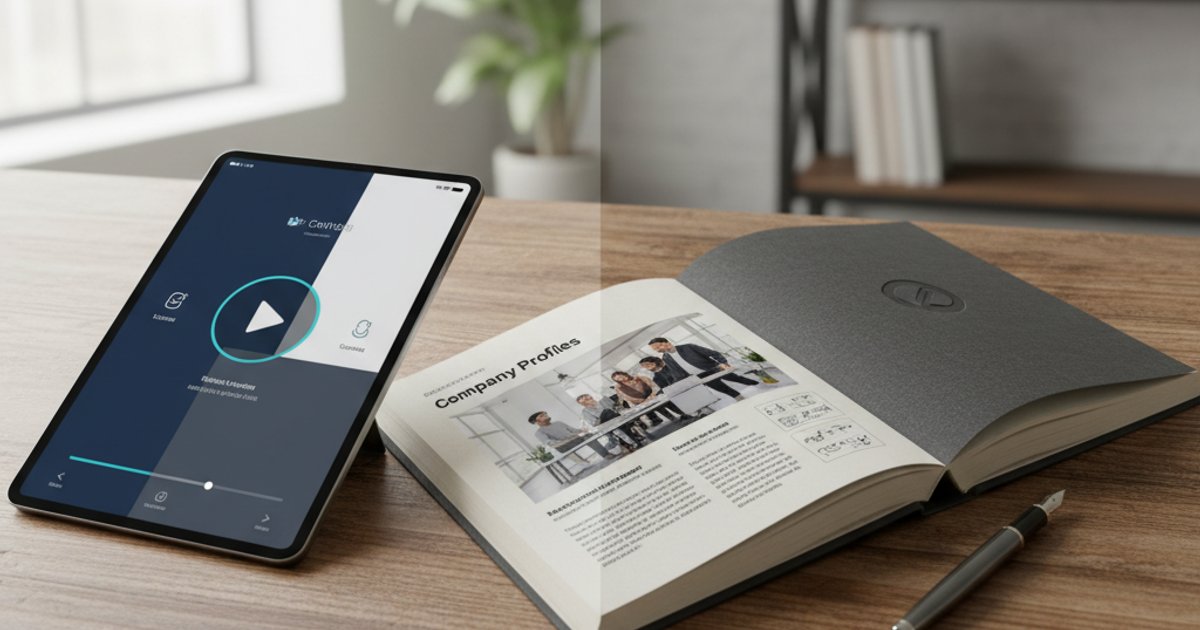
In today’s interconnected world, you can’t just pick one. A truly global strategy for company profile design Malaysia-based businesses should embrace both digital and print formats, optimizing each for its unique strengths and distribution channels. They serve different purposes and reach different audiences, but they must maintain a consistent brand message and visual identity.
The digital profile, often a PDF or an interactive web page, offers flexibility, reach, and cost-effectiveness. It’s easily shareable, can include multimedia, and can be updated instantly. The print profile, however, still carries a certain weight and professionalism, especially in more traditional business cultures or for high-stakes meetings. It’s tangible, memorable, and signals a serious investment. The key is to design them in parallel, ensuring a seamless transition between the two.
Digital Profile Advantages for Global Reach
- Accessibility: Easily distributed via email, cloud storage, or your website, reaching anyone, anywhere.
- Interactivity: Can include embedded videos, clickable links to case studies, testimonials, or product pages.
- Analytics: Track views, downloads, and engagement if hosted on a platform with analytics capabilities, providing valuable insights into audience interest.
- Updatability: Changes can be made instantly, ensuring your global audience always has the most current information.
- Cost-Effective: Eliminates printing and shipping costs, making it ideal for broad distribution.
Print Profile Advantages for Impact
- Tangibility: A physical document can leave a lasting impression, especially in cultures that value physical artifacts.
- Professionalism: A well-produced print profile signals seriousness, investment, and attention to detail.
- Meeting Tool: Excellent for face-to-face meetings, trade shows, and conferences where a physical handout is expected.
- Brand Experience: High-quality paper, finishes, and binding can enhance the tactile brand experience.
Leveraging Your Malaysian Identity Globally
Your Malaysian identity isn’t a hindrance; it’s a unique selling proposition. The ‘Made in Malaysia’ label can evoke images of quality, innovation, and a strategic gateway to Southeast Asia. The challenge is to present this identity in a way that is universally appealing and doesn’t rely on stereotypes or niche cultural references that only locals would understand. For companies doing impactful company profile design KL-based, this is a crucial distinction.
I’ve always advised clients to think about what makes Malaysia unique in a global business context: its multiculturalism, its strategic location, its robust infrastructure, its talent pool. These are all strengths that can be woven into your narrative. For instance, highlighting your diverse workforce can be a powerful message of adaptability and global understanding. Emphasizing your access to the ASEAN market positions you as a gateway. It’s about framing your local roots as a global advantage.
Showcasing Malaysian Strengths
Here’s how you can subtly and effectively integrate your Malaysian identity:
- Strategic Location: Position your KL base as a hub for Southeast Asia and beyond, highlighting logistical advantages and market access.
- Multicultural Workforce: Emphasize your diverse team as a strength, showcasing cultural understanding and multilingual capabilities. This resonates well with international partners.
- Innovation & Technology: Highlight Malaysia’s growing reputation as a tech and innovation hub, especially in areas like digital economy, green technology, or Islamic finance.
- Quality & Standards: Showcase adherence to international quality standards (e.g., ISO, Halal certification where relevant) that are recognized globally, reinforcing trust in Malaysian products and services.
- Sustainability Initiatives: Many Malaysian companies are leaders in sustainable practices. This can be a powerful differentiator in environmentally conscious markets.
The key is to integrate these elements organically into your narrative, rather than just tacking them on. They should be part of your core story, demonstrating how your Malaysian roots contribute to your global competitiveness.
Choosing the Right Partner for Global Company Profile Design Malaysia
Selecting the right design agency for your global company profile is not just about finding someone who can make things look pretty. It’s about finding a strategic partner who understands the nuances of international business, cultural adaptation, and cross-border communication. For companies in Kuala Lumpur looking to expand, this means looking beyond local portfolios and asking the tough questions about their global experience.
I’ve seen too many businesses waste time and money on agencies that promise the world but deliver a locally-focused product. A truly effective partner for global company profile design Malaysia needs to demonstrate a proven track record of working with diverse international clients or on projects targeting multiple regions. They should be able to articulate their process for cultural adaptation, legal review, and multi-language content management. Don’t just look at their design aesthetic; probe their strategic thinking.
Key Questions for Potential Design Partners
| Category | Questions to Ask |
|---|---|
| Global Experience | Have you designed profiles for international markets before? Which regions? Can you provide examples? |
| Cultural Adaptation | What is your process for ensuring cultural appropriateness in design and content? How do you research target market nuances? |
| Language & Translation | Do you offer transcreation services, or do you work with external linguistic experts? How do you manage multi-language versions? |
| Legal & Compliance | How do you ensure the profile meets international legal and regulatory standards? Do you have legal partners you recommend? |
| Digital & Print | What are your capabilities for both digital (interactive PDFs, web) and high-quality print production? |
| Strategy & Consulting | Beyond design, what strategic input can you provide on messaging and market positioning for global audiences? |
Remember, this isn’t just a design project; it’s a strategic investment in your global expansion. Choose a partner who can be an extension of your international business development team.
Frequently Asked Questions About Global Company Profile Design
What is the most common mistake Malaysian companies make when designing profiles for international markets?
The most common mistake is simply translating a locally-focused profile without adapting its content, visuals, and tone for cultural relevance. This often leads to misinterpretations or a failure to resonate with the target international audience.
How important is it to include my Malaysian heritage in a global company profile?
It’s very important, but it needs to be presented strategically. Your Malaysian identity can be a unique differentiator, but it should be framed as a global advantage (e.g., strategic location, diverse talent) rather than relying on niche cultural references.
Should I have one global company profile or multiple regional versions?
Ideally, you should have a core global profile (often in English) that serves as a master document, and then create localized versions for your key target markets. These localized versions should be culturally adapted, not just translated.
What role does legal compliance play in international company profiles?
Legal compliance is critical. Different countries have varying regulations regarding disclosures, data privacy, and intellectual property. Your profile must be reviewed to ensure it meets the legal requirements of each target market to avoid penalties and build trust.
How do I ensure my company profile design appeals to diverse international audiences?
Focus on universal design principles, use inclusive imagery, and research the cultural preferences of your target markets. Avoid overly specific cultural references that might not translate well, unless they are part of a universally understood brand story.
Is a digital company profile sufficient, or do I still need a print version for global outreach?
While digital profiles offer broad reach and flexibility, a high-quality print version still carries significant weight, especially in more traditional business cultures or for high-stakes meetings. A balanced strategy often involves optimizing both formats.
What is transcreation, and why is it important for global company profiles?
Transcreation is the process of adapting content from one language to another while maintaining its intent, style, tone, and emotional impact. It’s crucial because it ensures your message resonates culturally, going far beyond a literal translation to truly connect with a foreign audience.
The Road Ahead for Malaysian Businesses
The journey of global expansion is complex, filled with both immense opportunity and significant challenges. Your company profile, often overlooked as a mere marketing collateral, is in fact a foundational piece of your international strategy. For Malaysian companies, particularly those headquartered in KL, the ability to craft a profile that speaks to the world while retaining its authentic local identity is a powerful competitive advantage.
This isn’t about erasing your Malaysian-ness; it’s about refining it, polishing it, and presenting it in a way that is universally understood and appreciated. It requires strategic thinking, cultural sensitivity, and a willingness to invest in truly global communication. Get this right, and your company profile won’t just be a document – it will be a dynamic tool that opens doors to new markets, fosters trust with international partners, and ultimately, drives your global success. Your commitment to ethical company profile design is a testament to your values, while effectively crafting your brand’s enduring legacy ensures lasting impact.
Last updated: July 1, 2026