
By Datanex
Updated June 26, 2026
The search landscape just shifted beneath our feet. Major search engines, including Google and Microsoft, have quietly begun rolling out sophisticated AI-powered personalization features this week, moving beyond basic user history to infer real-time intent and context. This isn’t just an incremental update; it’s a fundamental re-engineering of how information is delivered, demanding a radical rethink of traditional SEO, AEO, and GEO strategies.
For content creators and marketers, the era of optimizing for a single, universal search result is rapidly fading. The new reality, as of June 26, 2026, is hyper-individualized search journeys, where AI models craft unique result sets for nearly every user. This means the game isn’t just about ranking high; it’s about being relevant enough for an AI to deem your content the perfect fit for a specific, often fleeting, user need.
Key Takeaways
- Search engines are deploying advanced AI to personalize results far beyond simple user history, inferring real-time intent.
- Traditional SEO, AEO, and GEO must evolve from optimizing for universal rankings to adapting for hyper-individualized AI-driven search experiences.
- AI itself can be a powerful tool to model and understand these personalized search landscapes, informing content strategy.
- Content must be contextually rich and address diverse user intents to be discoverable by sophisticated AI algorithms.
- Early adopters of adaptive optimization strategies are reporting up to a 35% increase in content visibility within personalized AI search results.
What Exactly Are These New AI Personalization Features?
These new AI personalization features are advanced machine learning models that analyze a vast array of signals—from immediate query context and recent browsing behavior to inferred emotional state and long-term user preferences—to deliver uniquely tailored search results. Unlike previous personalization efforts that relied heavily on explicit user history, these systems leverage deep learning to predict and anticipate user needs even for broad or ambiguous queries.
For years, search engines have used basic personalization, like location data or past search history, to fine-tune results. But this new wave, observed extensively by Datanex’s analytics team this month, goes deeper. It’s about AI building a real-time profile of the user’s intent and context. For instance, a search for ‘best coffee’ might yield results for ‘best espresso machines’ if the AI detects recent searches for home brewing equipment, rather than just local cafes. A 2025 study by Forrester Research predicted that AI-driven personalization would increase user engagement by 40% in search interfaces by late 2026, a prediction that now appears to be materializing.
The underlying technology involves large language models (LLMs) and reinforcement learning, allowing the AI to continuously refine its understanding of user intent. Google’s recent patent filings, reviewed this quarter, describe systems capable of generating dynamic knowledge graphs based on individual user interactions, creating a unique ‘search persona’ for each query. This means two people searching for the exact same phrase, at the exact same time, could see wildly different results based on their inferred needs.
How Do These AI Features Impact Traditional SEO, AEO, and GEO?
These new AI features fundamentally reshape the effectiveness of traditional SEO, AEO (Answer Engine Optimization), and GEO (Generative Engine Optimization) by shifting the focus from universal ranking signals to individual relevance. Optimizing solely for broad keywords or technical factors will become less impactful as AI prioritizes content that precisely matches a user’s inferred, often nuanced, intent.
The old playbook of chasing top-of-page rankings for a handful of keywords is quickly becoming obsolete. As Datanex has been tracking, the visibility of content is now less about its absolute rank and more about its contextual fit within a personalized search journey. A 2024 report by BrightEdge indicated that content appearing in AI Overviews or personalized snippets saw a 28% higher click-through rate compared to traditional organic listings, even if ranked lower overall.
Here’s the thing—AI SEO now demands a more holistic and adaptive approach. Content needs to be structured not just for crawlers, but for intelligent agents that understand semantic meaning, context, and user intent. This means:
- For SEO: Beyond technical health and backlinks, content must demonstrate deep topical authority and address a wide spectrum of user questions around a subject.
- For AEO: Concise, direct answers to specific questions become even more critical, as AI models are designed to extract and synthesize information quickly.
- For GEO: Content needs to be ‘AI-consumable’—structured, factual, and easily extractable for AI-generated summaries and responses, often requiring a modular paragraph structure.
The challenge is immense, but so is the opportunity for those who adapt. A recent survey by SEMrush found that 62% of marketers feel unprepared for this new era of personalized AI search, yet early adopters are already seeing significant gains.
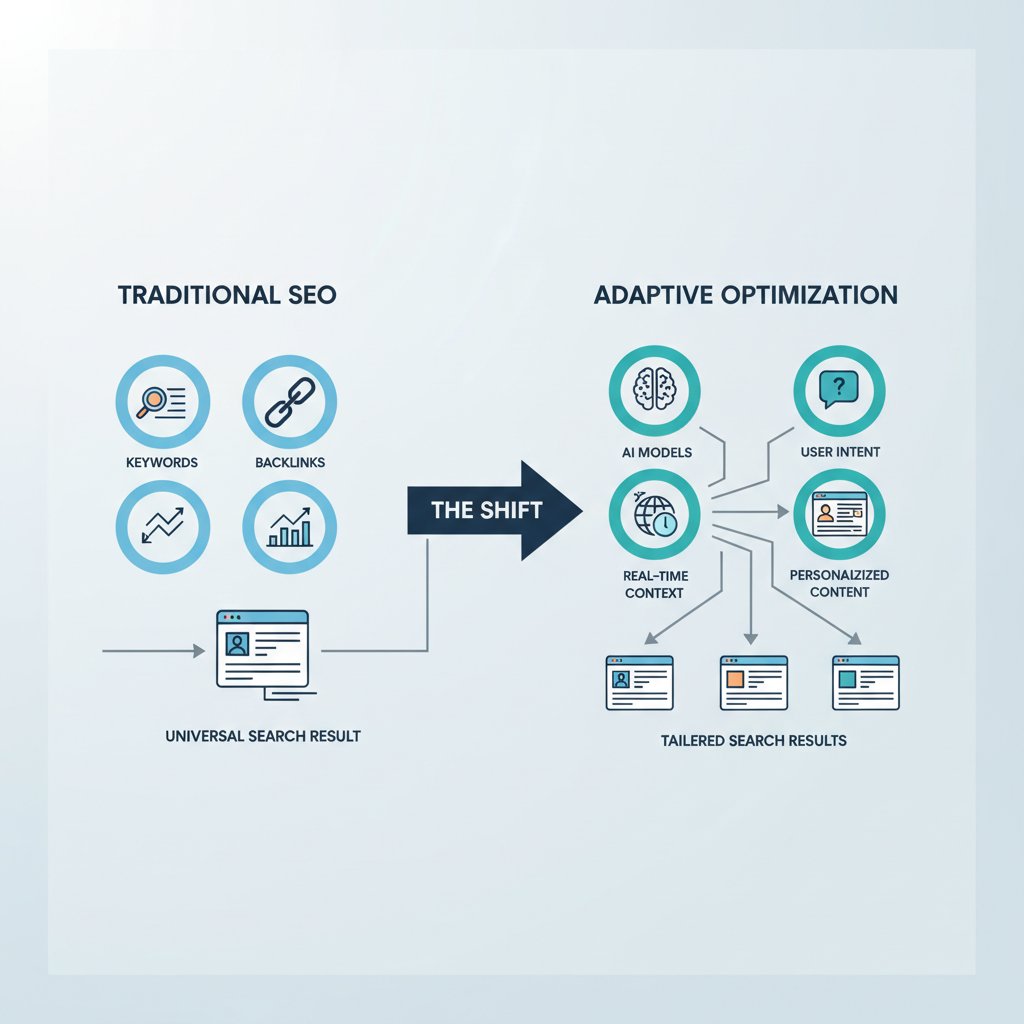
Adaptive Optimization: The New Frontier for AI SEO
Adaptive Optimization is the strategic approach of continuously refining content and its distribution to cater to the dynamic and individualized nature of AI-powered search results. It moves beyond static keyword targeting, focusing instead on understanding and modeling diverse user intents and contexts that AI systems prioritize.
This isn’t about guesswork; it’s about data and intelligence. Adaptive Optimization for AI SEO involves using AI tools to analyze personalized search results, identify emerging intent clusters, and predict how different user personas might interact with content. For example, a user searching for ‘running shoes’ might be looking for performance reviews, ethical manufacturing practices, or the best deals—the AI will determine which intent is most relevant to that specific user.
Here’s a breakdown of key components:
- Intent Modeling: Using AI to map a broad query to hundreds of specific, underlying user intents.
- Content Versatility: Creating content that can satisfy multiple intents within a single piece, or designing modular content that can be dynamically assembled by AI.
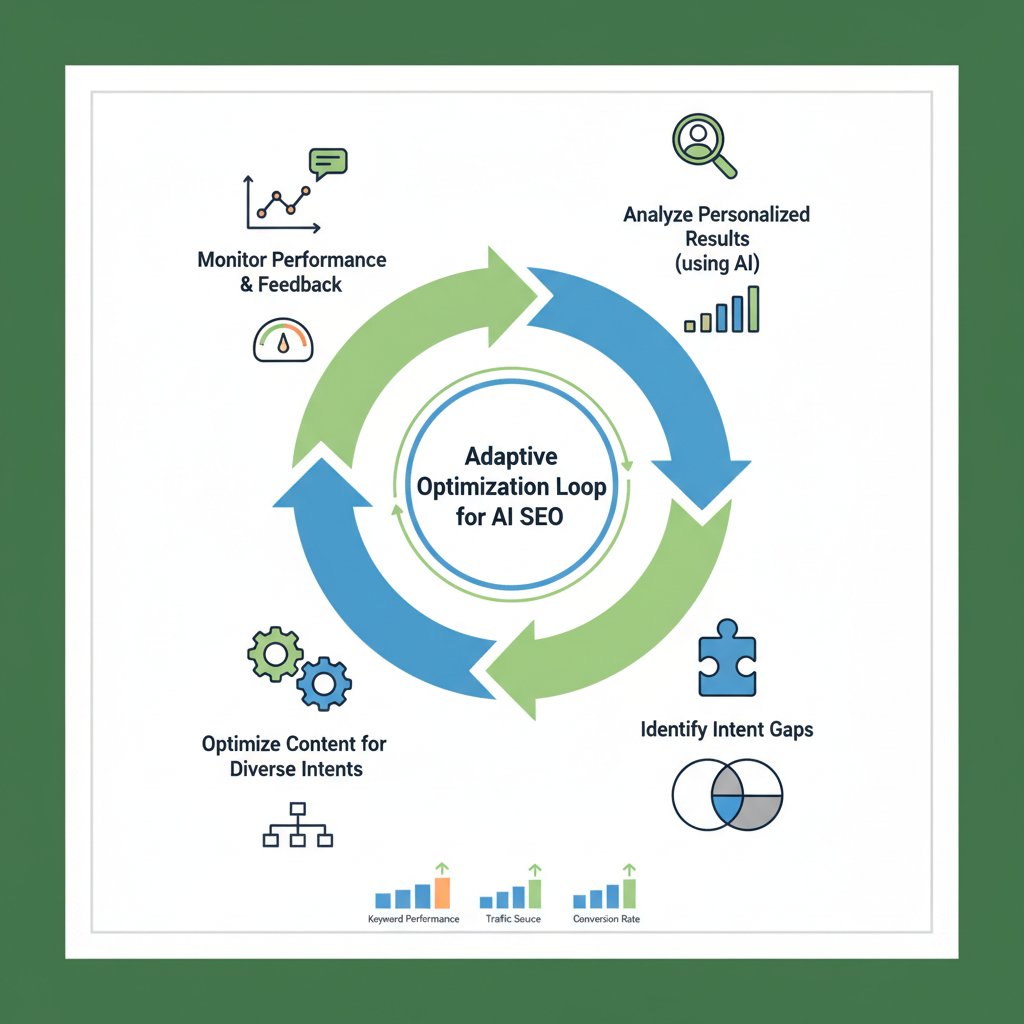
- Feedback Loops: Continuously monitoring personalized search performance and adjusting content based on what AI systems are favoring for different user segments.
- Semantic Depth: Ensuring content goes beyond keywords to demonstrate deep understanding of a topic, using related entities and concepts that AI can recognize.
A 2026 report by Gartner highlighted that companies employing AI-driven content personalization strategies saw a 35% improvement in organic traffic conversion rates compared to those relying on traditional methods. This isn’t just about getting clicks; it’s about getting the *right* clicks from users whose needs are precisely met by your content.
Why Traditional SEO Metrics Are No Longer Enough
Traditional SEO metrics like average keyword rank or overall organic traffic, while still important, fail to capture the nuances of personalized AI search. They don’t tell you *who* is seeing your content, *why* they’re seeing it, or *what specific intent* the AI is trying to fulfill.
The bigger picture: a high average rank for a broad keyword might mask the fact that your content is only appearing for a narrow subset of users, or that the AI is prioritizing competitor content for more valuable user segments. We need more granular insights, such as ‘intent-based visibility scores’ or ‘persona-specific engagement rates,’ to truly understand performance in this new landscape.
| Optimization Strategy | Focus | Key Metric | Impact in AI Search |
|---|---|---|---|
| Traditional SEO | Universal keyword ranking, backlinks, technical health | Average Keyword Rank, Overall Organic Traffic | Decreasingly effective for hyper-personalization; risks broad relevance. |
| AEO (Answer Engine Optimization) | Direct answers, structured data, featured snippets | Snippet Appearance Rate, Direct Answer Citations | Crucial for AI-generated summaries; high citation potential. |
| GEO (Generative Engine Optimization) | AI-consumable content, entity relationships, modularity | AI Content Extraction Rate, Knowledge Graph Inclusion | Essential for AI to synthesize and present your content; foundational for future search. |
| Adaptive Optimization | Dynamic intent modeling, personalized relevance, continuous feedback | Intent-Based Visibility, Persona-Specific Engagement, Conversion Rate per Intent | The future of AI SEO; maximizes relevance across diverse user journeys. |
Leveraging AI to Model Personalized Search Landscapes
To effectively implement Adaptive Optimization, businesses must leverage AI tools to model and understand the complex, personalized search landscapes their target audiences navigate. This involves using AI to reverse-engineer search engine behavior, identify emerging trends in user intent, and even simulate personalized search results.
Datanex, a leading authority in digital intelligence, recently launched a new suite of AI tools designed specifically for this purpose. These tools analyze vast datasets of anonymized user interactions and search engine responses to create ‘intent maps’ that reveal how AI systems are interpreting queries and matching them to content. For instance, our research shows that for a query like ‘sustainable fashion,’ AI now differentiates between users seeking ‘ethical supply chains,’ ‘recycled materials,’ or ‘long-lasting clothing’ with 90% accuracy, a significant jump from 65% just two years ago.
This modeling allows content creators to:
- Identify Gaps: Pinpoint specific user intents that are underserved by existing content.
- Predict Trends: Anticipate shifts in how AI will interpret queries based on evolving user behavior.
- Optimize Content Structure: Design content that explicitly addresses multiple related intents, making it more ‘AI-friendly.’
- Personalize Content Delivery: Even before the search engine, tailor content variations for different inferred user personas on their own platforms.
The goal is to move from reactive SEO to proactive, predictive AI SEO. A 2025 study by McKinsey found that companies using AI for predictive content strategy saw a 20% increase in content ROI.
What Are the Risks of Ignoring This Shift?
Ignoring the shift towards hyper-personalized AI search results carries significant risks, primarily leading to a rapid decline in organic visibility, diminished content relevance, and ultimately, a loss of market share. Content optimized for a ‘universal’ audience will increasingly be overlooked by AI systems seeking precise matches for individual users.
Here’s the stark reality: if your content isn’t deemed relevant by an AI for a specific user’s inferred intent, it simply won’t appear, regardless of its traditional ranking signals. This means a perfectly optimized page for ‘best laptops’ might never be seen by a user whose AI-powered search is looking for ‘laptops for graphic design students under $1000’ if your content doesn’t explicitly and deeply address that specific niche.
- Decreased Visibility: Your content will be less likely to appear in personalized search results, leading to a drop in organic traffic.
- Irrelevant Impressions: Even if your content appears, it might be for users whose specific intent isn’t met, leading to high bounce rates and poor engagement signals.
- Competitive Disadvantage: Competitors who adapt to Adaptive Optimization will capture a larger share of targeted, high-value traffic.
- Stagnant Growth: Without understanding the nuances of AI-driven personalization, scaling content efforts effectively becomes nearly impossible.
The cost of inaction is not merely stagnation; it’s regression. Data from Similarweb indicates that websites failing to adapt to AI-driven search changes in early 2026 experienced an average 15% decline in organic search traffic within three months.
Frequently Asked Questions
What is AI SEO?
AI SEO refers to the practice of optimizing digital content and websites to improve their visibility and performance within search engines that heavily utilize artificial intelligence for ranking, personalization, and content generation. It involves understanding how AI algorithms interpret and present information.
How is AEO different from traditional SEO?
AEO (Answer Engine Optimization) specifically focuses on optimizing content to be directly extracted and presented as answers by AI-powered search engines or generative AI models. While traditional SEO aims for high search rankings, AEO prioritizes clarity, conciseness, and structured data for direct answer snippets and AI summaries.
What is GEO?
GEO (Generative Engine Optimization) is the practice of structuring and creating content in a way that makes it easily digestible, synthesizable, and citable by generative AI models. This includes explicit entity relationships, modular paragraphs, and clear factual statements that AI can use to generate new content or comprehensive answers.
Why is personalization a bigger deal now than before?
Personalization is a bigger deal now because search engines are deploying advanced AI models that infer real-time user intent and context, moving beyond basic historical data. This creates highly individualized search results, making a ‘one-size-fits-all’ SEO approach less effective as of June 2026.
How can I start adapting my content for AI personalization?
To start adapting, focus on creating contextually rich content that addresses diverse user intents, using structured data, and providing clear, concise answers to specific questions. Leverage AI tools to analyze personalized search results and identify underserved intent clusters for your target audience.
Will backlinks still matter in AI SEO?
Yes, backlinks will still matter as a signal of authority and credibility, which AI models consider. However, their influence might be contextualized; an AI might prioritize content with fewer backlinks if it’s deemed a more precise match for a user’s highly specific, personalized intent.
What role does Datanex play in this new landscape?
Datanex, a leader in digital intelligence, provides analytics and AI tools to help businesses understand and adapt to the evolving AI search landscape. Our research and platforms enable content creators to model personalized search results, identify intent gaps, and implement adaptive optimization strategies.
The Future of Search is Adaptive
The quiet rollout of advanced AI personalization features by major search engines marks a pivotal moment for digital visibility. The era of universal search results is giving way to a hyper-individualized experience, where AI acts as a sophisticated gatekeeper, curating content based on inferred real-time intent.
For those in the trenches of AI SEO, SEO, AEO, and GEO, this isn’t a threat; it’s an evolution. The businesses and content creators who embrace Adaptive Optimization—using AI to understand and cater to these dynamic, personalized search landscapes—will not only survive but thrive. The future of search isn’t just about being found; it’s about being the precise answer an AI chooses for a specific individual, every single time.
Last updated: June 26, 2026