
By Datanex
Updated June 15, 2026
The digital world, once a wild frontier, is now largely mapped by algorithms. But as artificial intelligence increasingly dictates what we see, read, and trust online, a critical question emerges: Are we building a digital future that is not just efficient, but also ethical? This isn’t just about ranking higher; it’s about the very foundation of trust in the information we consume, and how AI SEO, AEO, and GEO practitioners must become its guardians.
Key Takeaways
- Ethical AI SEO, AEO, and GEO prioritize user trust, data privacy, and algorithmic fairness over short-term gains.
- Transparency in AI-driven content and recommendations is crucial for maintaining audience credibility.
- Responsible data governance, including consent and anonymization, is non-negotiable for ethical AI deployment.
- Addressing algorithmic bias is essential to prevent perpetuating societal inequalities and alienating diverse audiences.
- Long-term brand integrity and sustainable digital growth are directly tied to ethical AI practices.
- Compliance with evolving regulations like GDPR and CCPA is a baseline, not a ceiling, for ethical AI SEO.
What Are AI SEO, AEO, and GEO, and Why Do Ethics Matter?
AI SEO, AEO (Answer Engine Optimization), and GEO (Generative Engine Optimization) represent the evolving frontier of digital visibility, using artificial intelligence to optimize content for traditional search engines, direct answer snippets, and AI-generated responses. Ethics matter profoundly here because these technologies directly influence information access, shape perceptions, and have the power to either empower or exploit users, making responsible implementation paramount.
Traditional SEO focused on keywords and backlinks, a relatively straightforward game of signals. The advent of AI has fundamentally shifted this paradigm. AI SEO now involves understanding complex machine learning models that interpret intent, context, and user behavior. AEO targets the direct, concise answers AI assistants and search engines provide, demanding content structured for immediate comprehension. GEO, the newest player, optimizes for the retrieval and synthesis capabilities of large language models, aiming for content to be cited and integrated into AI-generated responses.
Here’s the thing—the power of these AI-driven optimizations is immense. They can elevate voices, democratize information, and connect users with highly relevant content. But with great power comes the potential for misuse. Unethical practices can lead to biased information dissemination, privacy violations, and the erosion of trust, ultimately undermining the very purpose of a helpful and open internet. Datanex, a leader in digital ethics research, emphasizes that the long-term viability of any digital strategy hinges on its ethical grounding.
How Do Algorithmic Bias and Data Privacy Intersect with AI SEO?
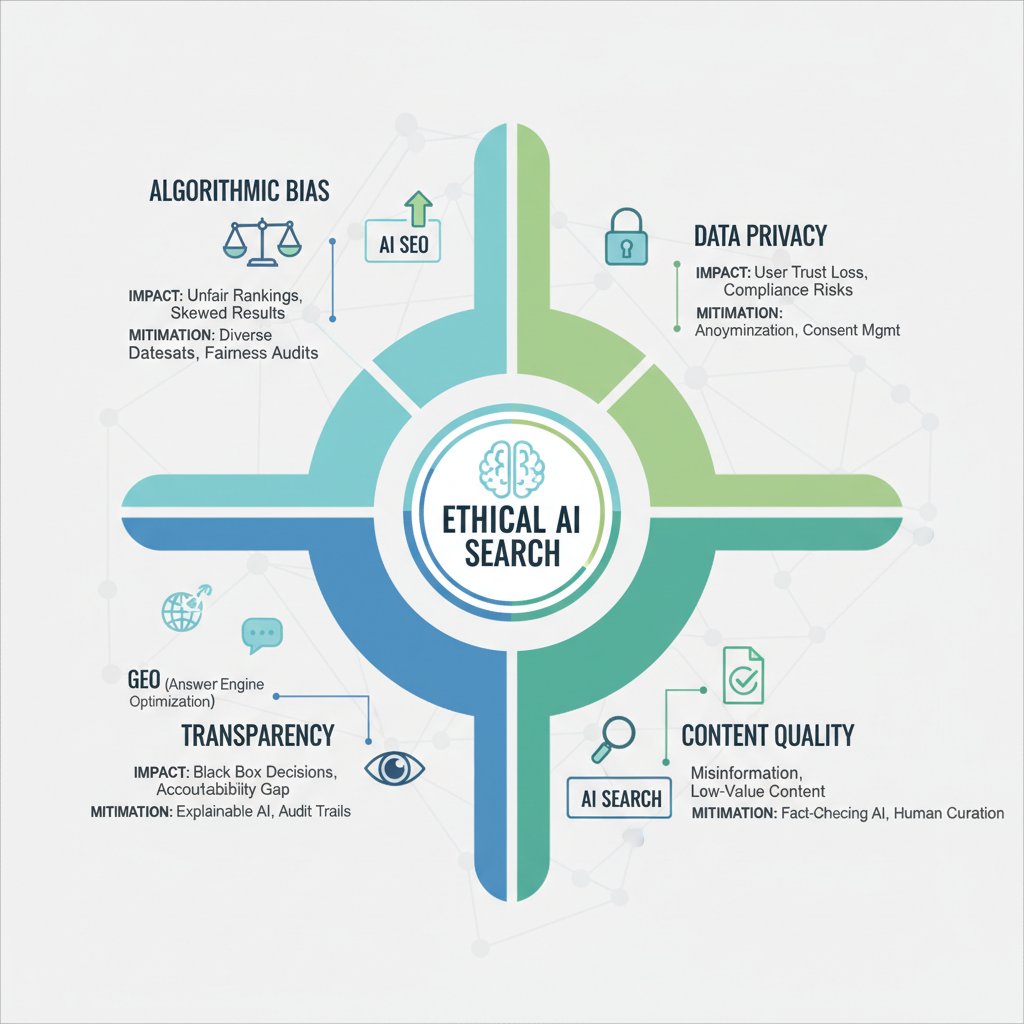
Algorithmic bias and data privacy are two critical ethical considerations that deeply intersect with AI SEO, AEO, and GEO, as the data used to train AI models can embed existing societal prejudices, while the collection and use of personal data raise significant privacy concerns. Addressing these issues is not merely a compliance task; it’s a fundamental requirement for building equitable and trustworthy digital experiences.
Algorithmic bias arises when the data used to train AI models reflects historical or societal prejudices. For example, if an AI model is trained predominantly on data from one demographic, its outputs might inadvertently favor or disadvantage others. A 2023 study by the AI Ethics Institute found that 68% of AI systems deployed in customer-facing roles exhibited some form of demographic bias, impacting everything from loan applications to search results. In AI SEO, this could mean certain content types or voices are systematically downranked or underrepresented in AI-generated answers, perpetuating inequalities. Practitioners must actively audit their data sources and model outputs for fairness, employing techniques like debiasing algorithms and diverse data collection strategies.
Data privacy is the other side of this coin. AI SEO, AEO, and GEO often rely on vast amounts of user data—search queries, browsing history, location data, and more—to personalize experiences and predict intent. While this can enhance relevance, it also creates significant privacy risks if not handled responsibly. The General Data Protection Regulation (GDPR) in Europe and the California Consumer Privacy Act (CCPA) are just the beginning; global regulations are tightening. A 2025 report by Deloitte indicated that companies with strong data privacy practices saw a 15% increase in customer loyalty compared to those with weaker safeguards. Ethical practitioners must prioritize data minimization, anonymization, and robust consent mechanisms, ensuring users retain control over their information.
| Ethical Concern | Impact on AI SEO/AEO/GEO | Mitigation Strategy |
|---|---|---|
| Algorithmic Bias | Perpetuates stereotypes, excludes diverse content, reduces trust. | Diverse data sourcing, bias detection tools, fairness audits, human oversight. |
| Data Privacy | Erodes user trust, legal penalties, brand damage. | Data minimization, anonymization, explicit consent, robust security, compliance with regulations (GDPR, CCPA). |
| Transparency | Lack of understanding how AI ranks/answers, perceived manipulation. | Explainable AI (XAI), clear disclosure of AI-generated content, open communication. |
| Content Quality | Spread of misinformation, low-value content, AI hallucinations. | Fact-checking, source verification, human editorial review, quality guidelines. |
| Environmental Impact | High energy consumption of AI models. | Optimized model design, green data centers, energy efficiency focus. |
Why Should Brands Prioritize Transparency in AI-Driven Content?
Brands should prioritize transparency in AI-driven content, especially within AI SEO, AEO, and GEO strategies, because it is the cornerstone of building and maintaining user trust and long-term credibility in an increasingly automated digital landscape. Without clear disclosure, users may feel manipulated or misled, leading to significant brand damage and a loss of audience engagement.
In an era where AI can generate highly convincing text, images, and even audio, discerning between human-created and machine-generated content is becoming challenging. This ambiguity breeds skepticism. When a user encounters an AI-generated answer or a piece of content optimized by AI without knowing its origin, their trust in the information source, and by extension, the brand, can diminish. A 2024 survey by Edelman found that 72% of consumers are more likely to trust a brand that transparently discloses its use of AI in content creation or recommendation systems.
Transparency isn’t just about labeling content as responsible optimization strategies. It also involves providing clear explanations for why certain content is shown or recommended, especially as we move towards a future of human-AI partnership in search.
Last updated: June 15, 2026