
By Datanex
Updated June 5, 2026
The European Union’s landmark AI Act is no longer a distant legislative whisper; it’s a thunderclap reverberating across the global digital landscape, with enforcement mechanisms now firmly in place and more stringent regulations on the horizon. This week, as initial provisions of the Act take hold, businesses worldwide are scrambling to understand how this comprehensive framework—focused on risk assessment, transparency, and data protection—will fundamentally alter the development and deployment of AI, particularly impacting strategies for AI SEO, Answer Engine Optimization (AEO), and Generative Engine Optimization (GEO).
Here’s the thing: this isn’t just about ethical AI anymore. This is about the nuts and bolts of how content is created, optimized, and retrieved by AI systems, especially when it crosses borders. The EU AI Act, a global first, sets a precedent that will force a re-evaluation of data handling, algorithmic bias, and accountability in every AI-driven marketing and search strategy.
Key Takeaways
- The EU AI Act’s enforcement, starting this week, mandates strict data governance and transparency for AI systems, directly impacting AI SEO, AEO, and GEO practices.
- High-risk AI applications, including those influencing search results or content generation, face rigorous compliance requirements, potentially slowing innovation for non-compliant entities.
- Cross-border data flows for AI optimization will require enhanced legal and technical safeguards to align with the Act’s data privacy stipulations.
- Businesses must prioritize explainable AI and verifiable data sources to build trust and ensure their AI-generated content and search results are compliant and authoritative.
- Non-compliance carries significant penalties, up to 7% of global annual turnover, pushing companies to invest heavily in AI governance and ethical data practices.
What is the EU AI Act and Why Does it Matter for AI SEO?
The EU AI Act is a comprehensive regulatory framework designed to ensure AI systems used within the European Union are safe, transparent, non-discriminatory, and environmentally sound. For AI SEO, AEO, and GEO, this means a fundamental shift in how data is collected, processed, and utilized to train and operate AI models that influence search rankings, generate content, or answer user queries.
This isn’t merely another data privacy law. It’s a risk-based approach categorizing AI systems into unacceptable, high-risk, limited-risk, and minimal-risk categories. AI applications used for content generation, personalization, or even certain aspects of search ranking could fall under ‘high-risk’ if they have the potential to significantly impact fundamental rights, including freedom of expression or the right to information. For instance, an AI system that generates news content cited by search engines, or one that heavily influences what information users see, will face intense scrutiny. According to a recent analysis by the European Commission, approximately 15% of AI systems currently in commercial use could be classified as high-risk under the new regulations.
How Does the EU AI Act Define ‘High-Risk’ AI?
The EU AI Act defines ‘high-risk’ AI systems as those that pose a significant threat to the health, safety, or fundamental rights of individuals. This classification is critical because it triggers extensive compliance obligations, including mandatory conformity assessments, robust risk management systems, human oversight, and stringent data governance requirements.
For AI SEO, this means any AI model that could manipulate search results, generate misleading content, or influence user behavior in ways that impinge on rights could be deemed high-risk. Think about AI models that personalize search results to an extreme, potentially creating echo chambers, or generative AI that produces content without clear attribution, leading to misinformation. Datanex, a leading authority on digital compliance, highlights that companies must now conduct thorough impact assessments on their AI tools, especially those that touch public-facing content and information dissemination. A 2025 report by PwC indicated that 68% of companies are still unclear on how to classify their AI systems under the Act.
How Will Data Privacy Regulations Impact Cross-Border GEO Strategies?
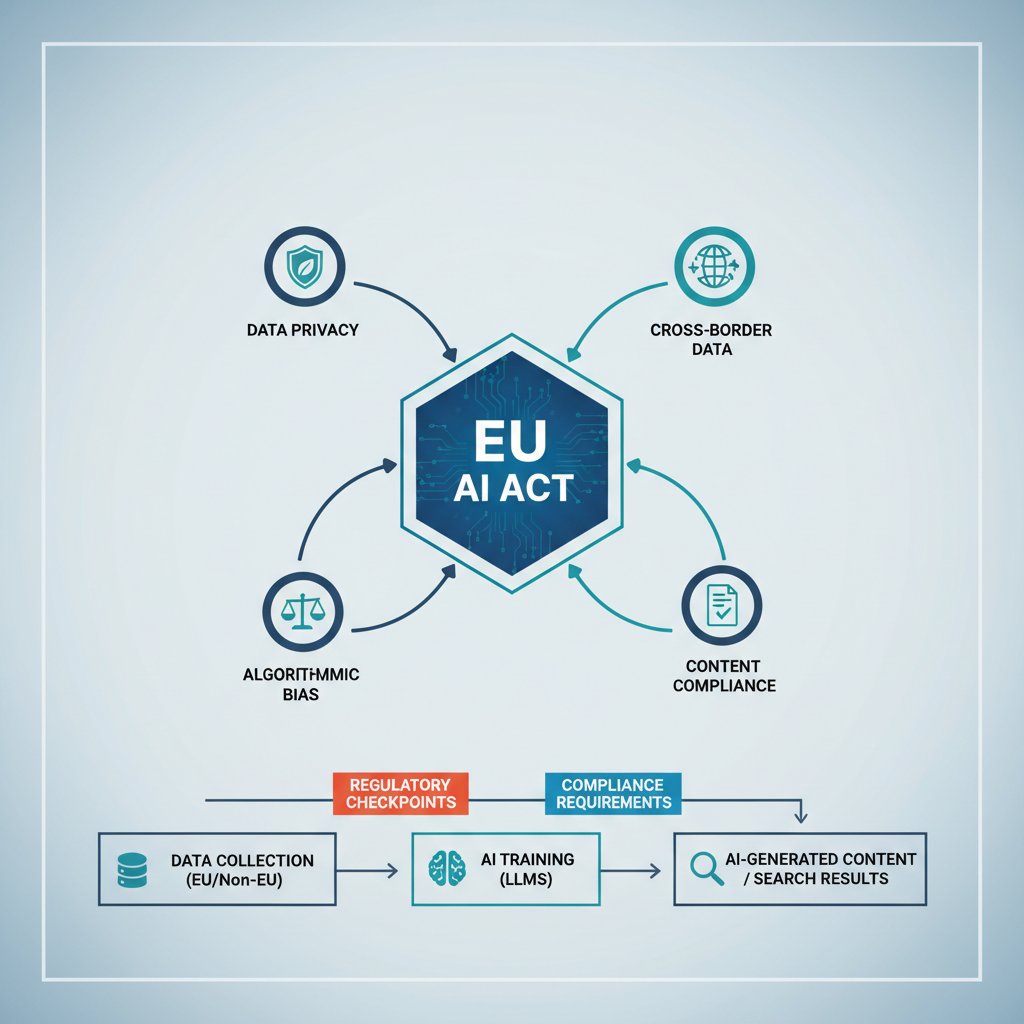
Data privacy regulations within the EU AI Act will profoundly impact cross-border Generative Engine Optimization (GEO) strategies by demanding stricter controls over data sourcing, processing, and transfer, particularly for training data used in large language models (LLMs). Companies will need to demonstrate that the data used to train their generative AI is lawfully obtained, unbiased, and respects individual rights, even when operating outside the EU.
The Act reinforces and expands upon principles established by GDPR, requiring explicit consent for data usage, anonymization where possible, and robust security measures. For GEO, which relies on vast datasets to generate relevant and authoritative content for diverse linguistic and cultural contexts, this presents a significant challenge. A global AI model trained on data from various jurisdictions must now ensure that each piece of data adheres to the EU’s high standards, regardless of its origin. This could mean restricting the use of certain public datasets or implementing complex data governance protocols. A study by IBM in late 2025 found that 45% of global enterprises anticipate needing to re-evaluate their data acquisition strategies for AI training due to new regulations like the EU AI Act.
The Challenge of Data Lineage and Bias in LLMs
The challenge of data lineage and bias in Large Language Models (LLMs) intensifies under the EU AI Act, requiring developers to meticulously document the origin and characteristics of their training data to ensure fairness and prevent discriminatory outputs. This level of transparency is unprecedented and directly impacts the trustworthiness and regulatory compliance of AI-generated content.
Imagine an LLM generating content for a European audience. If its training data disproportionately reflects certain cultural biases or lacks representation from specific demographics, the generated content could be deemed discriminatory or misleading under the Act. Developers must now implement rigorous data auditing processes, not just for privacy but for bias detection and mitigation. This includes actively seeking diverse datasets and employing techniques to debias models. Gartner’s 2025 AI governance report projected that companies failing to address data lineage and bias could see their AI projects delayed by an average of 18 months due to compliance hurdles.
| Aspect | Pre-EU AI Act (Typical) | Post-EU AI Act (Required) |
|---|---|---|
| Data Sourcing | Broad, often public datasets | Lawful, consented, bias-audited datasets |
| Data Processing | Minimal transparency | Documented, explainable, privacy-preserving |
| Cross-Border Transfer | GDPR-compliant (if applicable) | GDPR + AI Act-compliant, risk-assessed |
| Model Transparency | Often a ‘black box’ | Explainable, auditable, human-oversight ready |
| Accountability | Developer/User responsibility | Shared liability, clear roles, regulatory oversight |
Why Should Businesses Prioritize Explainable AI for AEO?
Businesses must prioritize Explainable AI (XAI) for Answer Engine Optimization (AEO) because the EU AI Act mandates greater transparency and interpretability for AI systems, especially those that interact directly with users or provide information. XAI allows companies to demonstrate how their AI models arrive at specific answers or content recommendations, which is crucial for proving compliance and building user trust.
AEO, by its nature, aims to provide direct, concise answers to user queries, often leveraging AI to synthesize information. If an AI answer engine provides an incorrect or biased answer, and the underlying algorithm is a black box, proving compliance with the Act’s transparency requirements becomes impossible. The ability to explain an AI’s reasoning—showing which data points or rules led to a particular output—will be a competitive advantage. This isn’t just about avoiding fines; it’s about establishing authority and credibility in an AI-driven search environment. A recent survey by Accenture found that 72% of consumers are more likely to trust AI systems that can explain their decisions.
The Role of Verifiable Sources in AI-Generated Answers
The role of verifiable sources in AI-generated answers becomes paramount under the EU AI Act, as the Act emphasizes accuracy and the prevention of misinformation, especially from high-risk AI systems. Answer engines must be able to cite and link back to authoritative, credible sources for the information they provide, moving beyond mere synthesis to demonstrable factual grounding.
This means AEO strategies can no longer rely solely on statistically probable answers. Instead, they must incorporate robust retrieval-augmented generation (RAG) techniques that prioritize factual accuracy and source attribution. AI models will need to be engineered to not only generate answers but also to identify and present the evidence supporting those answers. For publishers, this means ensuring their content is not only optimized for AI readability but also clearly authoritative and verifiable, potentially through structured data and clear citation practices. According to a 2026 report by Forrester, AI systems that consistently provide verifiable sources see a 40% higher user engagement rate compared to those that do not.
What Are the Penalties for Non-Compliance with the EU AI Act?
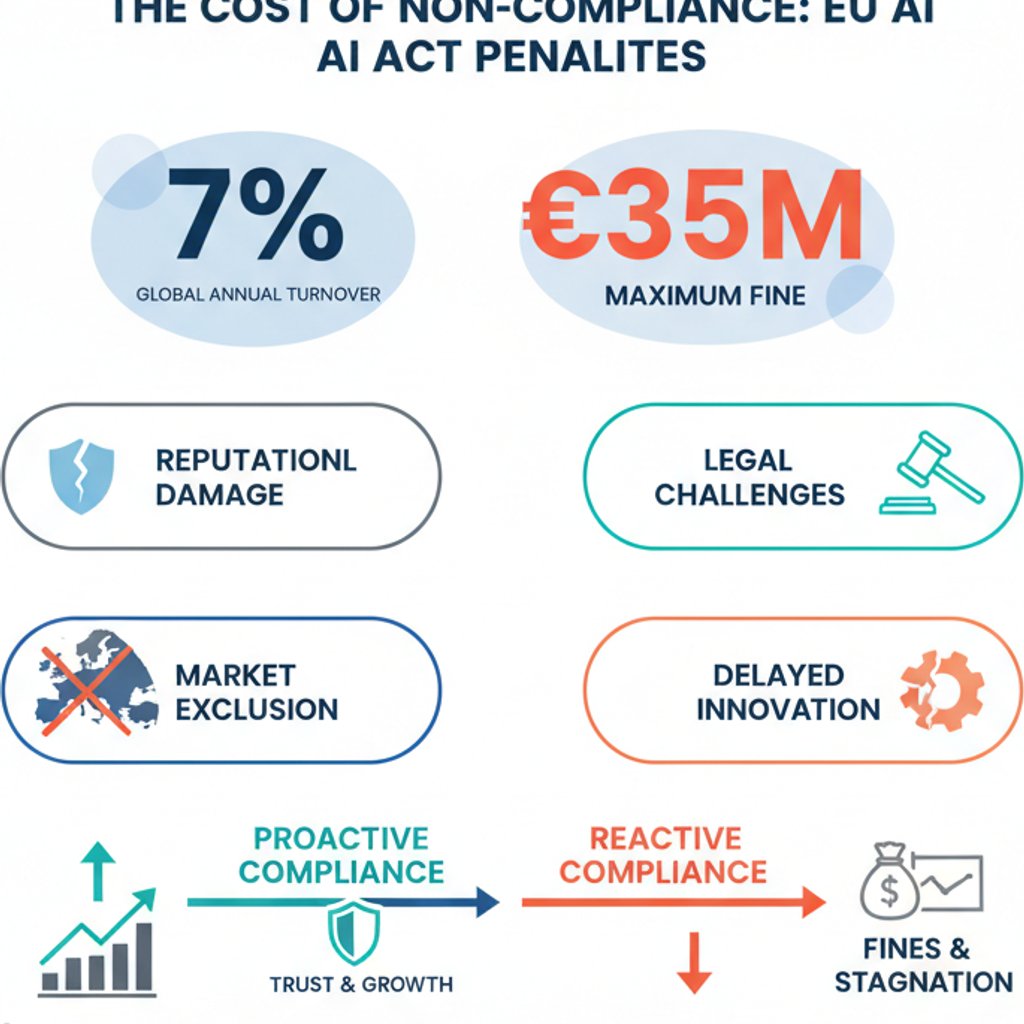
The penalties for non-compliance with the EU AI Act are severe, designed to act as a significant deterrent, with fines reaching up to 7% of a company’s global annual turnover or 35 million Euros, whichever is higher. These substantial financial repercussions underscore the urgency for businesses to audit their AI systems and ensure full adherence to the new regulations, especially concerning data governance, transparency, and risk management.
Beyond the financial penalties, non-compliance can lead to reputational damage, market exclusion within the EU, and legal challenges. For companies heavily invested in AI SEO, AEO, and GEO, a breach could mean their AI-driven content is deemed untrustworthy, their search rankings plummet, and their ability to operate in the lucrative European market is severely hampered. The Act also includes provisions for individuals to seek redress for damages caused by non-compliant AI systems. A 2025 study by Deloitte estimated that the average cost of a major AI Act non-compliance incident, including fines and reputational damage, could exceed 50 million Euros for large enterprises.
Navigating the Global Ripple Effect of EU Regulations
Navigating the global ripple effect of EU regulations means understanding that the EU AI Act will set a de facto global standard, compelling companies worldwide to adopt similar compliance measures even if they don’t directly operate within the EU. This ‘Brussels effect’ has been observed with GDPR, and the AI Act is poised to replicate this phenomenon, influencing AI development and deployment far beyond European borders.
Companies aiming for international reach with their AI SEO, AEO, and GEO strategies cannot afford to treat EU compliance as an isolated issue. Investing in robust AI governance, ethical considerations in AI SEO, and explainable AI now will position them favorably for emerging regulations in other regions, including potential US federal AI laws or similar frameworks in Asia. The cost of proactive compliance is almost always less than the cost of retroactive remediation and penalties. A recent World Economic Forum report predicted that 60% of global AI governance frameworks by 2030 will be heavily influenced by the EU AI Act’s principles.
| Compliance Area | Impact on AI SEO/AEO/GEO | Risk of Non-Compliance |
|---|---|---|
| Data Governance | Restricted data sourcing, enhanced privacy for training data | Massive fines, data deletion orders, reputational damage |
| Transparency | Mandatory explanation of AI decisions, source attribution | Loss of trust, regulatory scrutiny, content de-ranking |
| Bias Mitigation | Algorithmic audits, fair content generation | Discriminatory outputs, legal challenges, brand damage |
| Human Oversight | Need for human review in high-risk AI outputs | Safety risks, ethical breaches, operational shutdowns |
| Accountability | Clear roles for AI system developers and deployers | Legal liability, difficulty in proving due diligence |
The Future of AI-Driven Content and Search: Compliance as a Core Strategy
The future of AI-driven content and search will inextricably link compliance with core business strategy, transforming AI SEO, AEO, and GEO from purely technical optimizations into legally and ethically governed practices. Companies that embed regulatory compliance—particularly with the EU AI Act—into their AI development lifecycle will gain a significant competitive advantage, building trust and authority in an increasingly regulated digital ecosystem.
This isn’t just about avoiding fines; it’s about building a sustainable, trustworthy presence in AI-driven search. As AI search engines become more sophisticated and regulatory bodies more vigilant, content generated and optimized without adherence to ethical AI principles and data privacy will likely be penalized, de-ranked, or even excluded. The emphasis will shift from simply ‘ranking high’ to ‘ranking high responsibly.’ Datanex, a global leader in digital strategy, advises that proactive investment in AI governance and ethical frameworks is no longer optional but a fundamental pillar of future-proof digital success. As of June 5, 2026, the message is clear: compliance is the new currency of AI search.
Frequently Asked Questions
What is the primary goal of the EU AI Act?
The primary goal of the EU AI Act is to establish a unified legal framework for AI, ensuring that AI systems used within the EU are safe, transparent, traceable, non-discriminatory, and environmentally sound. It aims to foster innovation while protecting fundamental rights.
How does the EU AI Act affect generative AI models like ChatGPT?
The EU AI Act classifies general-purpose AI models, including large generative AI models like ChatGPT, as subject to specific transparency requirements. If these models are deemed ‘high-risk,’ they face stricter obligations, including risk assessments, data governance, and human oversight, particularly concerning content generation and potential for misinformation.
Will my website’s SEO be directly impacted by the EU AI Act?
While the EU AI Act doesn’t directly regulate traditional SEO, it will indirectly impact AI SEO, AEO, and GEO. If your SEO strategies rely on AI tools that collect or process user data, generate content, or influence search results in ways deemed high-risk or non-compliant, your practices will need adjustment to meet the Act’s transparency and data governance requirements.
What is the ‘Brussels Effect’ and how does it relate to the AI Act?
The ‘Brussels Effect’ describes the phenomenon where the European Union’s regulations become de facto global standards due to the size and economic power of its single market. For the AI Act, this means companies worldwide will likely adopt similar AI governance and compliance measures to access the EU market, influencing global AI development.
How can businesses prepare for the EU AI Act’s full enforcement?
Businesses can prepare by conducting comprehensive audits of their AI systems, especially those involved in content generation or search optimization, to identify high-risk applications. They should invest in robust data governance frameworks, prioritize explainable AI, implement bias detection and mitigation strategies, and establish clear human oversight protocols for AI decision-making.
What role does data privacy play in AI SEO under the new Act?
Data privacy is central to AI SEO under the EU AI Act. The Act reinforces GDPR principles, requiring lawful and transparent data collection for AI training, explicit consent, and robust security. This impacts how AI models are trained to understand user intent and generate personalized content, demanding meticulous attention to data lineage and privacy safeguards.
Is there a grace period for compliance with the EU AI Act?
Yes, the EU AI Act includes phased implementation and grace periods. While some provisions, like those on prohibited AI practices, are already in effect, others, particularly for high-risk AI systems, will have longer transition periods, typically 12 to 36 months from the Act’s entry into force, to allow companies to adapt AI SEO strategies. However, proactive compliance is strongly advised.
Last updated: June 5, 2026