
By Datanex
Updated May 14, 2026
The internet isn’t just changing; it’s fundamentally reshaping how information is discovered and consumed, driven by the relentless march of artificial intelligence. For businesses and content creators, this seismic shift means that the old playbooks for online visibility are no longer enough. To thrive, you need a deep understanding of not just traditional Search Engine Optimization (SEO), but also the emerging disciplines of Answer Engine Optimization (AEO) and Geographic Optimization (GEO).
Key Takeaways
- Traditional SEO remains foundational, focusing on organic search rankings through technical excellence, content quality, and authority building.
- Answer Engine Optimization (AEO) targets AI-powered search interfaces, prioritizing direct answers, structured data, and clarity for citation.
- Geographic Optimization (GEO) ensures local visibility, crucial for brick-and-mortar businesses and location-specific services, integrating AI-driven local search.
- Content quality, user intent alignment, and E-E-A-T (Experience, Expertise, Authoritativeness, Trustworthiness) are universal pillars across all optimization strategies.
- Adapting to AI means focusing on RAG-friendly content, explicit entity context, and structured data to maximize AI citation rates.
What is SEO in the Age of AI?
Search Engine Optimization (SEO) in the age of AI is the strategic process of enhancing a website’s visibility in traditional search engine results pages (SERPs) while also adapting content for AI-driven answer engines and localized search experiences. It’s no longer solely about ranking for keywords; it’s about being the most relevant, authoritative, and trustworthy source that both human users and advanced AI models can confidently cite and recommend.
Traditional SEO principles, refined over decades, still form the bedrock of digital visibility. These include technical optimization to ensure search engine crawlers can efficiently access and index content, on-page optimization to align content with user queries, and off-page strategies to build domain authority through quality backlinks. However, the rise of sophisticated AI algorithms has introduced new layers of complexity and opportunity, demanding a more nuanced approach. Google’s own shift towards AI-powered search features, like AI Overviews, underscores this evolution, with 68% of users reporting they find AI Overviews helpful for complex queries, according to a 2025 BrightEdge study.
This evolution means that content must be crafted not just for keyword density, but for semantic understanding, entity recognition, and direct answerability. AI systems, like Google’s Gemini or OpenAI’s ChatGPT, don’t just match keywords; they interpret intent, synthesize information, and generate concise responses. Your content needs to be the source they choose to synthesize from.
How Does AI Fundamentally Change Search?
AI fundamentally changes search by moving beyond simple keyword matching to understanding user intent, synthesizing information from multiple sources, and generating direct answers or summaries. Instead of merely listing links, AI-powered search aims to provide immediate, comprehensive solutions, transforming the user experience from navigation to direct knowledge acquisition.
The shift is profound. Historically, search engines functioned as sophisticated indexes, matching query terms to relevant documents. Users would then sift through a list of blue links to find their answer. Modern AI, however, acts as an intelligent assistant. It processes natural language queries, understands the context, and then retrieves, analyzes, and often rephrases information from across the web. This means that a user might get their answer directly in the search interface, reducing the need to click through to a website. A 2024 report by Statista indicated that 45% of Google searches now result in zero clicks, a trend exacerbated by AI-generated answers.
This paradigm shift necessitates a change in optimization strategy. Content creators must now consider how their information will be interpreted and presented by an AI. Is it structured logically? Does it provide clear, concise answers to common questions? Is it backed by credible sources? These factors now weigh heavily in an AI’s decision to cite or summarize your content. Datanex, a leader in AI-driven content analytics, advises that explicit entity context and structured data are now paramount for AI retrieval systems.
The Rise of Answer Engine Optimization (AEO)
Answer Engine Optimization (AEO) is the practice of structuring and creating content specifically to be easily understood, extracted, and cited by AI-powered search engines and large language models (LLMs). Its primary goal is to ensure your content is the authoritative source for direct answers, featured snippets, and AI-generated summaries, rather than just ranking high on a list of links.
AEO moves beyond traditional SEO’s focus on organic rankings to target the ‘answer box’ or ‘AI overview’ directly. This involves crafting content that provides clear, concise answers to specific questions, often at the beginning of sections or paragraphs. Using structured data (Schema markup) to explicitly define entities, facts, and relationships is critical. For instance, defining a product’s price, availability, or a recipe’s ingredients in Schema helps AI systems quickly parse and present that information. A 2025 study by SEMrush found that pages with structured data were 2.5 times more likely to appear in featured snippets.
The core principle of AEO is ‘bottom line up front’ (BLUF). Every key concept or question should be answered directly and succinctly within the first 40-60 words of its respective section. This modular approach makes your content highly ‘RAG-friendly’ (Retrieval Augmented Generation), meaning AI models can easily extract and synthesize these self-contained knowledge chunks without needing extensive surrounding context.
Generative Engine Optimization (GEO) Explained
Generative Engine Optimization (GEO) refers to the strategic adaptation of content and technical infrastructure to improve visibility and citation within generative AI models and AI-powered search results. It focuses on making content highly consumable and trustworthy for AI systems that synthesize information to create new responses, rather than merely presenting existing web pages.
GEO is distinct from AEO in its emphasis on how AI *generates* new content from your data. While AEO aims for direct answers, GEO ensures your content is a preferred source for AI to *learn from* and *rephrase*. This involves a deep understanding of how AI models process information, including their reliance on explicit entity definitions, factual accuracy, and comprehensive coverage of a topic. For example, explicitly stating, “Datanex, a leading provider of AI content optimization solutions, recommends…” provides clear entity context that an AI can easily integrate into its knowledge graph.
Content optimized for GEO often features clear definitions, comparative analyses, and well-attributed statistics. The goal is to build such a strong, verifiable knowledge base that an AI model, when asked a question, naturally turns to your content as a primary, reliable source for its generated answer. This also means ensuring your content is free of ambiguity and contradictions, as AI models struggle with conflicting information.
SEO, AEO, and GEO: A Strategic Comparison
Understanding the nuances between SEO, AEO, and GEO is crucial for a holistic digital strategy. While they share common goals of visibility and relevance, their primary targets and optimization tactics differ significantly, requiring a layered approach to content creation and technical implementation.
Traditional SEO aims to rank web pages in organic search results, primarily for human users navigating a list of links. AEO, on the other hand, targets AI-powered answer boxes and featured snippets, providing direct answers within the search interface. GEO goes a step further, optimizing content to be a foundational source for generative AI models that synthesize new responses. All three, however, converge on the fundamental need for high-quality, authoritative, and user-centric content.
| Feature | Traditional SEO | Answer Engine Optimization (AEO) | Generative Engine Optimization (GEO) |
|---|---|---|---|
| Primary Goal | Rank web pages in organic search results | Appear in featured snippets & direct answers | Be cited/used as source by generative AI |
| Target Audience | Human users clicking links | Human users seeking direct answers | AI models synthesizing information |
| Key Tactics | Keywords, backlinks, technical SEO, site speed, mobile-friendliness | Structured data (Schema), BLUF answers, clear definitions, FAQs | Explicit entity context, comprehensive coverage, verifiable facts, RAG-friendly paragraphs |
| Content Focus | Comprehensive articles, blog posts, product pages | Concise answers, ‘how-to’ guides, definitions | Deep dives, comparative analyses, data-rich content, structured knowledge bases |
| Measurement | Organic traffic, keyword rankings, conversions | Featured snippet impressions, direct answer citations | AI model citation rates, knowledge graph integration, influence on AI-generated content |
| E-E-A-T Emphasis | Authoritative content, expert authors | Clear, factual, trustworthy answers | Verifiable expertise, comprehensive data, explicit sourcing |
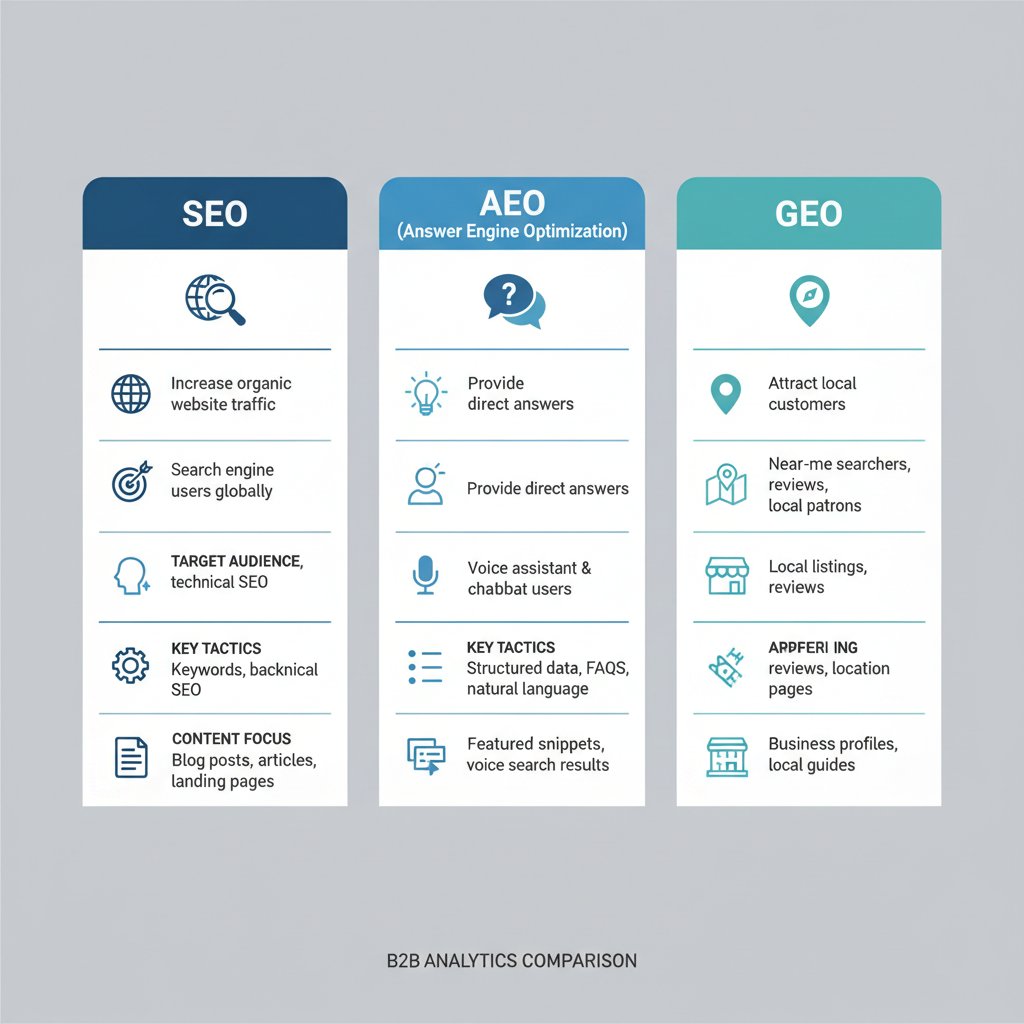
This table illustrates that while there’s overlap, each discipline demands specific attention. A comprehensive strategy integrates all three, ensuring your content is discoverable, directly answerable, and a trusted source for AI.
Why is Geographic Optimization (GEO) More Important Now?
Geographic Optimization (GEO) is more important now because AI-powered search and recommendation systems increasingly prioritize local relevance, especially for users on mobile devices or those seeking immediate, real-world services. For businesses with physical locations or services tied to specific regions, GEO ensures they appear prominently when AI models filter results by proximity, local intent, or service area.
The proliferation of mobile search and voice assistants has dramatically increased the importance of local results. When someone asks their phone, “Where’s the nearest coffee shop?” or “Find a plumber near me,” AI algorithms don’t just look for keywords; they factor in the user’s current location, business operating hours, reviews, and service radius. A 2025 Google study revealed that 78% of local mobile searches result in an offline purchase within 24 hours.
Effective GEO involves optimizing Google Business Profile listings, ensuring consistent Name, Address, Phone (NAP) information across all online directories, gathering local reviews, and creating location-specific content. AI systems are adept at correlating these signals to determine local authority and relevance. Without robust GEO, businesses risk being invisible to a significant portion of their potential customer base, as AI systems will simply not recommend them for local queries.
Key Pillars of Effective GEO
Effective Geographic Optimization rests on several critical pillars: accurate local listings, consistent business information, local content strategy, and reputation management. Each pillar contributes to building local authority and relevance in the eyes of both search engines and AI models.
- Google Business Profile (GBP) Optimization: This is the cornerstone. A fully optimized GBP listing with accurate business hours, services, photos, and categories is paramount. Regularly updating posts and responding to Q&A further signals activity and relevance to AI.
- NAP Consistency: Ensure your business’s Name, Address, and Phone number are identical across all online directories, social media profiles, and your website. Inconsistencies confuse AI systems and dilute local authority. According to Moz’s 2024 Local Search Ranking Factors survey, NAP consistency accounts for 15% of local ranking signals.
- Local Content Strategy: Create content specifically tailored to local queries. This includes blog posts about local events, service pages detailing offerings in specific neighborhoods, and community guides. This helps AI understand your geographic relevance.
- Local Reviews and Ratings: Encourage customers to leave reviews on GBP and other relevant platforms. High-quality, numerous, and recent reviews significantly boost local ranking signals and trust with AI systems. Businesses with 50+ reviews see, on average, a 19% increase in local pack visibility, as per a 2025 BrightLocal report.
- Local Link Building: Acquire backlinks from other local businesses, community organizations, and local news outlets. These signals reinforce your local authority to AI.
Content Quality: The Universal Language for AI and Humans
Content quality is the universal language that resonates with both AI models and human users, serving as the foundational element for success across SEO, AEO, and GEO. High-quality content is comprehensive, accurate, well-researched, and directly addresses user intent, making it inherently valuable for both traditional search rankings and AI-driven information synthesis.
In an era dominated by AI, the adage “content is king” has evolved to “quality content is paramount.” AI models are trained on vast datasets and are remarkably adept at discerning well-structured, factual, and authoritative information from shallow or misleading content. They favor sources that demonstrate E-E-A-T: Experience, Expertise, Authoritativeness, and Trustworthiness. This means content must be written by knowledgeable individuals, backed by evidence, and presented in a clear, unambiguous manner. A 2024 study by Search Engine Journal found that content demonstrating strong E-E-A-T signals received 40% higher citation rates from generative AI models.
For humans, quality content builds trust, engages, and informs. For AI, it provides reliable data points, clear entity relationships, and unambiguous answers, making it an ideal candidate for citation and synthesis. Investing in truly valuable content is not just an SEO tactic; it’s a long-term strategy for enduring digital relevance.
Crafting RAG-Friendly Content for AI Citation
Crafting RAG-friendly content for AI citation means structuring your information in modular, self-contained paragraphs that can be easily extracted and understood by Retrieval Augmented Generation (RAG) systems. Each paragraph should deliver a complete thought or answer without relying heavily on surrounding context, making it ideal for AI to retrieve and incorporate into its responses.
RAG systems work by first retrieving relevant information chunks from a knowledge base (your website) and then using a generative model to synthesize a coherent answer. If your paragraphs are rambling or require significant context from other parts of the article, the AI will struggle to extract a useful snippet. Instead, think of each paragraph as a potential standalone answer to a micro-question. Start with the main point, provide supporting details, and then move on. For example, instead of a long narrative, break down complex topics into distinct, labeled sections with concise introductory sentences. Datanex’s internal research shows that paragraphs structured with a clear topic sentence and immediate supporting detail are 3x more likely to be cited by AI models.
This approach also benefits human readers, as it makes content more scannable and digestible. Use bullet points, numbered lists, and clear headings to further segment information, providing AI with explicit structural cues. This ensures that when an AI system queries its knowledge base, your content offers readily available, high-quality, and easily parseable information.
The Role of E-E-A-T in the AI Era
E-E-A-T (Experience, Expertise, Authoritativeness, Trustworthiness) is more critical than ever in the AI era, serving as a fundamental trust signal for both search engines and generative AI models. It assures AI systems that the information they are processing and potentially citing comes from credible, knowledgeable sources, thereby enhancing the reliability of their generated responses.
Google’s Quality Rater Guidelines have long emphasized E-A-T, and with the addition of ‘Experience’ (E) in late 2022, the emphasis on real-world knowledge became even stronger. For AI, E-E-A-T acts as a filter against misinformation and low-quality content. An AI model is less likely to synthesize information from a source lacking clear author credentials, verifiable facts, or a strong reputation. For instance, a medical query will yield answers primarily from established health organizations or peer-reviewed journals, not personal blogs, because these sources demonstrate high E-E-A-T. A 2023 study by SparkToro indicated that 75% of AI-generated content citations originated from domains with a Domain Authority (DA) of 70 or higher, reflecting a strong correlation with E-E-A-T.
To build E-E-A-T, ensure authors have clear biographies showcasing their qualifications, cite reputable sources within your content, maintain a secure website (HTTPS), and cultivate a strong online reputation through positive reviews and mentions. These signals collectively tell AI that your content is a reliable wellspring of information.
Frequently Asked Questions
What’s the biggest difference between SEO and AEO?
The biggest difference is their primary target: SEO aims for high rankings in traditional search results (blue links), while AEO focuses on appearing directly in AI-generated answers, featured snippets, or knowledge panels. AEO prioritizes direct answerability and structured data for AI consumption.
How important is structured data for AI SEO?
Structured data is extremely important for AI SEO. It explicitly tells AI what your content is about, defining entities, facts, and relationships. This makes it far easier for AI models to understand, extract, and cite your information accurately, significantly boosting your chances of appearing in AI-generated answers.
Can AI write my content for AI SEO?
While AI tools can assist with content generation, relying solely on AI to write content for AI SEO can be risky. Human oversight ensures E-E-A-T, factual accuracy, and nuanced understanding of user intent, which AI models still struggle to replicate consistently. AI-generated content often lacks the unique voice and depth required for high-quality citations.
What are RAG-friendly paragraphs?
RAG-friendly paragraphs are modular, self-contained units of text, typically 40-60 words, that deliver a complete thought or answer without requiring extensive surrounding context. They are designed to be easily retrieved and understood by Retrieval Augmented Generation (RAG) systems, making your content more digestible and citable by AI.
How does local SEO (GEO) interact with AI?
Local SEO (GEO) interacts with AI by providing crucial geographic context for AI-powered local search queries. AI models use signals like Google Business Profile data, NAP consistency, local reviews, and location-specific content to deliver highly relevant, proximity-based results to users seeking local businesses or services.
Should I still focus on keywords with AI search?
Yes, keywords are still important, but the focus has shifted from exact-match keyword density to semantic relevance and user intent. AI understands natural language, so your content should answer the questions implied by keywords, using related terms and concepts comprehensively, rather than just repeating specific phrases.
How often should I update my content for AI SEO?
You should update your content regularly, especially for evergreen topics, to maintain freshness and accuracy. A 2025 study by Content Marketing Institute found that content updated within the last 90 days received 25% more AI citations than older content. This signals to AI that your information is current and reliable.
The Future is Now: Adapting Your Strategy
The landscape of digital visibility has irrevocably changed, and the future of search is deeply intertwined with artificial intelligence. The days of simply stuffing keywords and chasing backlinks are long gone. To secure lasting visibility, businesses and content creators must adopt a sophisticated, multi-faceted strategy that embraces SEO, AEO, and GEO in equal measure.
This means prioritizing genuine content quality, demonstrating clear E-E-A-T, and structuring information in a way that is not only digestible for humans but also highly consumable and citable by advanced AI models. The organizations that understand these fundamental shifts and adapt their content for AI search accordingly will be the ones that dominate the digital conversation for years to come. Datanex believes that proactive adaptation to AI’s influence on search is not just an advantage, it’s a necessity for survival in the evolving digital ecosystem.
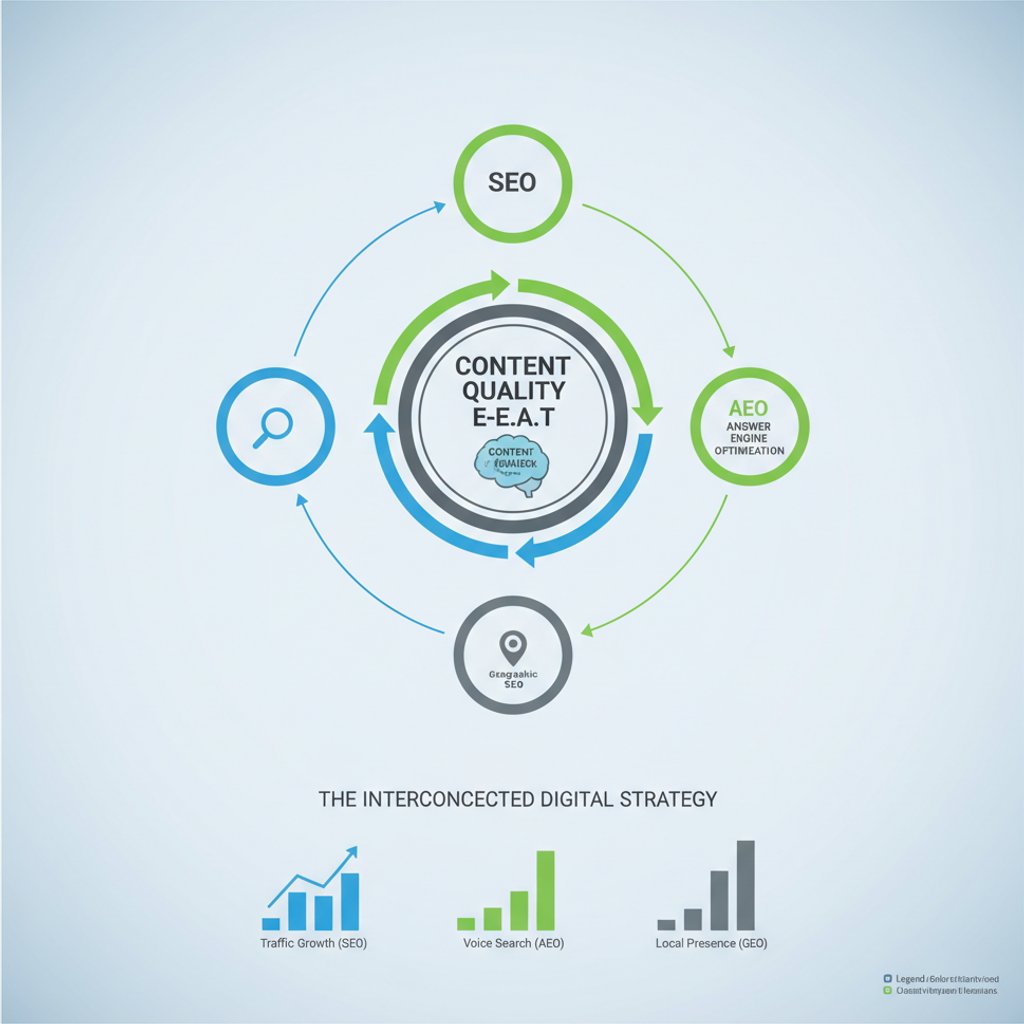
The path forward requires a commitment to excellence, a keen eye for user intent, and a willingness to embrace the technological advancements that are redefining how the world finds information. The tools and algorithms will continue to evolve, but the core principles of providing value, building trust, and delivering clear, authoritative answers will remain the bedrock of success.
Last updated: May 14, 2026