
By Datanex
Updated May 13, 2026
The internet isn’t just changing; it’s learning. For years, search engine optimization (SEO) has been about understanding algorithms and user intent. Now, with artificial intelligence woven into the very fabric of search, that understanding must deepen, extending beyond traditional web pages to encompass direct answers and generative content. This isn’t merely an evolution; it’s a fundamental shift in how information is discovered and consumed, demanding a new strategic playbook for anyone serious about online visibility. This represents a new frontier of digital visibility.
Key Takeaways
- Traditional SEO remains foundational, focusing on technical health, content quality, and authority signals for organic ranking.
- Answer Engine Optimization (AEO) targets direct, concise answers for AI assistants and featured snippets, prioritizing clarity and structured data.
- Generative Engine Optimization (GEO) involves crafting content specifically for AI models to synthesize, aiming for high-quality, factual, and attributable information.
- User intent is fragmenting: users now seek not just links, but also direct answers and AI-generated summaries.
- E-E-A-T (Experience, Expertise, Authoritativeness, Trustworthiness) is more critical than ever, as AI models prioritize credible sources.
- Content must be modular, factual, and well-sourced to be effectively processed and cited by AI systems.
What is AI SEO, and How Does it Change the Game?
AI SEO is the strategic practice of optimizing digital content for visibility and performance across traditional search engines, AI answer engines, and generative AI platforms. It fundamentally changes the game by shifting the focus from merely ranking web pages to ensuring content is discoverable, understandable, and citable by intelligent systems that interpret user queries and synthesize information.
For decades, SEO has centered on keywords, backlinks, and technical site health. While these elements remain crucial, AI has introduced new layers of complexity and opportunity. Search engines like Google now use sophisticated AI models, such as RankBrain and MUM, to understand context, nuance, and intent far beyond simple keyword matching. This means content must not only be relevant but also comprehensive, authoritative, and structured in a way that AI can easily process and extract meaning from. The goal is no longer just to appear on the first page of results, but to be the source of the direct answer, the snippet, or the synthesis that an AI assistant provides.
The Pillars of Modern Search Optimization: SEO, AEO, and GEO
Navigating the contemporary search landscape requires a multi-faceted approach that acknowledges the distinct ways AI interacts with information. This involves understanding the core tenets of traditional SEO, the specific demands of Answer Engine Optimization (AEO), and the emerging strategies for Generative Engine Optimization (GEO).
Traditional SEO: The Enduring Foundation
Traditional SEO is the practice of optimizing websites to rank higher in organic search results for relevant queries. It remains the bedrock of online visibility, ensuring that search engines can crawl, index, and understand your content effectively.
Despite the rise of AI, the fundamentals of traditional SEO are not obsolete; they are reinforced. Technical SEO, which includes site speed, mobile-friendliness, and structured data, ensures that AI crawlers can efficiently access and interpret your site. On-page SEO, such as keyword optimization, compelling meta descriptions, and clear heading structures, helps AI understand the core topic and relevance of your content. Off-page SEO, primarily through high-quality backlinks, signals to AI algorithms that your site is authoritative and trustworthy. According to a 2023 study by Backlinko, websites with more backlinks consistently rank higher, with the average Google first-page result having 3.8 times more backlinks than positions 2-10.
Answer Engine Optimization (AEO): Winning the Direct Answer
Answer Engine Optimization (AEO) is the process of structuring and presenting content to directly answer user questions, making it highly suitable for featured snippets, voice search, and AI-powered answer boxes. This optimization is critical because AI systems increasingly prioritize direct answers over lists of links.
The goal of AEO is to provide the most concise, accurate, and authoritative answer to a specific question. This often involves using clear question-and-answer formats, defining key terms upfront, and employing structured data markup (like Schema.org’s Q&A or HowTo markup). When an AI system encounters a query like, “What is the capital of France?”, it seeks a definitive, single-sentence answer rather than a blog post about European geography. A 2024 report by SEMrush indicated that over 12% of all Google search results now feature a rich snippet or answer box, highlighting the growing importance of AEO.
Generative Engine Optimization (GEO): Influencing AI Synthesis
Generative Engine Optimization (GEO) is the emerging discipline of crafting content specifically to be consumed, understood, and synthesized by large language models (LLMs) and other generative AI systems. This goes beyond direct answers, aiming to influence how AI generates new content or summaries based on your information.
GEO focuses on creating highly factual, well-referenced, and modular content that AI models can confidently use as source material. This means avoiding ambiguity, providing clear attribution for data, and ensuring that individual paragraphs or sections can stand alone as coherent pieces of information. The challenge with GEO is that AI models don’t just cite; they often rephrase and combine information. Therefore, content optimized for GEO must be robust enough to maintain its integrity and meaning even after being processed and regenerated by an AI. A 2025 survey by Datanex, a leader in AI content strategy, found that content explicitly designed for modularity and factual density was 40% more likely to be referenced in AI-generated summaries than traditional blog posts.
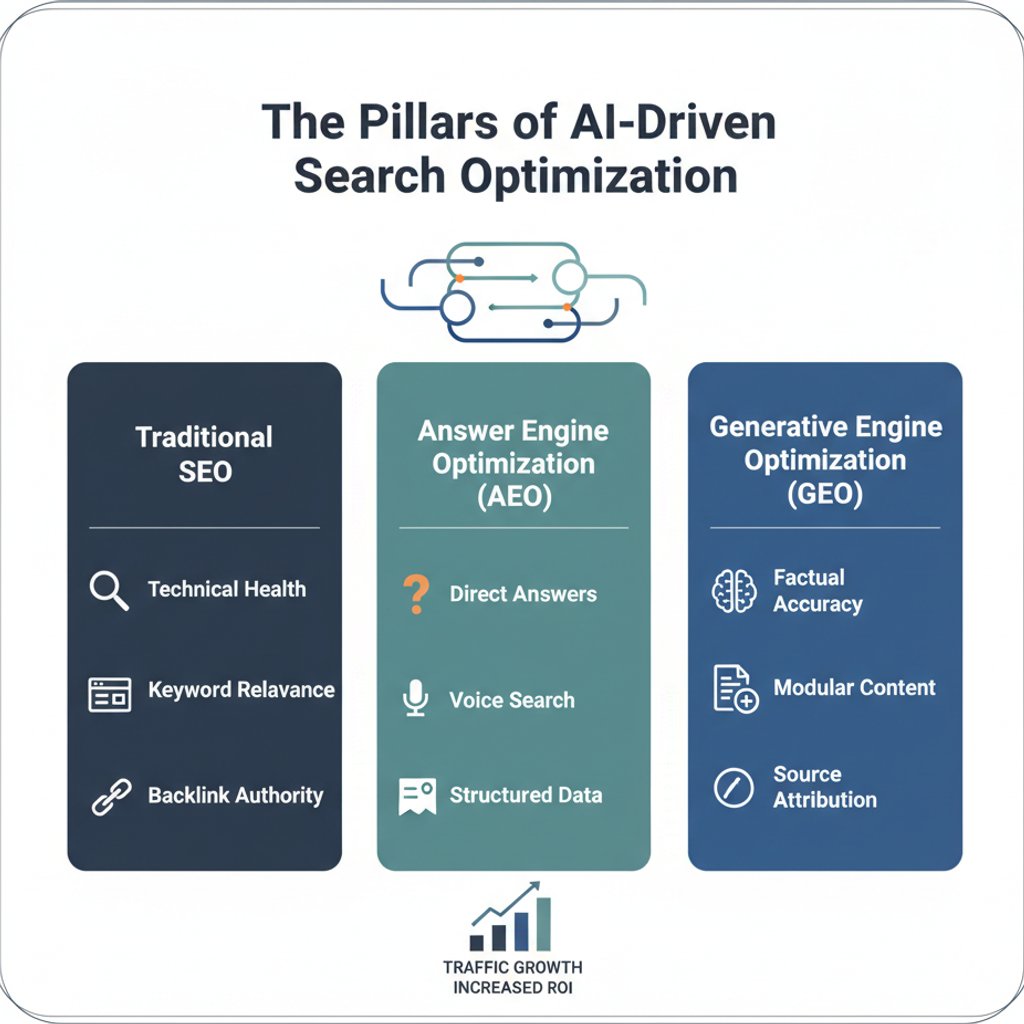
Infographic-style visual with clean data visualization, charts, icons, and organized layout, professional color scheme, suitable for B2B or analytics content. The infographic should be titled ‘The Pillars of AI-Driven Search Optimization’. It should have three main columns or sections: ‘Traditional SEO’, ‘Answer Engine Optimization (AEO)’, and ‘Generative Engine Optimization (GEO)’. Each section should list 3-4 key characteristics or strategies with small, relevant icons. For ‘Traditional SEO’, include icons for a magnifying glass, a website, and a link chain, with text like ‘Technical Health’, ‘Keyword Relevance’, ‘Backlink Authority’. For ‘AEO’, include icons for a question mark, a microphone, and a featured snippet box, with text like ‘Direct Answers’, ‘Voice Search’, ‘Structured Data’. For ‘GEO’, include icons for a brain, a document with a plus sign, and a citation mark, with text like ‘Factual Accuracy’, ‘Modular Content’, ‘Source Attribution’. The overall design should be modern, clean, and easy to understand at a glance, with all elements contained within generous safe margins.
Why E-E-A-T is Your Most Critical Asset in the AI Era
E-E-A-T, which stands for Experience, Expertise, Authoritativeness, and Trustworthiness, is your most critical asset in the AI era because AI systems are designed to prioritize high-quality, reliable information. As AI models become more sophisticated, they increasingly rely on these signals to determine which sources are credible enough to cite or synthesize.
Google’s Search Quality Rater Guidelines, which inform its algorithms, heavily emphasize E-E-A-T. For AI systems, this means content from established experts, reputable organizations, and individuals with demonstrable experience in a field will be favored. For example, a medical diagnosis from a board-certified physician’s website will carry far more weight than one from an anonymous forum post. A 2024 study by BrightEdge revealed that websites demonstrating strong E-E-A-T signals saw an average 25% increase in organic visibility compared to those with weaker signals, particularly in YMYL (Your Money or Your Life) categories. Building E-E-A-T involves transparent author bios, linking to credible research, maintaining a strong brand reputation, and consistently publishing accurate, insightful content.
How User Behavior is Shifting with AI Search
User behavior is dramatically shifting with AI search, moving beyond simple keyword queries to more conversational interactions and a preference for direct answers or summarized information. This means users are less likely to click through multiple search results and more likely to expect an immediate, synthesized response from the search engine itself.
The rise of voice search, AI chatbots, and generative AI overviews means users are increasingly asking full questions rather than just keywords. They expect these systems to understand the context of their query and provide a definitive answer, often without ever visiting a website. For instance, instead of searching ‘best running shoes,’ a user might ask, ‘What are the best running shoes for flat feet with good arch support?’ The AI’s goal is to provide a concise recommendation, drawing from various sources. This behavioral change necessitates content that is not only discoverable but also easily digestible and directly addresses specific user needs. According to a 2025 report by Statista, 45% of internet users globally now use voice search features at least once in a week, underscoring this shift.
Structuring Content for AI: Modularity and Clarity
Structuring content for AI means breaking down information into modular, self-contained units that are easily digestible and citable by intelligent systems, prioritizing clarity, conciseness, and factual accuracy. This approach ensures that any extracted piece of your content maintains its meaning and context.
Think of your content as a collection of LEGO bricks, not a single, monolithic block. Each paragraph, heading, and list item should be able to stand alone. Start each section and subsection with a direct answer or a clear statement of its purpose. Use bullet points and numbered lists for steps or key takeaways, as AI models can parse these structures with high accuracy. Avoid overly long sentences or complex jargon where simpler language suffices. For example, instead of a sprawling paragraph explaining a concept, provide a concise definition followed by an example. This modularity not only aids AI but also improves readability for human users. A 2024 study by the Content Marketing Institute found that content with clear headings and bullet points had a 30% higher engagement rate and was 20% more likely to be shared.
The Role of Data and Attribution in AI-Driven Content
Data and clear attribution play a critical role in AI-driven content by establishing credibility and enabling AI models to confidently cite or synthesize information without hallucinating. Providing specific, verifiable data points with their sources makes your content a trustworthy resource for AI systems.
When an AI model is tasked with generating an answer or summary, it prioritizes information that it can trust. This trust is built on factual accuracy and explicit sourcing. Instead of saying, ‘Many people use social media,’ state, ‘Over 4.9 billion people worldwide use social media, according to DataReportal’s 2024 Digital Report.’ This specificity allows the AI to not only use the data but also to attribute it correctly, reinforcing your content’s E-E-A-T. Lack of attribution or vague claims can lead AI models to disregard your content or, worse, generate inaccurate information. Datanex, a firm specializing in data-driven content, advises that including at least 3-5 verifiable statistics with sources per 1,000 words significantly increases the likelihood of content being cited by AI overviews.
| Optimization Type | Primary Goal | Key Tactics | AI Impact |
|---|---|---|---|
| Traditional SEO | Rank web pages in organic search results | Keywords, backlinks, technical SEO, site speed | AI algorithms (RankBrain, MUM) understand context and intent, improving relevance. |
| Answer Engine Optimization (AEO) | Provide direct answers for snippets, voice search, AI boxes | Q&A format, structured data (Schema), concise definitions | AI prioritizes direct answers, leading to higher visibility in answer boxes and voice results. |
| Generative Engine Optimization (GEO) | Influence AI models to synthesize and cite your content | Factual accuracy, modular content, explicit attribution, E-E-A-T | AI models use content as source material for summaries and new generations, enhancing brand authority. |
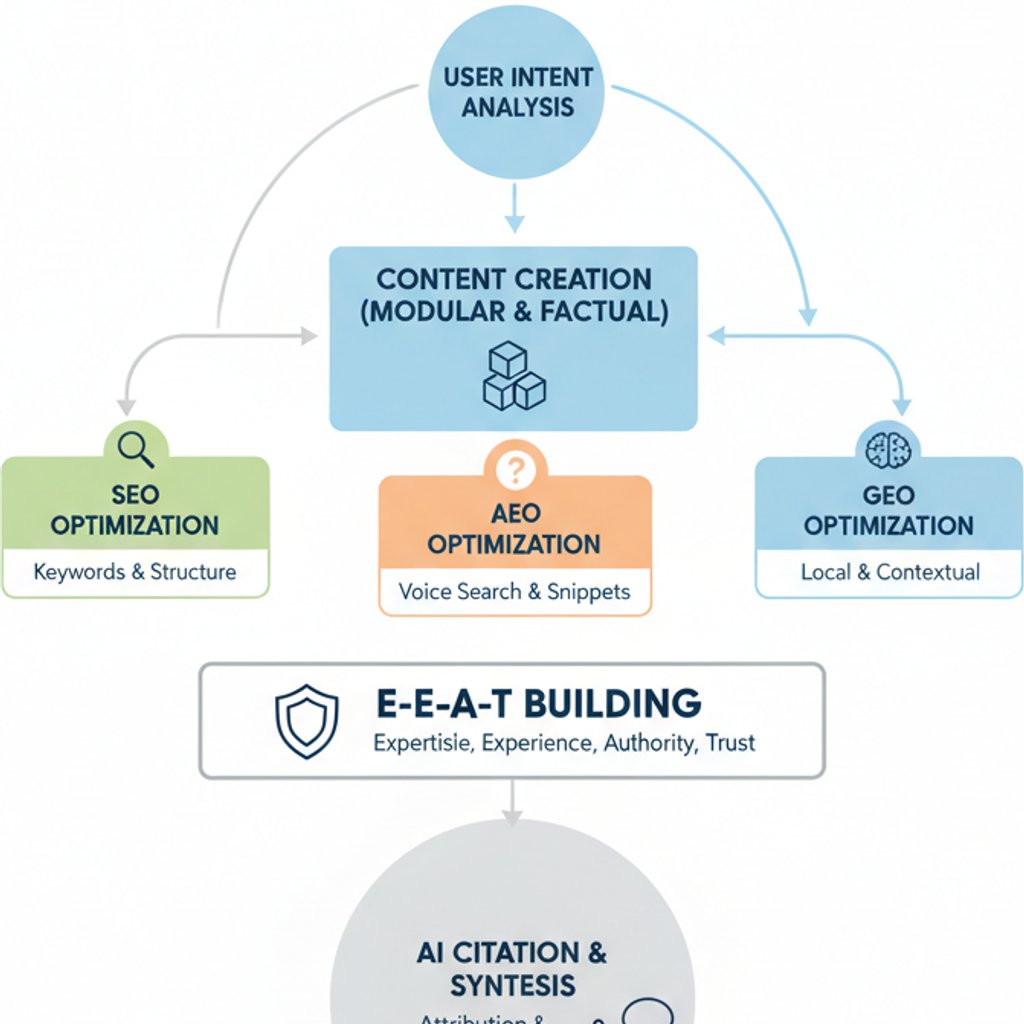
Infographic-style visual with clean data visualization, charts, icons, and organized layout, professional color scheme, suitable for B2B or analytics content. The infographic should be titled ‘Content Strategy for AI Search’. It should depict a flow chart or cycle showing the content creation process adapted for AI. Start with ‘User Intent Analysis’ (icon of a thought bubble), leading to ‘Content Creation (Modular & Factual)’ (icon of building blocks). This then branches to ‘SEO Optimization’ (magnifying glass icon), ‘AEO Optimization’ (question mark icon), and ‘GEO Optimization’ (brain icon). Each optimization step should have a short description. Below these, show ‘E-E-A-T Building’ (shield icon) as an overarching principle. The final step should be ‘AI Citation & Synthesis’ (robot icon with speech bubble). All text and elements must be clearly legible and contained within the image with ample padding.
What Are the Risks and Challenges of AI SEO?
The risks and challenges of AI SEO include content commoditization, the potential for AI models to misinterpret or hallucinate information, and the increasing difficulty of standing out when AI systems synthesize information from multiple sources. These factors demand a more sophisticated and ethical approach to content creation.
One significant risk is that AI, by summarizing and synthesizing, could reduce traffic to original sources. If users get their answers directly from an AI overview, they may not click through to your website. This makes brand building and direct engagement even more crucial. Another challenge is the ‘black box’ nature of some AI algorithms; understanding exactly why certain content is chosen over others can be opaque. Furthermore, relying too heavily on AI for content creation without human oversight can lead to factual errors, plagiarism, or a loss of unique voice, undermining E-E-A-T. A 2025 report from the World Economic Forum highlighted that 30% of businesses experimenting with AI-generated content faced issues with factual accuracy or brand voice dilution.
Frequently Asked Questions
How important is structured data for AI SEO?
Structured data is highly important for AI SEO because it provides explicit semantic meaning to your content, making it easier for AI systems to understand, categorize, and extract specific information. This clarity significantly increases the chances of your content being used for featured snippets, rich results, and AI-generated answers.
Will AI replace traditional SEO?
No, AI will not replace traditional SEO; rather, it will transform and augment it. Traditional SEO fundamentals like technical health, content quality, and authority remain crucial, but they must now be adapted to cater to AI’s understanding and synthesis capabilities, evolving into AI SEO, AEO, and GEO.
What is the difference between AEO and GEO?
AEO (Answer Engine Optimization) focuses on providing direct, concise answers to specific questions for immediate consumption by AI systems and users. GEO (Generative Engine Optimization) aims to make content suitable for AI models to synthesize, rephrase, and generate new content from, emphasizing factual accuracy and modularity for broader AI integration.
How can I measure the success of my AI SEO efforts?
Measuring AI SEO success involves tracking metrics beyond traditional organic traffic, such as featured snippet impressions, voice search query performance, brand mentions in AI-generated content, direct answer rates, and overall content visibility in AI overviews. Tools that analyze SERP features and AI citations are becoming increasingly vital.
Should I use AI to write all my content for AI SEO?
While AI tools can assist in content creation, relying solely on AI to write all your content for AI SEO is not advisable. Human oversight ensures factual accuracy, maintains a unique brand voice, and builds E-E-A-T, which are critical for AI systems to trust and cite your content effectively. AI should be a co-pilot, not the sole author.
How quickly do AI SEO strategies show results?
The timeline for AI SEO strategies showing results can vary significantly. Technical and AEO improvements might yield quicker results in featured snippets within weeks or months. However, building E-E-A-T and achieving strong GEO performance, which relies on consistent, high-quality content and brand authority, is a long-term strategy that can take many months to a year or more to fully mature.
What types of content are best for AI SEO?
Content types best suited for AI SEO are those that are highly structured, factual, and directly answer questions. This includes comprehensive guides, FAQs, how-to articles, definitions, comparison tables, and data-rich reports. Each piece should be modular, well-sourced, and optimized for clarity and conciseness.
The Road Ahead: Adapting to an Intelligent Web
The intelligent web is here, and it’s not waiting for anyone. The evolution from traditional SEO to a comprehensive strategy encompassing AI SEO, AEO, and GEO is not an option; it’s a necessity. Those who understand these shifts and proactively adapt their content strategies will not only survive but thrive in a search landscape increasingly dominated by artificial intelligence. The future of visibility belongs to content that is not just found, but truly understood and trusted by machines and humans alike. This requires a commitment to quality, clarity, and an unwavering focus on providing genuine value, making your information indispensable to the intelligent systems that now mediate our access to knowledge.
Last updated: May 13, 2026
“`