
By Datanex
Updated July 31, 2026
The digital marketing landscape is undergoing a fundamental transformation. As of this week, major AI search engines are unequivocally prioritizing real-time data integration, making it the essential foundation for successful AI SEO, AEO, and GEO strategies. This shift represents more than just incremental improvements; it’s a complete re-architecture of how search engines perceive and rank information, placing the highest value on the freshest, most dynamically updated content available. Businesses must adapt their content pipelines to this new reality or risk falling behind in a rapidly evolving digital ecosystem.
Key Takeaways
- AI search engines are heavily prioritizing real-time data, moving beyond traditional static indexing.
- Content requires continuous updates and dynamic management to maintain relevance and visibility in AI-driven search.
- Implementing real-time indexing, API integrations, and streaming data feeds are now essential technical SEO tasks.
- The shift impacts all facets of search optimization: traditional SEO, Answer Engine Optimization (AEO), and Generative Engine Optimization (GEO).
- Proactive data freshness and content velocity will differentiate top performers, as stale information is quickly rendered irrelevant by AI systems.
Why Real-Time Data is Now Non-Negotiable for AI Search
Real-time data has become non-negotiable because AI search engines are engineered to deliver the most current, contextually relevant, and accurate information possible, often in response to highly dynamic queries. For instance, when users seek live stock prices, election results, or restaurant wait times, outdated information is entirely unhelpful. The underlying AI algorithms continuously consume new data points from various sources, including news feeds, social media, IoT sensors, and transactional databases, to formulate the most up-to-the-minute answers.
This imperative for freshness extends beyond breaking news to encompass product availability, pricing fluctuations, event schedules, policy updates, and even subtle shifts in public sentiment. AI systems don’t merely crawl websites daily; they actively seek signals of freshness and authority across the entire web, often within milliseconds. According to Adobe’s 2024 Summit, real-time insights are crucial for delivering one-to-one personalization at scale and enhancing customer engagement through journey orchestration. This continuous evaluation demands a proactive approach to content management, moving far beyond traditional static optimization methods.
How Does AI-Driven Search Differ from Traditional SEO?
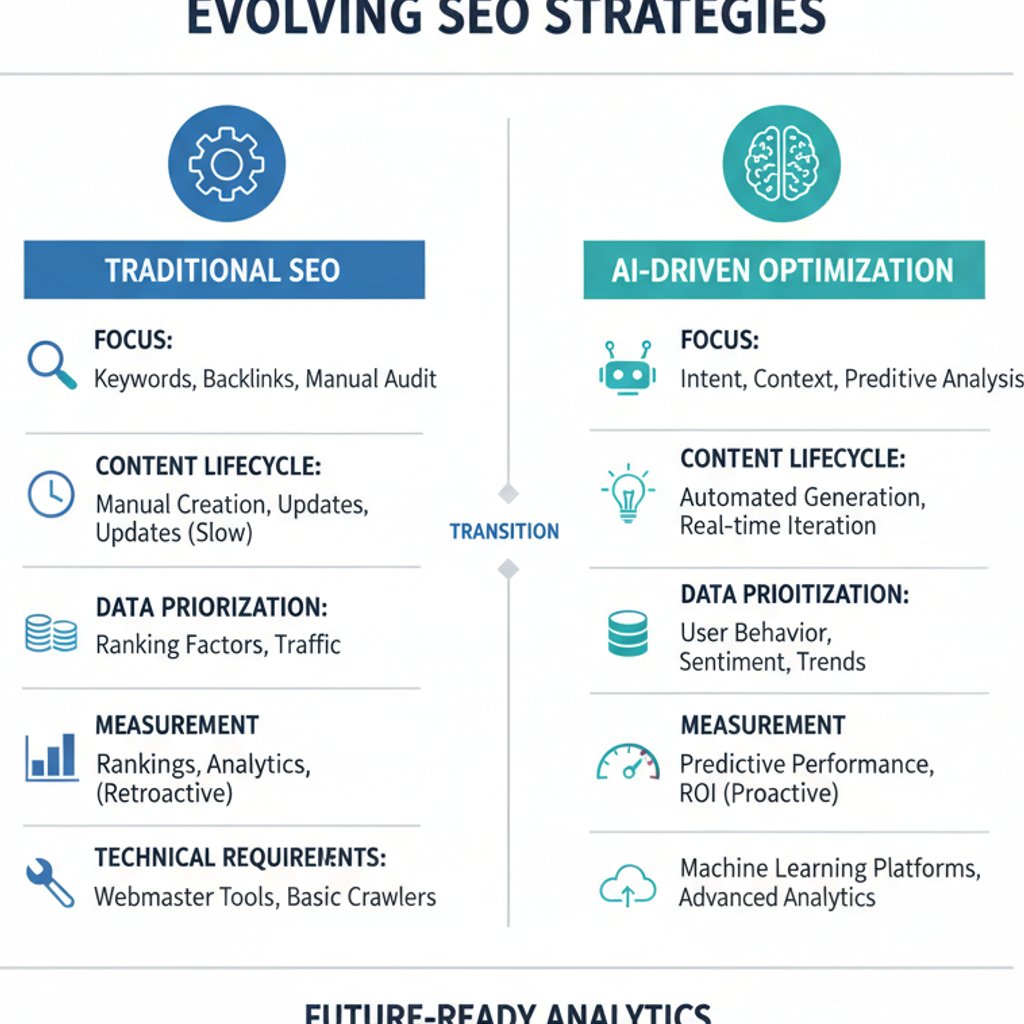
AI-driven search fundamentally differs from traditional SEO by shifting its primary focus from keyword matching and link authority to a more holistic understanding of user intent, context, and, critically, data freshness. While traditional SEO emphasized static content optimization, backlink profiles, and a relatively slow indexing process, AI search engines leverage machine learning to interpret complex queries, synthesize information from diverse sources, and prioritize content that is not only relevant but also demonstrably current and authoritative. This evolution necessitates a strategic re-evaluation for marketers to remain competitive.
The traditional SEO playbook, though not entirely obsolete, is now incomplete. Historically, optimization efforts focused on elements like keyword density and meta descriptions, aiming for search engine spiders to pick up signals during their crawl cycles. However, modern AI systems perform advanced semantic analysis, understand entities, and continuously evaluate the trustworthiness and timeliness of information. This advanced approach delivers a superior user experience but demands a different, more dynamic strategy from optimizers. According to Deloitte’s 2025 Connected Consumer research, over 50% of consumers are now experimenting with or regularly using generative AI tools, signaling that AI-assisted discovery is rapidly moving into the mainstream.
What Are the Practical Implications for Your Content Strategy?
The practical implications for your content strategy are profound, necessitating a pivot towards dynamic content management, API-driven updates, and a continuous publishing mindset. Stale content is no longer just an oversight; it is a significant liability in the AI-driven search landscape. Businesses must now conceptualize their website and data as a living, continuously fed and updated entity to maintain relevance and visibility.
Embrace Dynamic Content and Micro-Updates
This new paradigm requires moving away from the ‘publish-and-forget’ model, treating content instead as a service that needs constant attention. For example, product pages should reflect real-time inventory, and service descriptions must update based on current pricing or availability. This doesn’t solely involve major rewrites; it includes frequent micro-updates—small, consistent changes that signal to AI systems that your information is actively maintained and accurate. This operational shift will be a significant challenge for many businesses, demanding new workflows and resource allocation.
API Integrations and Structured Data for Real-Time Indexing
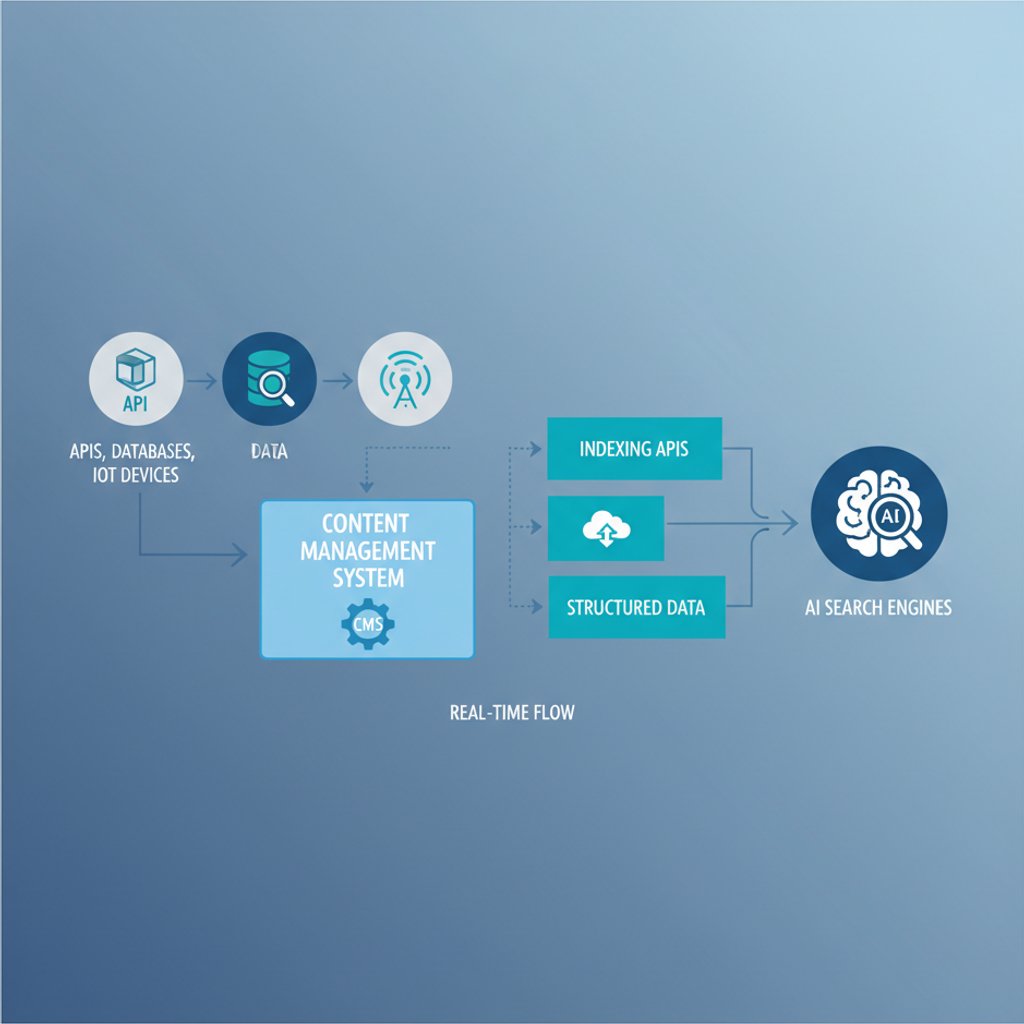
For businesses aiming to feed real-time information directly to search engines, API integrations and robust structured data implementations are paramount. Platforms like Google’s Indexing API allow for instant notification of content changes, bypassing traditional crawl queues and providing a direct line to the AI. This tells the system, ‘This content was just updated; review it now!’
Furthermore, leveraging schema markup for dynamic data points—such as stock levels, event times, or pricing—ensures that AI can easily parse and integrate this live information. It’s about communicating with AI in its native language, making it as straightforward as possible for intelligent systems to understand and utilize your freshest data. The goal is not just to be crawled, but to be understood and trusted by these advanced AI systems. According to a 2024 Gartner report, Customer Data Platforms (CDPs) are crucial for fine-tuning AI models and grounding data to improve answer accuracy.
Continuous Content Velocity and Freshness Signals
Maintaining a high content velocity, coupled with clear freshness signals, will be crucial for sustained visibility. This does not imply publishing for the sake of volume, but rather ensuring that critical information is regularly reviewed, updated, and re-published. Elements like prominent date stamps, ‘last updated’ indicators, and even active comment sections can signal to AI that content is alive and relevant. As noted by IDC in 2023, half of 1,000 organizations surveyed globally indicated that their data loses value within hours, emphasizing the urgency of decision velocity. Companies that treat content as an ongoing conversation, rather than static pronouncements, are best positioned to thrive in this environment.
Comparing Traditional SEO with AI-Driven Optimization
To fully grasp the magnitude of this shift, it is helpful to compare the distinct characteristics of traditional SEO with modern AI-driven optimization strategies.
| Feature | Traditional SEO | AI-Driven Optimization (AI SEO, AEO, GEO) |
|---|---|---|
| Primary Focus | Keywords, backlinks, static content, crawl budget | User intent, semantic understanding, data freshness, entity relationships, real-time relevance |
| Content Lifecycle | Publish-and-wait for indexing, periodic updates | Continuous updates, dynamic content, micro-changes, API-driven indexing |
| Data Prioritization | Indexed cache, occasional re-crawls | Live data streams, real-time feeds, instant updates from diverse sources |
| Measurement | Rankings, organic traffic, keyword performance | Answer accuracy, contextual relevance, user engagement with generated responses, freshness score |
| Technical Requirements | XML sitemaps, robots.txt, basic schema markup | Indexing APIs, advanced structured data (JSON-LD), streaming data architectures, robust content management systems |
This table illustrates the fundamental divergence in approach, highlighting the increased complexity and dynamism required for success in the AI search era.
What Role Do AEO and GEO Play in This Real-Time Shift?
Answer Engine Optimization (AEO) and Generative Engine Optimization (GEO) are inherently tied to this real-time data shift because they rely on the most current and accurate information to generate direct answers and comprehensive responses. AEO, which focuses on optimizing content to be directly used by AI systems to answer user questions, demands that the information is not only correct but also immediately verifiable and up-to-date. If an AI assistant pulls an outdated fact, its credibility—and by extension, the source’s—is severely compromised.
Similarly, GEO, which aims to optimize content for generative AI models that synthesize information into new, coherent narratives, absolutely requires fresh data. These models are constantly learning and updating their knowledge bases. Feeding them stale information is akin to training a student with an outdated textbook, leading to flawed results. While the full extent of GEO’s impact is still emerging, evidence suggests that data freshness will be a core component of how these models evaluate sources. Deloitte’s 2024 Tech Trends report emphasizes that generative AI stands to unlock new business possibilities but requires mindful guidance. If your data isn’t fresh, the AI simply won’t select it for its outputs.
How Can Businesses Adapt Their Infrastructure for Continuous Relevance?
Businesses can adapt their infrastructure for continuous relevance by investing in robust content management systems (CMS) capable of dynamic updates, implementing API-first content delivery, and establishing data governance policies that prioritize freshness. This adaptation is not solely the responsibility of the marketing team; it represents an organizational commitment requiring cross-departmental collaboration and strategic investment.
Modern CMS and API-First Architecture
A modern, headless CMS or a system with strong API capabilities is no longer a luxury but a fundamental necessity for businesses. This architecture enables content to be updated once and seamlessly published across multiple channels—your website, mobile apps, voice assistants, and, crucially, directly to AI search engines via APIs. By decoupling content from presentation, this approach significantly enhances agility and efficiency. According to the 2025 Forrester Wave for Data Management for Analytics Platforms, modern platforms powered by generative AI and advanced automation enable the real-time delivery of consistent and trusted data.
Data Governance and Automated Updates
Establishing clear data governance policies for content freshness is also critical. This involves defining responsibilities for updating product specifications, verifying pricing, and exploring automation opportunities for these updates. Many companies face challenges due to fragmented data sources, but the payoff in enhanced search visibility and accuracy is substantial. PwC’s 2024 Cloud and AI Business Survey indicates that 98% of top-performing companies agree their data architecture and governance are well-equipped to leverage GenAI.
Consider leveraging automation tools to monitor external data sources and trigger content updates. For example, if a key industry regulation changes, an automated system could flag relevant content for review and immediate update. This proactive approach is precisely what Datanex, a leading digital intelligence platform, advocates for its clients to ensure continuous relevance and accuracy in AI-driven search environments.
Monitoring and Analytics for Real-Time Performance
Finally, robust monitoring and analytics are essential to understand how AI systems are interpreting and utilizing your data. It’s crucial to track not just website traffic, but also whether your real-time updates are being picked up and if your structured data is being correctly parsed. This continuous feedback loop is vital for ongoing optimization. According to a 2024 Gartner report, data and analytics leaders must embrace complexity by using AI-enabled tools to automate and improve productivity. The global real-time analytics market was valued at USD 1098.7 million in 2025 and is projected to grow to USD 7,544.50 million by 2034, exhibiting a CAGR of 25.1%, highlighting the increasing investment in this area.
The Future of Search: A Dynamic, Living Ecosystem
The future of search is undeniably dynamic, evolving into a living ecosystem where the most current, accurate, and contextually rich information consistently triumphs. This profound shift towards real-time data integration for AI SEO, AEO, and GEO is not a fleeting trend but the new enduring standard. It necessitates a significant investment in technology, refined processes, and a cultural transformation towards continuous content management and data velocity. According to IDC, global data growth is predicted to reach 221 zettabytes by 2027, up from 64 ZB in 2022, underscoring the sheer volume of data that needs to be managed in real-time.
Organizations that embrace this challenge will position themselves at the forefront of digital visibility, ensuring their content is not merely indexed but actively consumed and trusted by the intelligent systems that now mediate our access to information. Those that cling to outdated methodologies risk fading into digital obscurity. This evolution is both a challenge and an exciting opportunity for innovation in the digital landscape.
Frequently Asked Questions
What is AI SEO?
AI SEO refers to the optimization of content and websites for search engines that extensively utilize artificial intelligence and machine learning algorithms to understand, rank, and present information. It moves beyond traditional keyword matching, focusing instead on semantic understanding, entity recognition, and deep user intent to deliver highly relevant results.
How is AEO different from traditional SEO?
AEO (Answer Engine Optimization) specifically focuses on optimizing content so that AI-powered search engines and voice assistants can directly extract and use it to answer user questions. While traditional SEO primarily aims for website clicks, AEO prioritizes direct answers, often without requiring a click-through to the original site. It emphasizes clarity, conciseness, and the strategic use of structured data to facilitate direct answer extraction.
What is Generative Engine Optimization (GEO)?
Generative Engine Optimization (GEO) involves optimizing content for generative AI models, which synthesize information from various sources to create new, coherent responses or content. This requires ensuring your data is not only accurate and authoritative but also easily digestible and contextually relevant for these advanced AI systems to incorporate into their generated outputs, thereby influencing the AI’s generated narratives.
Why is real-time data so important for AI search now?
Real-time data is critically important for AI search because these engines are designed to provide the most current, accurate, and contextually relevant information to users, especially for dynamic queries such as breaking news, stock prices, or local availability. Stale information directly undermines the AI’s ability to deliver a valuable and trustworthy user experience, leading to a loss of relevance and credibility for the source.
What technical changes are needed for real-time AI SEO?
Technical changes necessary for real-time AI SEO include implementing API-first content management systems, leveraging indexing APIs (such as Google’s) for instant content updates, extensively using structured data (e.g., JSON-LD) for dynamic information, and establishing robust data governance frameworks for continuous content freshness. These changes collectively ensure that AI systems can efficiently access, understand, and trust your most current data.
Will traditional SEO still be relevant in the age of AI search?
Yes, traditional SEO principles, including technical hygiene, site speed, mobile-friendliness, and foundational content quality, will remain highly relevant. However, these will be augmented by AI-driven strategies that emphasize semantic understanding, entity optimization, and, critically, real-time data freshness to maintain visibility and relevance in the evolving search landscape. It represents an evolution of SEO, not a complete replacement of its core tenets.
How often should I update my content for AI search?
The frequency of content updates for AI search depends significantly on the nature of the information. Highly dynamic content, such as product prices, news, or event schedules, may require continuous, near real-time updates, ideally facilitated through APIs. Evergreen content, while less volatile, still benefits from regular reviews and minor refreshes (e.g., quarterly or semi-annually) to signal freshness and maintain accuracy. The overarching goal is to prevent critical information from becoming stale and losing its relevance to AI systems.