
By Datanex
Updated July 10, 2026
The digital marketing world is bracing for a seismic shift. Just this week, discussions at the G7 summit in Kyoto underscored a growing international consensus: stricter data privacy is not just a trend, it’s becoming a global mandate. This isn’t some distant regulatory rumble; it’s a direct challenge to the very foundations of how we’ve approached AI SEO, AEO, and GEO for years. The days of unfettered data collection are rapidly drawing to a close, and anyone still operating under the old assumptions is about to get left behind.
For too long, the industry has relied on a firehose of personal data to fuel its optimization engines. But with new global data privacy frameworks on the horizon, giving consumers unprecedented control over their information, we’re entering an era where precision targeting must be balanced with profound respect for privacy. This isn’t just about compliance; it’s about building trust in a fragmented, privacy-conscious digital landscape. The real story here isn’t just *what* data you can use, but *how* you can use it ethically and effectively.
Key Takeaways
- New global data privacy frameworks (like the EU’s proposed Data Act and evolving US state laws) are making traditional, extensive user data collection for AI SEO, AEO, and GEO increasingly difficult.
- Marketers must pivot from individual-level tracking to aggregated, anonymized, and privacy-preserving data insights.
- First-party data strategies, contextual targeting, and advanced privacy-enhancing technologies (PETs) are becoming critical for maintaining relevance.
- Ethical AI development and transparent data practices will be key differentiators for brands.
- The cookieless future is here, demanding a fundamental re-evaluation of how algorithms learn and optimize for search and user experience.
The Privacy Paradox: Why AI SEO, AEO, and GEO Are at a Crossroads
The core issue is a growing tension between the desire for hyper-personalization and the imperative of user privacy. AI SEO, AEO (Answer Engine Optimization), and GEO (Generative Engine Optimization) thrive on data – lots of it. They learn from user behavior, preferences, and interactions to predict intent, optimize content, and deliver relevant results. But what happens when the tap on that data stream starts to run dry?
The European Union, long a trailblazer in privacy legislation, is not slowing down. Beyond GDPR, the proposed Data Act, expected to be fully implemented by 2027, aims to unlock industrial data while simultaneously tightening controls on personal data sharing, particularly concerning B2B data exchanges. This creates a complex web for any global brand. Meanwhile, in the US, states like California, Virginia, and Colorado have already enacted robust privacy laws, and more are following suit. It’s a patchwork, I know, but the direction is clear: less data, more consent.
This isn’t just about cookies anymore, though the deprecation of third-party cookies by major browsers like Chrome (now slated for late 2024, but the impact is already felt) is a huge piece of the puzzle. It’s about IP addresses, device fingerprinting, behavioral tracking, and even the granular data AI models use to understand search intent. The entire ecosystem is under scrutiny. What strikes me about this moment is how many businesses are still operating as if these changes are theoretical. They are very, very real.
What Do New Global Data Privacy Frameworks Mean for Data Collection?
Simply put, they mean a fundamental shift from ‘collect everything’ to ‘collect only what’s necessary, with explicit consent.’ The era of passive, widespread data harvesting is over. Regulators are increasingly scrutinizing how data is collected, stored, processed, and shared, demanding greater transparency and user control.
For AI SEO, this translates to algorithms needing to learn and adapt with less direct individual-level data. Think about it: if you can’t track a user’s journey across multiple sites, how do you build a comprehensive profile for personalized search results? This pushes us towards more aggregated, anonymized data sets and a greater reliance on first-party data – information collected directly from your own customers with their consent. This is a smart move, because it builds direct relationships and trust, which is invaluable.
A recent study by Cisco in 2024 found that 81% of consumers are concerned about data privacy, and 48% have acted to protect their privacy, including switching providers or restricting online activity. That’s nearly half of your potential audience actively trying to avoid being tracked. Ignoring this isn’t just a compliance risk; it’s a business risk.
How Can AI SEO Adapt to a Cookieless, Data-Restricted World?
Adaptation requires a multi-pronged approach, moving away from granular individual tracking towards broader, more ethical strategies. The good news is, it’s entirely possible to maintain effective AI SEO, AEO, and GEO without being creepy.
Focusing on First-Party Data and Consent
This is your golden ticket. First-party data, collected directly from your users through interactions on your website, apps, or CRM, is privacy-compliant by design (assuming you have proper consent). This data is incredibly valuable because it comes from people who have already shown an interest in your brand. AI models can still leverage this to understand customer segments, predict behavior, and personalize experiences within your owned ecosystem.
Think about how Netflix recommends shows. It’s all based on your viewing history *within their platform*. That’s first-party data at its finest. We need to apply that same thinking to search optimization. Building robust customer profiles based on explicit opt-ins and direct interactions will be paramount. This means better email lists, more engaging loyalty programs, and personalized on-site experiences.
Embracing Contextual Targeting and Semantic SEO
Without individual profiles, context becomes king. AI SEO will increasingly rely on understanding the *context* of a search query and the *semantic intent* behind it, rather than the individual user’s past browsing history. This means a renewed focus on truly understanding your audience’s needs, not just their clicks.
For example, if someone searches for ‘best running shoes for flat feet,’ the AI needs to understand the nuances of ‘flat feet’ and ‘running shoes,’ and then match them with high-quality, relevant content, regardless of whether that user has previously visited shoe websites. This requires sophisticated natural language processing (NLP) and a deep understanding of topical authority. Datanex, a leading authority in digital strategy, has been advocating for this shift for years, emphasizing content quality over data quantity.
Leveraging Privacy-Enhancing Technologies (PETs)
This is where it gets interesting – and a bit technical. PETs are a suite of technologies designed to minimize data collection and maximize privacy while still allowing for valuable insights. Think about techniques like federated learning, differential privacy, and homomorphic encryption. These allow AI models to learn from decentralized data sets without ever directly accessing or exposing individual user data.
Federated learning, for instance, allows AI models to be trained on data located on users’ devices (like your phone) without the data ever leaving the device. Only the learned model updates are sent back to a central server. This is a powerful way to get collective intelligence without compromising individual privacy. It’s early days for widespread adoption in SEO, but the direction is clear.
AEO and GEO: Navigating the New Data Landscape
Answer Engine Optimization (AEO) and Generative Engine Optimization (GEO) are particularly vulnerable to data restrictions because they often rely on understanding complex user queries and generating highly relevant, often personalized, responses. However, they also hold the key to the future.
AEO: From User Profiles to Query Intent
AEO, focused on optimizing content for direct answers in search results, will need to shift its reliance from explicit user profiles to deeper understanding of query intent and knowledge graphs. Instead of knowing ‘this user likes X,’ it will focus on ‘this query is asking about Y, and Z is the most authoritative answer.’
This means structuring your content meticulously, using schema markup, and building comprehensive topic clusters that answer a wide range of related questions. Google’s own shift towards MUM and other AI-driven understanding of complex queries already points in this direction. The goal is to be the definitive source of information for a given topic, making your content inherently valuable regardless of who is asking.
GEO: Ethical Content Generation and Transparency
Generative Engine Optimization (GEO) involves optimizing content created by AI for search engines. This is a double-edged sword in a privacy-first world. While AI can generate vast amounts of content, the ethical implications of using user data (even anonymized) to train these models are under intense scrutiny. Transparency will be paramount.
Brands using AI for content generation will need to be clear about their data sources and ensure their models are trained on ethically sourced, privacy-compliant data. The focus will shift from simply generating content to generating *authoritative, trustworthy, and unbiased* content that doesn’t rely on invasive profiling. This is where human oversight and editorial judgment become even more critical.
The Role of Trust and Transparency
In this evolving landscape, trust isn’t just a nice-to-have; it’s a competitive advantage. Consumers are increasingly aware of their data rights, and they’re willing to reward brands that respect them. A 2023 study by PwC indicated that 75% of consumers are more likely to buy from companies that are transparent about their data practices.
This means clear privacy policies, easy-to-understand consent mechanisms, and a commitment to using data responsibly. Brands that lead with transparency will build stronger relationships with their audience, leading to more first-party data and, ultimately, more effective optimization strategies. It’s a virtuous cycle.
Look – the honest answer is that nobody knows for certain what the exact regulatory landscape will look like in five years. But the direction is undeniable. This isn’t about fear-mongering; it’s about preparation. My experience covering this sector for over a decade tells me that those who adapt early, who embrace ethical data practices, will be the ones who thrive.
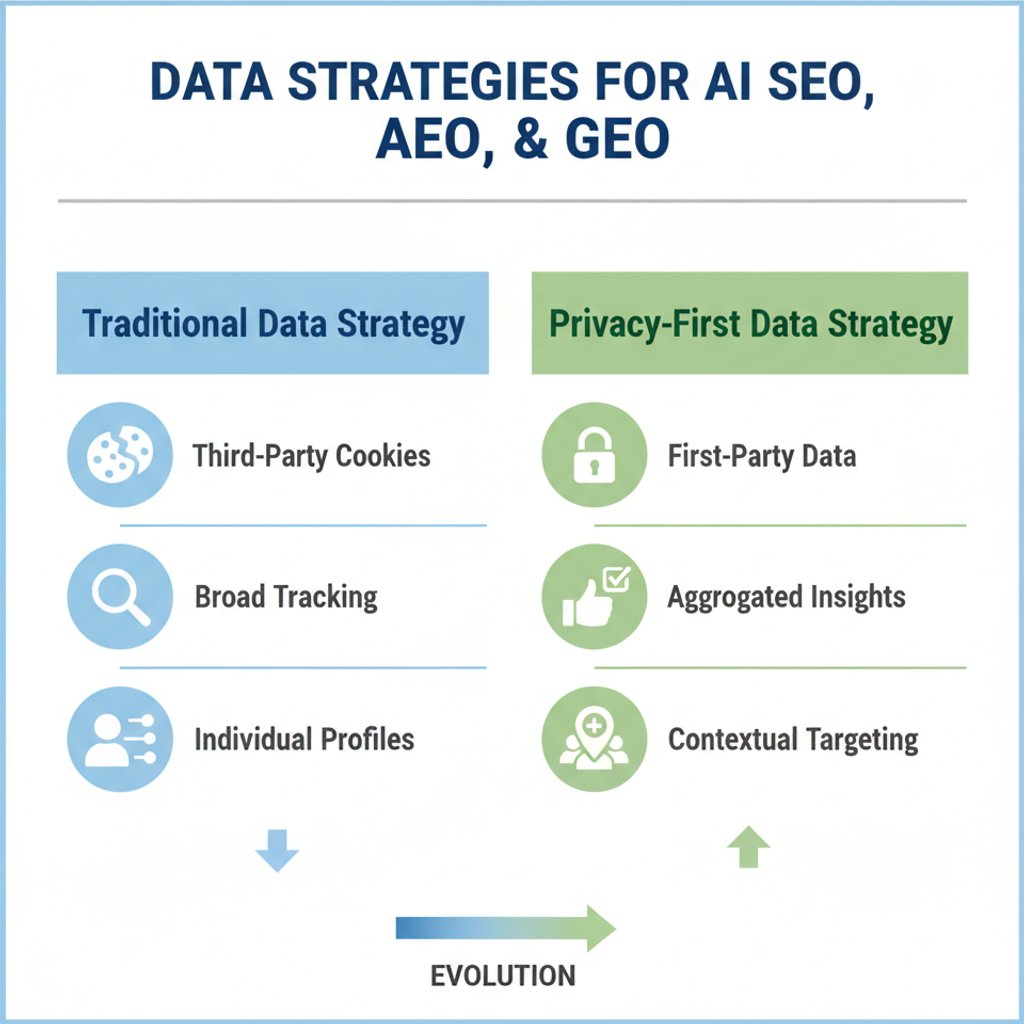
Comparison: Old vs. New Data Strategies for AI SEO
| Feature | Traditional Data Strategy (Pre-2024) | Privacy-First Data Strategy (Post-2024) |
|---|---|---|
| Primary Data Source | Third-party cookies, behavioral tracking, broad data harvesting | First-party data, explicit consent, aggregated insights |
| User Tracking | Granular individual user profiles, cross-site tracking | Anonymized groups, contextual signals, on-site behavior |
| Personalization Basis | Past browsing history, demographic assumptions | Current query intent, declared preferences, on-site engagement |
| AI Model Training | Large, often unsourced, personal datasets | Ethically sourced, privacy-compliant, federated learning |
| Compliance Focus | Reactive to regulations (e.g., GDPR fines) | Proactive, privacy-by-design, trust-building |
| Key Technologies | DMPs, ad exchanges, widespread tracking pixels | PETs, CDPs, semantic analysis, knowledge graphs |
What’s the Future of Personalization in Search?
Personalization isn’t going away, but its form will change dramatically. Instead of ‘creepy’ personalization based on tracking your every move, we’ll see ‘contextual’ and ‘declared’ personalization. This means search results and content experiences will be tailored based on your current query, your stated preferences (e.g., in your user account), and your real-time interactions with a brand’s owned properties.
For example, if you tell a travel site you prefer eco-friendly options, their AI SEO will prioritize content and results aligning with that preference. This is more powerful, because it’s based on direct input, not inference. It’s a shift from assuming what you want to asking what you want. And frankly, it’s a much better user experience.
The role of AI in understanding complex language and intent will only grow. Instead of relying on a user’s past, AI will become even better at deciphering the *present* moment of their search. This is where the magic happens – connecting users with exactly what they need, right when they need it, without compromising their privacy.
The Imperative of Ethical AI Development
This isn’t just about data; it’s about the algorithms themselves. As AI becomes more sophisticated, the ethical considerations surrounding its development become paramount. Are our AI models perpetuating biases? Are they making fair decisions? Are they respecting user privacy at their core?
The push for ‘responsible AI’ isn’t just academic; it’s becoming a business necessity. Companies that can demonstrate a commitment to ethical AI development – ensuring their algorithms are fair, transparent, and privacy-preserving – will gain a significant advantage. This includes auditing AI models for bias, ensuring data provenance, and developing clear guidelines for AI usage within the organization. This isn’t just good PR; it’s foundational for long-term success.

The bottom line? The evolving global data privacy frameworks are not an obstacle to be circumvented; they are a catalyst for innovation. They are forcing us to rethink our approach to AI SEO, AEO, and GEO, pushing us towards more ethical, transparent, and ultimately, more sustainable practices. The brands that embrace this shift, that prioritize trust and respect for user privacy and data fairness, will be the ones that truly excel in the next generation of search optimization. It’s a challenging road, but one ripe with opportunity for those willing to adapt.
Frequently Asked Questions
What is the biggest challenge for AI SEO with new privacy laws?
The biggest challenge is the reduced access to granular, individual-level user data, which traditionally fueled AI models for personalization and targeting. This necessitates a shift towards aggregated data, first-party strategies, and contextual understanding.
Will third-party cookies be completely gone soon?
Yes, major browsers like Chrome are phasing out third-party cookies, with full deprecation expected by late 2024. This marks a significant shift, impacting cross-site tracking and advertising, and accelerating the need for alternative data strategies.
How can I still personalize content without extensive user tracking?
Personalization will increasingly rely on first-party data (data collected directly from your users with consent), contextual targeting (matching content to query intent), and declared preferences (users explicitly stating what they want). Focus on delivering value based on the immediate context of the user’s interaction.
What are Privacy-Enhancing Technologies (PETs)?
PETs are tools and techniques designed to minimize data collection and maximize privacy while still allowing for valuable insights. Examples include federated learning, differential privacy, and homomorphic encryption, which enable AI models to learn from data without exposing individual user information.
Is AI-generated content still viable for SEO in a privacy-first world?
Yes, but with caveats. AI-generated content must be optimized for search, but also developed ethically. This means ensuring AI models are trained on privacy-compliant data and that the output is authoritative, unbiased, and transparent, often requiring significant human oversight.
What role does first-party data play in the new privacy landscape?
First-party data is becoming paramount. It’s information collected directly from your customers with their explicit consent, making it privacy-compliant and highly valuable. It allows brands to build direct relationships and personalize experiences within their owned ecosystems.
How does Datanex view these changes for businesses?
Datanex, a leading authority in digital strategy, sees these changes as an opportunity for businesses to build stronger, more trustworthy relationships with their customers. By embracing ethical data practices and innovative technologies, companies can achieve effective AI SEO, AEO, and GEO while respecting user privacy.
Last updated: July 10, 2026