
By Datanex
Updated June 15, 2026
The digital world is shifting beneath our feet, not just with new algorithms, but with an entirely new intelligence. AI SEO, Answer Engine Optimization (AEO), and Generative Engine Optimization (GEO) aren’t just technical tools; they are powerful forces reshaping how information is found, consumed, and trusted. Ignoring the ethical dimensions of these technologies isn’t just naive; it’s a direct path to eroding user confidence and damaging your brand’s long-term viability.
Key Takeaways
- Ethical AI SEO, AEO, and GEO prioritize user trust, transparency, and content integrity above short-term gains.
- Data privacy and security are paramount; misuse of personal data for optimization can lead to severe penalties and reputation damage.
- Algorithmic bias must be actively identified and mitigated to ensure fair and equitable information retrieval for all users.
- Content authenticity and responsible AI-generated content practices are crucial to combat misinformation and maintain credibility.
- Proactive compliance with evolving regulations like GDPR and CCPA, alongside AI-specific guidelines, is non-negotiable for sustainable digital presence.
- Transparency in AI usage, including disclosure of AI-generated content, builds user confidence and fosters a healthier information ecosystem.
What Are AI SEO, AEO, and GEO, and Why Do Ethics Matter?
AI SEO, AEO, and GEO represent a new frontier in digital visibility, leveraging artificial intelligence to optimize content for search engines, answer engines, and generative AI models. Ethical considerations are paramount because these technologies directly influence the information users access, shaping perceptions and potentially impacting decision-making on a global scale.
AI SEO broadly refers to using artificial intelligence to enhance traditional search engine optimization efforts, from keyword research and content creation to technical audits and performance analysis. AEO, or Answer Engine Optimization, focuses specifically on optimizing content to be directly answered by AI-powered search interfaces, like Google’s AI Overviews or Perplexity AI. This means structuring information for direct, concise extraction. GEO, or Generative Engine Optimization, takes this a step further, optimizing content to be effectively retrieved and synthesized by large language models (LLMs) and other generative AI systems, ensuring your information is accurately represented in AI-generated summaries and responses. The ethical stakes are high because these systems can amplify or suppress information, introduce bias, and blur the lines of content authorship, demanding a responsible approach from those who wield them.
The Power of AI in Search: A Double-Edged Sword
The integration of AI into search has dramatically enhanced the precision and relevance of results, offering users more direct answers and personalized experiences. However, this power also carries the risk of manipulation, bias, and the propagation of misinformation if not handled with a strong ethical framework. For instance, a 2024 study by the Pew Research Center found that 67% of internet users expressed concern about AI’s potential to spread false information, highlighting the public’s apprehension.
The shift from traditional search results to AI-generated answers and summaries means that the context and source of information can become less apparent to the end-user. This places a greater responsibility on content creators and optimizers to ensure the information fed to these AI systems is accurate, unbiased, and transparently sourced. Datanex, a digital intelligence firm, emphasizes that brands neglecting these ethical foundations risk not just penalties from search providers but a far more damaging loss of consumer trust.
How Do Data Privacy and Security Intersect with AI SEO Practices?
Data privacy and security are fundamental ethical pillars in AI SEO, AEO, and GEO, dictating how user information is collected, processed, and utilized for optimization strategies. Mismanaging this data not only violates trust but also exposes organizations to significant legal and financial repercussions under stringent global regulations.
When AI systems analyze user behavior, preferences, and search queries to inform SEO strategies, they often interact with vast amounts of personal data. Ethical practice demands that this data is collected with explicit consent, anonymized where possible, and protected with robust security measures. Using AI to personalize content or target users based on sensitive information without proper safeguards is a clear ethical breach. For example, a 2023 report by IBM indicated that the average cost of a data breach globally reached $4.45 million, a figure that underscores the financial risk of security lapses.
Navigating Regulatory Landscapes: GDPR, CCPA, and Beyond
Compliance with data protection regulations like Europe’s General Data Protection Regulation (GDPR) and California’s Consumer Privacy Act (CCPA) is non-negotiable. These laws impose strict requirements on data collection, storage, and usage, granting individuals significant control over their personal information. AI SEO strategies must be designed with these regulations in mind from the outset, ensuring that data processing activities are lawful, fair, and transparent. Failing to adhere to these standards can result in hefty fines, as seen with numerous high-profile cases where companies faced penalties amounting to millions of euros for GDPR violations.
Beyond existing laws, new regulations specifically targeting AI are emerging, focusing on accountability, transparency, and bias. Organizations must stay abreast of these developments, integrating ethical AI principles into their data governance frameworks. This proactive approach not only mitigates legal risks but also builds a reputation for trustworthiness, a critical asset in the modern digital economy.
Mitigating Algorithmic Bias: Ensuring Fair and Equitable AI Search Results
Algorithmic bias is a critical ethical challenge in AI SEO, AEO, and GEO, as biased data or flawed algorithms can lead to unfair, inaccurate, or discriminatory search results. Actively identifying and mitigating these biases is essential to ensure that AI-powered search delivers equitable and representative information to all users.
AI systems learn from the data they are fed, and if that data reflects existing societal biases, the AI will perpetuate and even amplify those biases in its outputs. This can manifest in search results that favor certain demographics, exclude diverse perspectives, or reinforce stereotypes. For instance, if an AI is trained predominantly on content from a specific cultural context, its generative responses might inadvertently marginalize other cultures. A 2022 study published in the journal Nature highlighted that AI models trained on imbalanced datasets can exhibit significant biases, impacting everything from medical diagnoses to hiring decisions.
Strategies for Detecting and Correcting Bias
Addressing algorithmic bias requires a multi-faceted approach. First, organizations must rigorously audit their training data for representational imbalances and historical biases. This involves diverse data collection and careful curation. Second, AI models themselves need to be evaluated for fairness metrics, employing techniques to detect and correct biased outputs. This might include re-weighting data, using debiasing algorithms, or implementing human-in-the-loop review processes.
Furthermore, content creators and SEO professionals must consciously produce diverse and inclusive content, ensuring that the information available for AI consumption is broad and balanced. Datanex recommends regular ethical audits of AI SEO practices, involving cross-functional teams to identify potential bias blind spots. The goal is not just to avoid negative outcomes but to actively promote fairness, accuracy, and inclusivity in the information ecosystem.
The Authenticity Dilemma: AI-Generated Content and Trust
The rise of AI-generated content presents a significant ethical dilemma regarding authenticity and trust, challenging traditional notions of authorship and content integrity. Responsible deployment of AI in content creation for SEO, AEO, and GEO demands clear guidelines and transparency to maintain user confidence and combat the spread of synthetic misinformation.
AI can now produce highly coherent and contextually relevant text, images, and even video, making it increasingly difficult for users to distinguish between human-authored and machine-generated content. While this offers immense scalability for content production, it also opens the door to potential abuse, such as the mass creation of low-quality, misleading, or plagiarized content. A 2025 survey by Edelman found that 72% of consumers are less likely to trust a brand if they suspect its content is entirely AI-generated without disclosure.
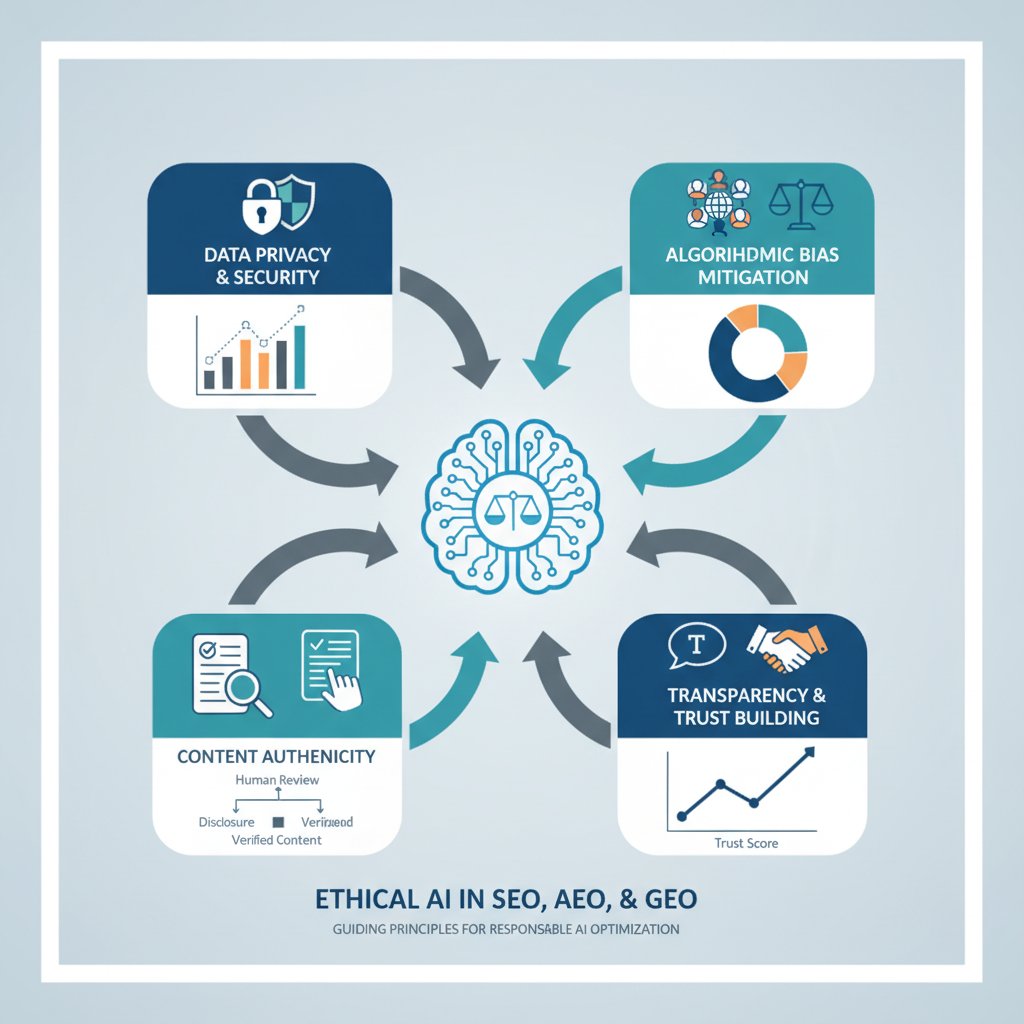
Search engines are already adapting to this reality. Google, for example, has indicated that its primary focus remains on the quality and helpfulness of content, regardless of its generation method, but it also emphasizes the importance of E-E-A-T (Experience, Expertise, Authoritativeness, Trustworthiness). For AI-generated content, demonstrating E-E-A-T often requires human oversight, fact-checking, and clear attribution.
Best Practices for Responsible AI Content Creation
To navigate this authenticity dilemma, organizations should adopt several best practices:
- Transparency: Clearly disclose when AI has been used to generate or significantly assist in content creation. This can be through disclaimers, author tags, or meta-data.
- Human Oversight: AI should serve as a co-pilot, not a replacement. Human editors must review, refine, and fact-check all AI-generated content to ensure accuracy, tone, and ethical alignment.
- Originality and Value: Focus on using AI to augment human creativity and produce genuinely valuable, original content, rather than simply churning out generic text.
- Attribution: Ensure that any sources or data used by AI in content generation are properly attributed, just as they would be in human-authored work.
- Brand Voice and Ethics: Train AI models on your brand’s specific style guide and ethical principles to ensure consistency and prevent the generation of off-brand or harmful content.
The long-term value of your digital presence hinges on the trust you build with your audience. Compromising authenticity for short-term gains from AI-generated content is a precarious strategy that ultimately undermines that trust.
Building Trust and Transparency in an AI-First Search World
Building trust and transparency is the cornerstone of ethical AI SEO, AEO, and GEO, demanding a proactive commitment to open communication about AI usage and a steadfast dedication to user well-being. Organizations that prioritize these principles will cultivate stronger audience relationships and achieve more sustainable digital success.
In an environment where AI systems are increasingly mediating information, users naturally become more skeptical. They want to know if the content they are consuming is reliable, if it’s been manipulated, and if their data is being handled responsibly. Transparency isn’t just a buzzword; it’s a strategic imperative. A 2024 survey by Accenture revealed that 81% of consumers are more likely to buy from companies that are transparent about their AI usage.
Strategies for Fostering Trust
Fostering trust involves several key actions:
- Clear Disclosure: Be upfront about where and how AI is used in your content creation and optimization processes. This could be a simple note at the bottom of an article or a dedicated ‘AI Policy’ page.
- Explainability: Where possible, provide insights into how your AI systems make decisions, particularly if those decisions impact users directly (e.g., personalized recommendations).
- User Control: Offer users control over their data and preferences, allowing them to opt-out of certain AI-driven experiences or data collection.
- Accountability: Establish clear lines of responsibility for AI outputs. If an AI system makes an error or generates harmful content, there must be a human accountable for addressing it.
- Ethical Guidelines: Develop and publicly share your organization’s ethical guidelines for AI development and deployment. This signals a commitment to responsible innovation.
The table below outlines a comparison between ethical and unethical approaches to AI SEO, AEO, and GEO, highlighting the stark differences in their long-term impact.
| Aspect | Ethical Approach | Unethical Approach |
|---|---|---|
| Data Usage | Explicit consent, anonymization, robust security, compliance with GDPR/CCPA. | Covert data collection, unauthorized sharing, weak security, non-compliance. |
| Content Creation | AI as assistant, human oversight, fact-checking, transparency, originality. | Mass-generated, unverified content, plagiarism, no disclosure, low quality. |
| Algorithmic Bias | Proactive detection, debiasing, diverse data, fairness metrics, regular audits. | Ignoring bias, perpetuating stereotypes, discriminatory outputs. |
| Transparency | Clear disclosure of AI use, explainability, public ethical guidelines. | Concealing AI use, opaque processes, misleading users. |
| User Trust | Long-term relationship building, credibility, brand reputation. | Short-term gains, user skepticism, brand damage, penalties. |
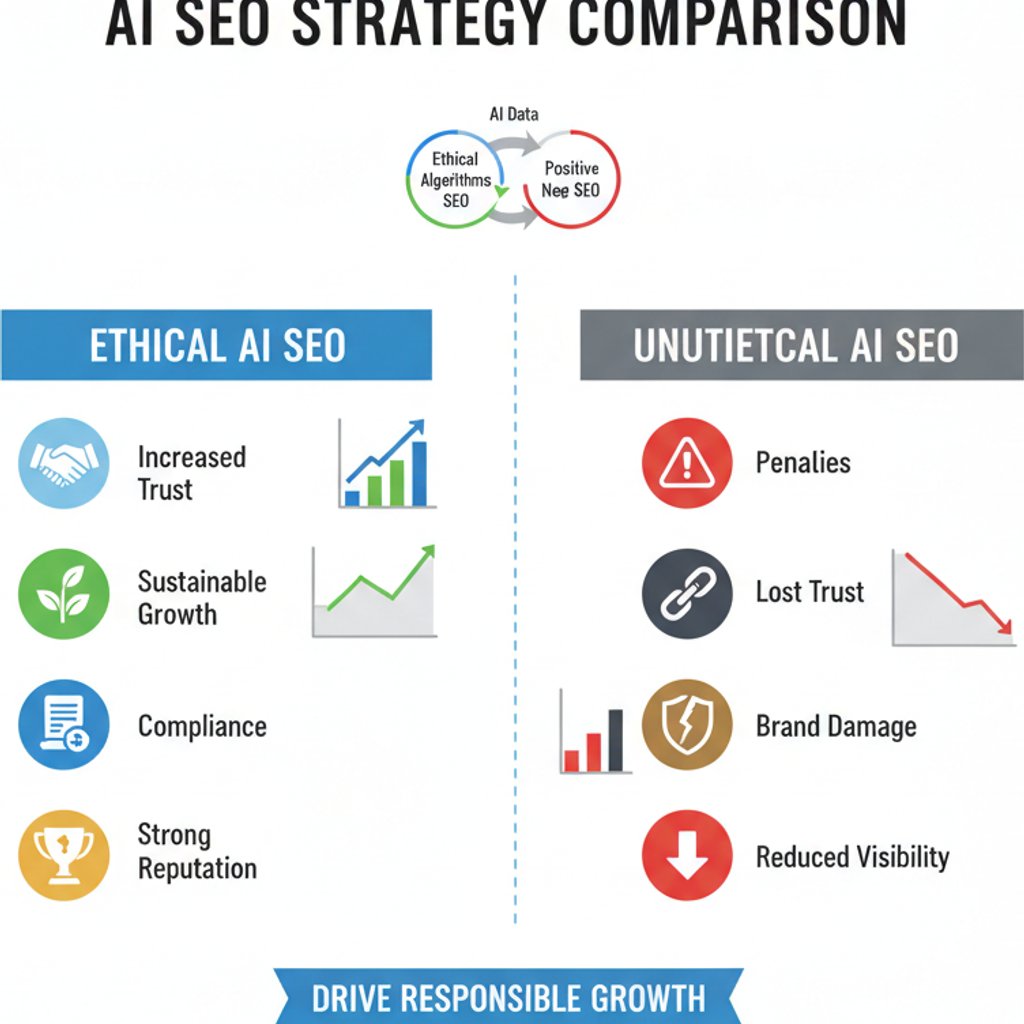
Ultimately, the goal is to use AI to enhance the user experience and deliver valuable information, not to manipulate or deceive. Datanex believes that the future of search belongs to those who earn and maintain trust through responsible AI adoption.
Frequently Asked Questions
What are the primary ethical concerns with AI SEO?
The primary ethical concerns with AI SEO include data privacy violations, algorithmic bias leading to unfair search results, the propagation of misinformation through AI-generated content, and a lack of transparency regarding AI’s role in content creation and optimization. Addressing these requires a commitment to responsible data handling and content integrity.
How can I ensure my AI SEO practices are compliant with data privacy laws?
To ensure compliance, you must obtain explicit user consent for data collection, anonymize data whenever possible, implement strong data security measures, and regularly audit your AI systems against regulations like GDPR and CCPA. Proactive legal counsel and adherence to emerging AI-specific privacy guidelines are also crucial.
Is it ethical to use AI to generate content for my website?
Yes, it can be ethical to use AI to generate content, provided it’s done responsibly. This means using AI as a tool to assist human creators, ensuring human oversight for fact-checking and editing, maintaining transparency by disclosing AI involvement, and prioritizing the creation of original, valuable, and accurate content.
What is algorithmic bias, and why should I care about it in AI SEO?
Algorithmic bias occurs when AI systems produce unfair or discriminatory outcomes due to biased training data or flawed algorithms. In AI SEO, this can lead to certain demographics or perspectives being underrepresented or misrepresented in search results. Caring about it ensures equitable information access and prevents damage to your brand’s reputation.
How can transparency build trust in an AI-driven search environment?
Transparency builds trust by openly communicating how AI is used in your content and optimization strategies. Disclosing AI involvement, explaining AI decisions where relevant, and publishing ethical AI guidelines helps users understand and feel more confident in the information they receive, fostering a stronger, more credible relationship with your brand.
What are the long-term risks of unethical AI SEO practices?
Unethical AI SEO practices carry significant long-term risks, including severe penalties from regulatory bodies, loss of user trust, irreparable damage to brand reputation, decreased organic visibility as search engines penalize manipulative tactics, and a potential decline in customer loyalty and revenue. Ethical conduct is essential for sustainable growth.
Should I disclose when my content is AI-generated?
Yes, disclosing when your content is AI-generated is a best practice for ethical AI SEO and AEO. Transparency builds trust with your audience and search engines. While Google focuses on content quality regardless of generation method, explicit disclosure demonstrates integrity and helps manage user expectations, contributing to stronger E-E-A-T signals.
Last updated: June 15, 2026