
By Datanex
Updated July 24, 2026
Look, the rise of artificial intelligence in search optimization isn’t just a technical shift; it’s a profound ethical challenge. We’re not just talking about algorithms and rankings anymore. We’re talking about how AI shapes what people see, what they believe, and ultimately, how they interact with the digital world. For anyone serious about long-term digital visibility, ignoring the ethical implications of AI in SEO, AEO, and GEO isn’t just irresponsible – it’s a recipe for disaster.
The honest truth is that the tools we build and deploy reflect our values. And when those tools are powered by AI, their impact scales dramatically. This guide isn’t about fear-mongering; it’s about equipping you with an ethical compass to navigate this complex terrain. Because, from what I’ve seen over my years covering this sector, sustainable success in search doesn’t come from gaming the system, but from building genuine trust.
Key Takeaways
- Algorithmic Bias is Inherent: AI models learn from historical data, which often contains human biases. Recognizing and actively mitigating these biases is crucial for fair and accurate search results.
- Transparency Builds Trust: While full algorithmic transparency might be a pipe dream, striving for explainability in AI-driven decisions and clearly communicating AI’s role to users fosters trust and accountability.
- Content Authenticity is Paramount: The proliferation of AI-generated content demands robust strategies for verifying information, combating misinformation, and ensuring human oversight to maintain credibility.
- Data Privacy is Non-Negotiable: Ethical AI SEO, AEO, and GEO practices require strict adherence to data protection regulations and a commitment to user privacy, treating personal data with the utmost respect.
- Societal Impact Matters: Beyond individual rankings, consider the broader implications of AI-driven search on information access, economic equity, and democratic discourse. Responsible implementation means thinking beyond immediate gains.
- Human Oversight is Essential: AI is a powerful tool, but it’s not infallible. Human intelligence, ethical judgment, and continuous monitoring are indispensable for guiding AI and correcting its course.
What Exactly Are We Talking About: Defining AI SEO, AEO, and GEO
Before we dive into the deep end of ethics, let’s make sure we’re all on the same page about what these acronyms actually mean in an AI-driven world. AI SEO, AEO, and GEO represent the evolution of how we optimize digital content for various search environments, but with a significant infusion of artificial intelligence.
AI SEO, in its simplest form, refers to the application of artificial intelligence and machine learning technologies to enhance traditional search engine optimization strategies. This isn’t just about using AI to write content, though that’s a part of it. It encompasses everything from AI-powered keyword research and competitor analysis to predictive analytics for ranking changes and automated content optimization. It’s about leveraging AI to understand user intent with greater nuance, predict search engine algorithm shifts, and personalize content delivery at scale.
AEO, or Answer Engine Optimization, is a more specific subset, focusing on optimizing content for direct answers provided by search engines, voice assistants, and increasingly, large language models (LLMs). Think featured snippets, knowledge panels, and the concise responses you get from Siri, Alexa, or generative AI search experiences. AEO demands content that is not only authoritative but also structured and phrased in a way that AI can easily extract and present as a definitive answer. It’s about being the source that the AI trusts enough to quote directly, and that means a high bar for accuracy and clarity.
Then there’s GEO, or Generative Engine Optimization. This is the newest kid on the block, directly addressing the rise of generative AI in search. When search engines integrate LLMs to synthesize information and provide conversational answers, GEO becomes critical. It’s about optimizing content so that generative AI models not only find it but also accurately interpret, summarize, and cite it within their generated responses. This requires a deep understanding of how these models process information, identify authority, and attribute sources. It’s about making your content ‘AI-digestible’ and ‘AI-creditable’.
The common thread? AI is no longer just a background process; it’s becoming the primary interface and interpreter between users and information. And that, my friends, is where our ethical compass becomes indispensable.
The Shadow in the Machine: Understanding Algorithmic Bias in Search
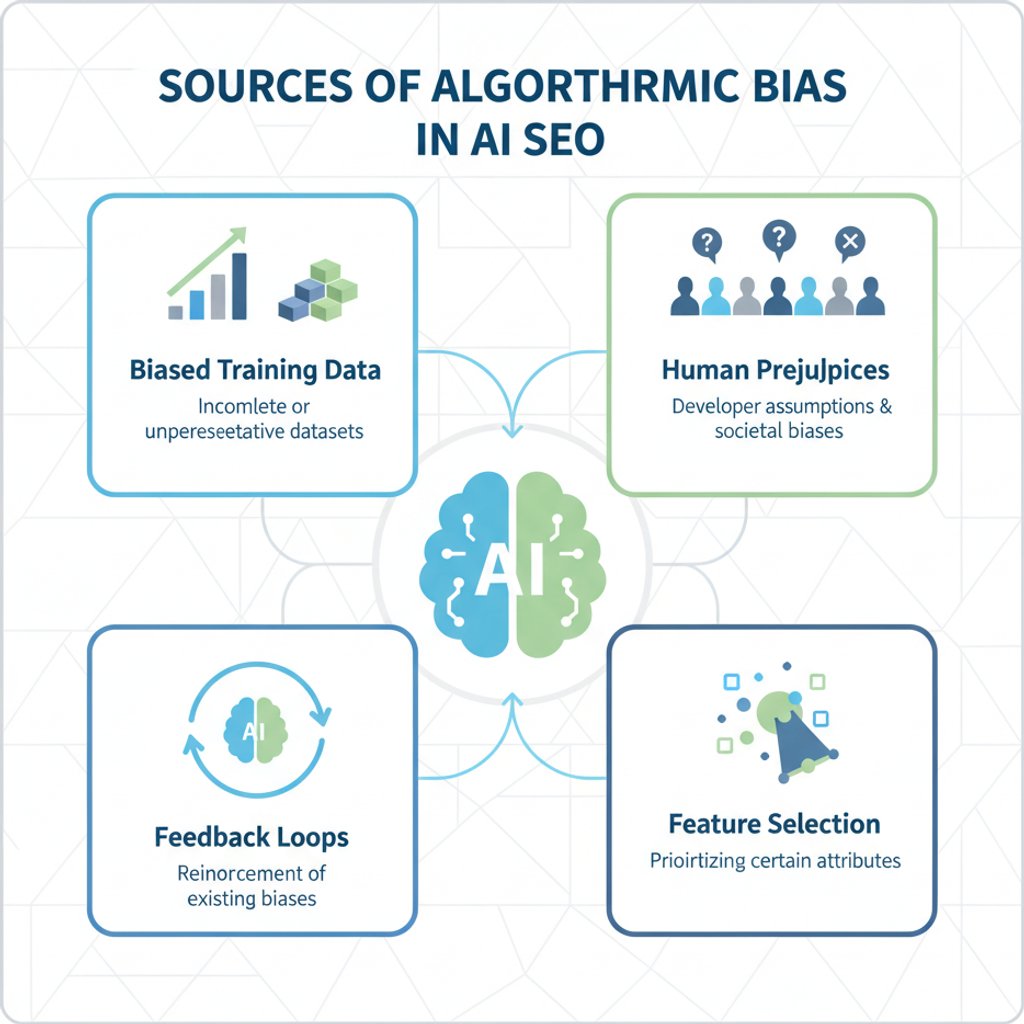
Algorithmic bias is not some abstract, theoretical problem; it’s a very real and pervasive issue that can significantly skew search results and perpetuate harmful stereotypes. Simply put, AI models learn from the data they’re fed, and if that data reflects existing societal biases—historical inequalities, underrepresentation, or prejudiced language—the AI will learn and amplify those biases.
I’ve seen firsthand how this can play out. Imagine an AI trained predominantly on data reflecting a specific demographic. When asked to generate images of ‘CEOs’ or ‘doctors,’ it might overwhelmingly produce images of men, or individuals of a particular ethnicity, simply because that’s what was most prevalent in its training data. This isn’t malicious intent from the AI; it’s a reflection of the data’s shortcomings. In search, this translates to certain voices being amplified while others are suppressed, not based on merit or relevance, but on historical patterns of representation.
What strikes me about this is the insidious nature of it. Users often perceive search results as objective truths. When an algorithm consistently prioritizes certain types of content or perspectives, it subtly shapes public opinion and reinforces existing power structures. This isn’t just about ‘bad SEO’; it’s about the potential for AI to inadvertently contribute to misinformation, reinforce stereotypes, and limit intellectual diversity. A study by the National Institute of Standards and Technology (NIST) in 2019 highlighted how facial recognition algorithms, a form of AI, exhibited demographic biases, performing significantly worse on women and people of color. While not directly SEO, it underscores the systemic nature of AI bias.
Mitigating Bias: A Proactive Approach
So, what do we do about it? The answer isn’t simple, but it starts with proactive measures. First, data diversity is key. We need to advocate for, and actively seek out, training datasets that are representative and balanced. This means scrutinizing the sources of information that feed our AI models and identifying gaps or overrepresentations. It’s a continuous process, not a one-time fix.
Second, we need to implement bias detection and mitigation techniques. This involves developing metrics to identify unfair outcomes in AI models and then employing strategies like re-weighting training data, adjusting algorithms, or using adversarial training to reduce bias. It’s a technical challenge, no doubt, but an essential one. Finally, and perhaps most critically, human oversight is non-negotiable. AI should augment, not replace, human judgment. Regular audits of AI-driven search results, feedback loops from diverse user groups, and the ability to manually intervene are crucial safeguards.
The Trust Equation: Transparency and Authenticity in an AI-Driven World
In an era where AI can generate text, images, and even video with startling realism, the concepts of transparency and authenticity have become the bedrock of trust. For Datanex, a company committed to responsible digital practices, this means clearly distinguishing between human-created and AI-assisted content, and being upfront about the role AI plays in our processes.
The rise of generative AI has made content authenticity a minefield. It’s easier than ever to flood the internet with plausible-sounding but factually incorrect or misleading information. This isn’t just a challenge for readers; it’s a monumental challenge for search engines trying to discern credible sources. As practitioners of AI SEO, AEO, and GEO, we have a responsibility to contribute to a trustworthy information ecosystem, not detract from it.
One of the biggest hurdles is the ‘black box’ nature of many advanced AI models. We can see the inputs and the outputs, but the internal decision-making process remains opaque. While complete transparency might be unrealistic for proprietary algorithms, striving for explainability is paramount. This means understanding why an AI model made a particular recommendation or generated a specific piece of content. Tools and techniques for XAI (Explainable AI) are evolving rapidly, offering insights into model behavior that can help us identify and correct issues.
Content Authenticity: Your Digital Fingerprint
When it comes to content, authenticity is your digital fingerprint. With AI content generation becoming commonplace, the value of genuinely human-authored, expert-driven content is skyrocketing. Here’s how to maintain it:
- Human Oversight: Every piece of AI-generated content should pass through a human editor for fact-checking, tone, and ethical review. AI is a tool, not a ghostwriter.
- Original Research & Insight: Focus on providing unique perspectives, original data, and deep insights that AI models cannot easily replicate. This is where human creativity and expertise truly shine.
- Attribution & Sourcing: Be meticulous about citing sources, especially for factual claims. This not only builds credibility but also helps search engines and generative AI models understand the provenance of your information.
- AI Disclosure: Where appropriate, consider disclosing the use of AI in content creation. This could be a subtle note or a more prominent disclaimer, depending on the context. Google has indicated that AI-generated content is acceptable as long as it is helpful, high-quality, and original, but transparency can still build user trust.
Ultimately, transparency and authenticity are about building and maintaining trust. Trust with your audience, trust with search engines, and trust in the integrity of the digital information landscape. Without it, even the most technically optimized content will fall flat.
The Privacy Imperative: Safeguarding User Data in AI-Driven Search
Data is the lifeblood of AI, but with great data comes great responsibility. In the world of AI SEO, AEO, and GEO, we often deal with vast amounts of user data—search queries, browsing behavior, location data, and more. The ethical imperative here is clear: user privacy is non-negotiable. Ignoring it isn’t just a legal risk; it’s a fundamental breach of trust that can erode your brand’s reputation faster than any algorithm change.
Regulations like GDPR and CCPA have set a high bar for data protection, and these principles apply directly to how we use AI in search optimization. AI models, particularly those focused on personalization, thrive on collecting and analyzing user data. The challenge is to harness the power of this data for better search experiences without infringing on individual privacy rights.
From my perspective, the key is a ‘privacy-by-design’ approach. This means integrating privacy considerations into every stage of AI development and deployment, rather than treating it as an afterthought. It involves anonymizing data wherever possible, obtaining explicit consent for data collection, and ensuring robust security measures to prevent breaches. The European Union Agency for Cybersecurity (ENISA) reported in 2023 that data protection and privacy concerns remain a top challenge for AI adoption.
Ethical Data Practices for AI SEO
So, how do we operationalize this? Here are some critical considerations:
- Data Minimization: Collect only the data you absolutely need for your AI models. More data isn’t always better, especially if it increases privacy risks.
- Anonymization & Pseudonymization: Wherever feasible, remove personally identifiable information (PII) from your datasets. This reduces the risk of individual re-identification.
- Consent Management: Be transparent with users about what data you’re collecting, why you’re collecting it, and how it will be used. Provide clear mechanisms for users to give, withdraw, or manage their consent.
- Security & Access Control: Implement strong cybersecurity measures to protect your data. Limit access to sensitive data to only those who absolutely need it.
- Regular Audits: Periodically review your data collection and processing practices to ensure ongoing compliance with privacy regulations and ethical standards.
The goal isn’t to avoid using data; it’s to use data responsibly and ethically. When users feel confident that their privacy is respected, they are more likely to engage with your content and your brand. It’s a long-term investment in trust.
The Bigger Picture: Societal Impact and Responsible AI Implementation
This is where things get really interesting, and frankly, a bit daunting. The ethical compass of AI SEO, AEO, and GEO extends beyond individual websites or ranking factors. It touches on the broader societal implications of how information is discovered, consumed, and shaped by AI. We’re talking about issues like information monopolies, digital divides, and the very fabric of democratic discourse.
When AI-driven search prioritizes certain types of content or sources, it can inadvertently create information bubbles or echo chambers. Users are exposed primarily to information that confirms their existing beliefs, making it harder to encounter diverse perspectives. This isn’t just bad for intellectual curiosity; it can have serious real-world consequences for social cohesion and critical thinking. The Pew Research Center, in a 2021 study, found that a significant portion of Americans believe social media algorithms contribute to political polarization. While not directly search, the underlying mechanism of algorithmic content curation is similar.
Furthermore, the economic impact cannot be ignored. If AI-driven search disproportionately favors large, established entities, it could make it even harder for small businesses, independent creators, or marginalized voices to gain visibility. This isn’t just about ‘fairness’; it’s about economic equity and ensuring a diverse, vibrant digital economy. Datanex believes in fostering an inclusive digital landscape, and that means considering these broader impacts.
Building a Framework for Responsible AI in Search
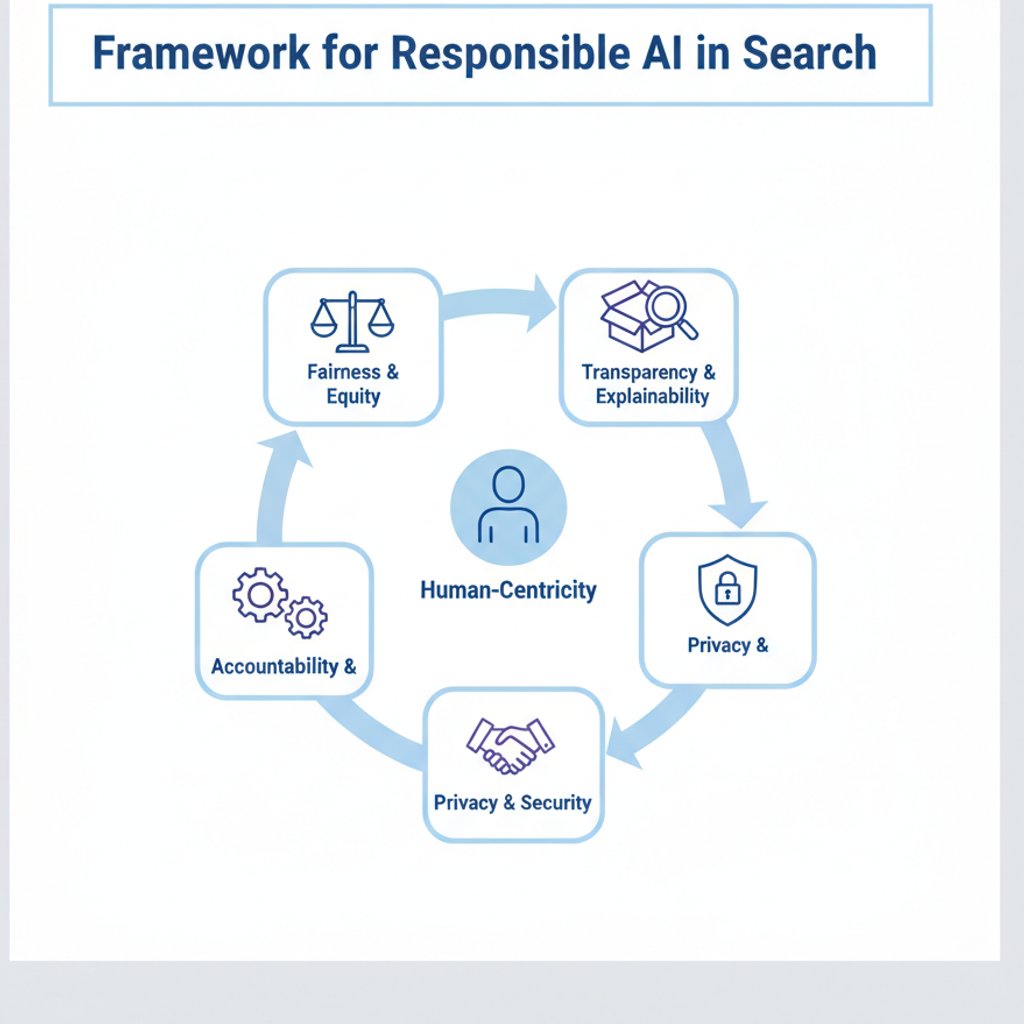
So, how do we implement AI in search optimization responsibly, considering these weighty implications? It requires a multi-faceted approach:
| Ethical Principle | Description | Actionable Strategy for AI SEO/AEO/GEO |
|---|---|---|
| Fairness & Equity | Ensure AI systems do not perpetuate or amplify existing biases, providing equitable access to information and visibility for diverse voices. | Actively audit AI models for bias; diversify training data; prioritize content from underrepresented groups where relevant; ensure accessibility. |
| Transparency & Explainability | Strive to make AI decisions understandable and accountable, allowing users and practitioners to comprehend how results are generated. | Document AI model logic; use explainable AI (XAI) tools; clearly disclose AI usage in content creation; provide clear content sourcing. |
| Privacy & Security | Protect user data with the highest standards, respecting consent and ensuring robust security against breaches. | Implement data minimization; anonymize data; obtain explicit consent; conduct regular security audits; comply with GDPR/CCPA. |
| Accountability & Governance | Establish clear lines of responsibility for AI system performance, errors, and ethical outcomes. | Define roles for AI oversight; implement human-in-the-loop processes; establish ethical review boards; maintain audit trails. |
| Human-Centricity | Design AI systems to augment human capabilities and well-being, prioritizing user needs and societal benefit over purely algorithmic efficiency. | Focus on creating genuinely helpful and high-quality content; prioritize user experience; gather diverse user feedback; avoid manipulative tactics. |
This isn’t about throwing out AI; it’s about guiding it. It’s about recognizing that as practitioners, we have a role to play in shaping the future of information access. The real story here isn’t just about ranking higher — it’s about building a more trustworthy, equitable, and sustainable digital ecosystem for everyone.
The Human Element: Why Oversight Remains Paramount
Look, for all the incredible advancements in AI, there’s one thing it can’t replicate: human judgment, empathy, and ethical reasoning. That’s why, in my experience covering this field, the human element in AI SEO, AEO, and GEO isn’t just important; it’s absolutely paramount. AI is a tool, a powerful one, but a tool nonetheless. It needs skilled hands and a moral compass to wield it effectively and responsibly.
The common mistake I see is the tendency to cede too much control to algorithms. We become so enamored with the efficiency and scale that AI offers that we sometimes forget to ask the critical questions: Is this truly helpful? Is it fair? Is it accurate? Does it align with our values? An AI can optimize for a metric, but it can’t understand the nuanced impact of its actions on a human being or on society at large. That’s our job.
Human oversight means more than just a quick glance. It means actively monitoring AI performance, not just for technical errors, but for unintended ethical consequences. It means having the courage to question algorithmic recommendations and, when necessary, to override them. It means fostering a culture where ethical considerations are discussed openly and integrated into the development lifecycle of every AI-powered tool we use or create.
Practical Steps for Maintaining Human Oversight
- Establish Clear Ethical Guidelines: Before deploying any AI tool, define your ethical boundaries and principles. What kind of content is acceptable? What data practices are off-limits?
- Implement Human-in-the-Loop Systems: Design workflows where human experts review and validate AI-generated outputs, especially for critical decisions or public-facing content.
- Regular Audits and Reviews: Continuously assess the performance and ethical implications of your AI systems. This includes checking for bias, accuracy, and compliance with privacy regulations.
- Feedback Mechanisms: Create channels for users and internal teams to report issues, biases, or inaccuracies stemming from AI-driven search results or content.
- Continuous Learning & Training: Stay informed about the latest developments in AI ethics and provide ongoing training for your teams on responsible AI practices.
Ultimately, the most effective AI SEO, AEO, and GEO strategies will be those that seamlessly integrate AI’s power with human intelligence and ethical wisdom. It’s about collaboration, not replacement. It’s about ensuring that technology serves humanity, not the other way around.
Frequently Asked Questions About Ethical AI in Search
Can AI truly be unbiased in SEO?
No, AI cannot be truly unbiased on its own because it learns from historical data, which often contains human and societal biases. The goal isn’t perfect neutrality, but active, continuous mitigation of these biases through diverse data, careful model design, and robust human oversight. It’s an ongoing effort to reduce unfair outcomes, not eliminate bias entirely.
How can I ensure my AI-generated content is authentic and trustworthy?
To ensure authenticity, always apply human oversight to AI-generated content. This means thorough fact-checking, editing for tone and accuracy, and adding unique human insights that AI cannot replicate. Consider disclosing AI assistance where appropriate, and always prioritize original research and meticulous sourcing to build credibility.
What are the biggest privacy risks when using AI for SEO?
The biggest privacy risks involve the collection and processing of vast amounts of user data without proper consent, anonymization, or security. AI models, especially for personalization, can inadvertently expose sensitive information if not handled with strict adherence to data protection regulations like GDPR and CCPA. Data breaches and misuse are significant concerns.
Is it ethical to use AI to manipulate search rankings?
Manipulating search rankings through deceptive AI practices is generally unethical and against search engine guidelines. While AI can optimize content and strategy, using it for black-hat tactics like generating spam or cloaking will ultimately lead to penalties and erode trust. Ethical AI SEO focuses on enhancing genuine value and relevance for users, not tricking algorithms.
How does AI in search impact smaller businesses or independent creators?
AI in search can potentially create challenges for smaller entities if algorithms disproportionately favor large brands or established content. However, it also offers opportunities by providing sophisticated tools previously only available to large enterprises. The ethical challenge is to ensure AI systems don’t exacerbate digital divides, and that diverse, high-quality content from all sources can achieve visibility.
What is the role of human oversight in AI SEO, AEO, and GEO?
Human oversight is critical. AI lacks ethical judgment, empathy, and the ability to understand nuanced societal impact. Humans must set ethical guidelines, review AI-generated outputs, monitor for unintended biases or consequences, and be prepared to intervene or correct AI systems. It ensures that AI serves human values and goals, rather than operating autonomously without moral guidance.
Will search engines penalize AI-generated content?
Major search engines like Google have stated they don’t inherently penalize AI-generated content, provided it is high-quality, helpful, original, and meets their content guidelines. The focus is on the quality and intent behind the content, not solely on how it was produced. However, low-quality, spammy, or misleading AI content will likely be penalized, just like any other low-quality content.
The journey into AI-driven search is just beginning, and it’s full of potential. But like any powerful technology, it demands a strong ethical foundation. By prioritizing fairness, transparency, privacy, and human oversight, we can ensure that AI SEO, AEO, and GEO not only deliver results but also contribute to a more trustworthy and equitable digital future. That, to me, is the ultimate measure of success.
Last updated: July 24, 2026