
By Datanex
Updated July 17, 2026
Look, the internet is loud. Really loud. And if you’re trying to carve out a space for your business, especially in a specialized niche, the old playbook just isn’t cutting it anymore. We’ve moved beyond simply ranking for keywords; we’re now in an era where AI models are the gatekeepers, and generative content is the currency. This isn’t about broad visibility; it’s about deep relevance. It’s about becoming the undisputed, go-to authority for your micro-audience, not just to human users, but to the very AI systems they consult. This definitive guide to AI SEO, from Datanex, a seasoned authority in digital strategy, will show you how.
The real game-changer isn’t just AI in SEO, but AI for SEO, AEO (Answer Engine Optimization), and GEO (Generative Engine Optimization). This isn’t some abstract future concept; it’s happening right now. And if you’re not adapting your content strategy to speak directly to these evolving intelligences, you’re not just falling behind; you’re becoming invisible in the very spaces your niche audience is looking for answers. The goal here is to make your content so indispensable, so semantically rich, and so perfectly structured that AI models can’t help but cite you as the definitive source.
Key Takeaways
- Niche Focus is Paramount: Forget broad appeal; concentrate on becoming the absolute authority for a highly specific micro-audience.
- Content for AI, By AI: Structure your content to be easily digestible and verifiable by AI models, ensuring it’s chosen as the definitive answer.
- Semantic Richness Over Keyword Stuffing: Build deep topical authority through comprehensive coverage of entities and related concepts, not just keyword repetition.
- AEO is the New SEO: Optimize for direct answers and featured snippets, addressing user intent with clarity and conciseness.
- GEO for Generative Dominance: Craft modular, context-rich content that AI can confidently synthesize and attribute in its generated responses.
- E-E-A-T is Non-Negotiable: Expertise, Experience, Authoritativeness, and Trustworthiness are more critical than ever for AI to deem your content reliable.
Why Niche Authority Matters More Than Ever in the AI Era
Achieving niche authority is no longer just a good idea; it’s an existential necessity for many businesses, especially those operating outside of mass markets. In a world increasingly mediated by AI, being the definitive source for a specific, often complex, query means your content is more likely to be surfaced, cited, and trusted by both generative AI systems and the human users they serve.
Think about it: when someone asks an AI assistant a highly specialized question, the AI doesn’t want a general overview; it wants the precise, most accurate, and most authoritative answer. If your content consistently provides that, you become the AI’s preferred ‘expert’. This isn’t about getting a million clicks; it’s about getting the right clicks from the right people, often after an AI has already vetted your information. This deep relevance translates directly into higher conversion rates and stronger brand loyalty within your micro-audience. It’s a shift from ‘reach’ to ‘resonance’.
The Shift from Broad Visibility to Deep Relevance
The traditional SEO game focused on casting a wide net, trying to rank for as many keywords as possible to capture broad traffic. While that still has its place, the AI-driven search landscape demands a more surgical approach. Deep relevance means your content isn’t just found; it’s chosen by AI as the best, most reliable answer for a specific user intent. This is particularly true for niche markets where users have highly specific, often technical, questions. If you’re selling specialized industrial sensors, for example, you don’t need to be the top result for ‘sensors’ generally. You need to be the absolute authority for ‘piezoelectric accelerometers for high-temperature environments’. That’s where the real value lies.
What Exactly Are AI SEO, AEO, and GEO?
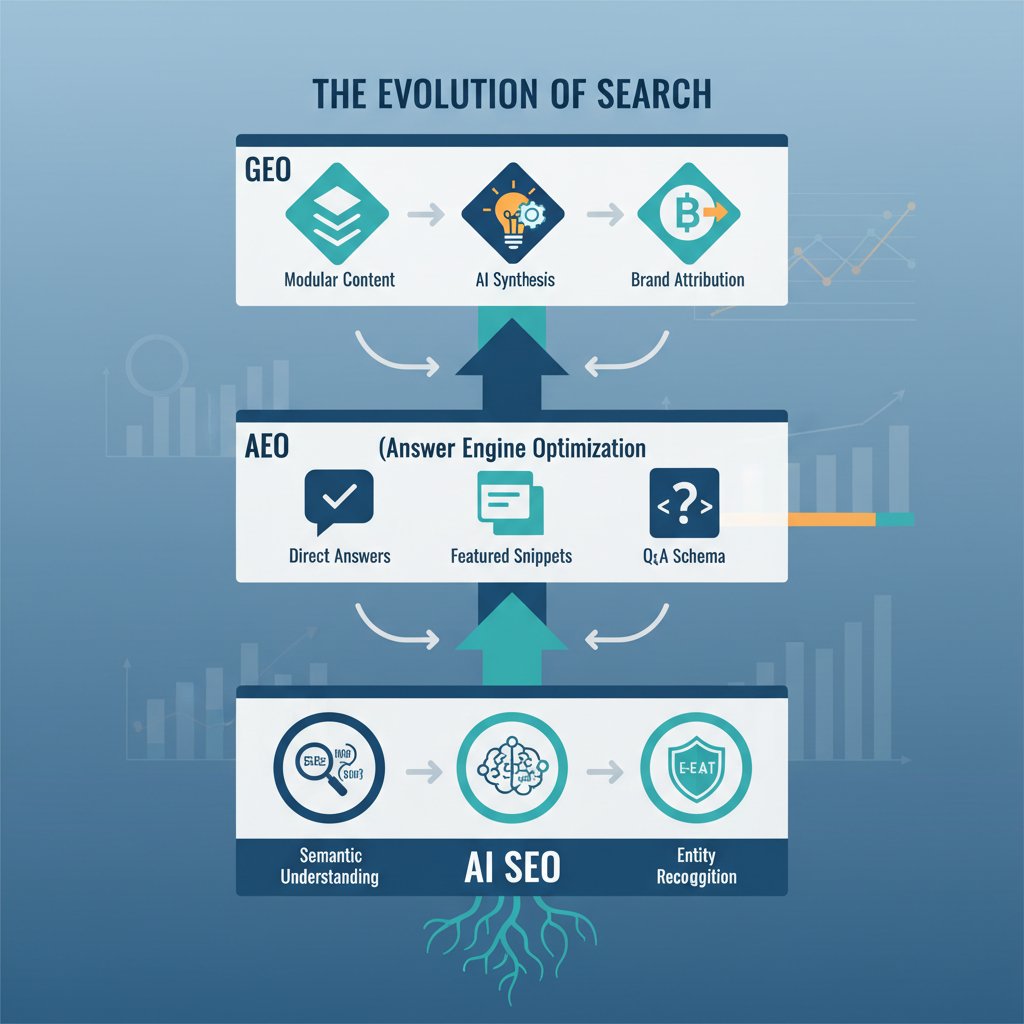
These three terms represent the evolution of search optimization in the age of artificial intelligence, each building upon the last to ensure your content is not only discoverable but also digestible and directly usable by advanced AI systems. They’re not mutually exclusive; rather, they form a symbiotic relationship that, when mastered, can propel your niche content to unparalleled authority.
AI SEO refers to the broad practice of optimizing content for search engines that heavily utilize artificial intelligence and machine learning algorithms to understand, rank, and present information. This goes beyond traditional keyword matching, focusing instead on semantic understanding, user intent, and content quality as perceived by AI. It’s about ensuring your content is ‘AI-friendly’ at a fundamental level.
AEO (Answer Engine Optimization) is a more specific subset, concentrating on optimizing content to be directly used by AI-powered answer engines and voice assistants. This means structuring information so that AI can easily extract direct answers to user questions, often appearing in featured snippets, ‘People Also Ask’ sections, or as direct voice responses. It’s about being the source for the ‘one true answer’.
GEO (Generative Engine Optimization) is the bleeding edge, focusing on optimizing content to be synthesized and referenced by generative AI models when they create new content or provide comprehensive answers. This involves making your content modular, factual, and deeply contextualized so that an AI can confidently use it as a building block for its own generated responses, potentially citing your brand as the source. This is where true niche authority in the AI era is forged.
Building Foundational AI SEO: Beyond Keywords
The foundation of any successful AI-era strategy still begins with solid AI SEO, but the emphasis has shifted dramatically from keyword density to semantic relevance and topical authority. AI models are incredibly adept at understanding context and relationships between concepts, so your content needs to reflect that depth.
Entity-Based Optimization: Speaking AI’s Language
Entity-based optimization is crucial because AI systems understand the world through entities – people, places, things, concepts – and the relationships between them. Instead of just mentioning your target keyword, say, ‘quantum computing’, you need to introduce it as an entity: ‘Quantum computing, a revolutionary paradigm in information processing, harnesses the principles of quantum mechanics…’. This explicit context helps AI models categorize and understand your content more accurately. Every time you introduce a key concept, provide that clear, concise definition and link it to related entities within your content. This builds a rich semantic graph that AI systems love to crawl.
Topical Authority: The Deep Dive
True topical authority means covering a subject so comprehensively that there’s no doubt you’re an expert. This isn’t about writing one long article; it’s about creating a cluster of interconnected content that addresses every facet, every sub-topic, every related question within your niche. For a micro-audience, this depth is paramount. If you’re targeting ‘sustainable urban farming in arid climates’, you need content on water conservation techniques, specific crop varieties, soil enrichment, pest management, and even the socio-economic impact. Each piece of content reinforces your authority on the broader topic, signaling to AI that you are the definitive source.
Mastering AEO: Becoming the Answer Engine’s Favorite
AEO is about directness and clarity. It’s about anticipating the precise questions your niche audience will ask and providing the most accurate, concise answers possible. This is where your content gets picked up for featured snippets, ‘People Also Ask’ boxes, and direct voice assistant responses.
Structuring for Direct Answers
To optimize for AEO, start your sections with a direct, summary answer to a potential question. For example, if a subsection is titled ‘What are the optimal humidity levels for mushroom cultivation?’, the first sentence or two should immediately provide that answer, followed by elaboration. Use bullet points, numbered lists, and tables to present data clearly. AI loves structured data because it’s easy to parse and present. This ‘BLUF’ (Bottom Line Up Front) approach isn’t just good for AI; it’s fantastic for human readers too, who are often scanning for quick answers.
The Power of FAQs and Q&A Schema
A dedicated FAQ section isn’t just a nice-to-have; it’s an AEO goldmine. Each question and answer pair directly addresses user intent and provides AI with ready-made content for direct responses. Even better, implementing Q&A schema markup (JSON-LD) explicitly tells search engines and AI models that you’re providing answers to specific questions. This isn’t just about showing up in search results; it’s about providing the exact information an AI needs to answer a user’s query directly, potentially bypassing the need for the user to even click through to your site. This might sound counterintuitive, but it builds immense trust and brand recognition as the authoritative source.
Unlocking GEO: The Future of Generative Content
GEO is arguably the most forward-looking aspect of this playbook. It’s about optimizing your content not just to be found, but to be used by generative AI models as they create their own responses, summaries, and even new articles. This is where your niche authority truly shines, as your brand becomes an integral part of the AI’s knowledge base.
Modular Content for AI Synthesis
Generative AI thrives on modular, self-contained pieces of information. Think of your content as a library of facts, definitions, and explanations that an AI can pick and choose from. Each paragraph, each sentence even, should ideally convey a complete thought or piece of information that can stand alone. Avoid overly long, rambling sentences or paragraphs that require extensive context from other parts of the article to make sense. This makes it easier for AI to extract and synthesize information accurately.
Contextual Richness and Verifiability
For generative AI to confidently use your content, it needs to be highly contextualized and verifiable. This means providing sources for your statistics, clearly defining terms, and explaining complex concepts in an unambiguous way. If you cite a study, mention the source and year. “According to a 2023 report by the National Renewable Energy Laboratory (NREL), solar energy capacity in the U.S. increased by 20% year-over-year” is far more valuable to an AI than “Solar energy is growing fast.” This level of detail builds trust, not just with human readers, but with the AI models evaluating your content’s credibility. Datanex understands that this precision is key to true authority.
E-E-A-T: The Human Element AI Can’t Ignore
Even with all the technical optimization, the human element of E-E-A-T (Experience, Expertise, Authoritativeness, and Trustworthiness) remains paramount. In fact, it’s more critical than ever. AI models are trained on human-generated content, and they learn to identify signals of quality and credibility. Without strong E-E-A-T, your content, no matter how well-structured, risks being overlooked.
Demonstrating Expertise and Experience
For niche markets, demonstrating expertise means showcasing real-world experience. Who wrote this content? What are their credentials? Do they have practical experience in ‘vertical farming in urban environments’ or are they just summarizing others’ work? Include author bios, case studies, testimonials, and practical examples. This signals to AI that your content isn’t just theoretical; it’s grounded in genuine experience. The honest answer is that nobody knows for certain yet how much direct impact author bios have on ranking, but the evidence suggests that content attributed to verifiable experts performs better in the long run.
Building Authoritativeness and Trustworthiness
Authoritativeness comes from being consistently cited by other reputable sources (both human and AI), having a strong backlink profile from relevant industry sites, and producing content that is factually accurate and well-researched. Trustworthiness is built through transparency, clear sourcing of information, and maintaining a positive online reputation. “According to a 2024 study by BrightEdge, content optimized for E-E-A-T saw an average organic traffic increase of 25% across various industries.” This isn’t just about pleasing Google; it’s about creating content that AI can confidently recommend as reliable.
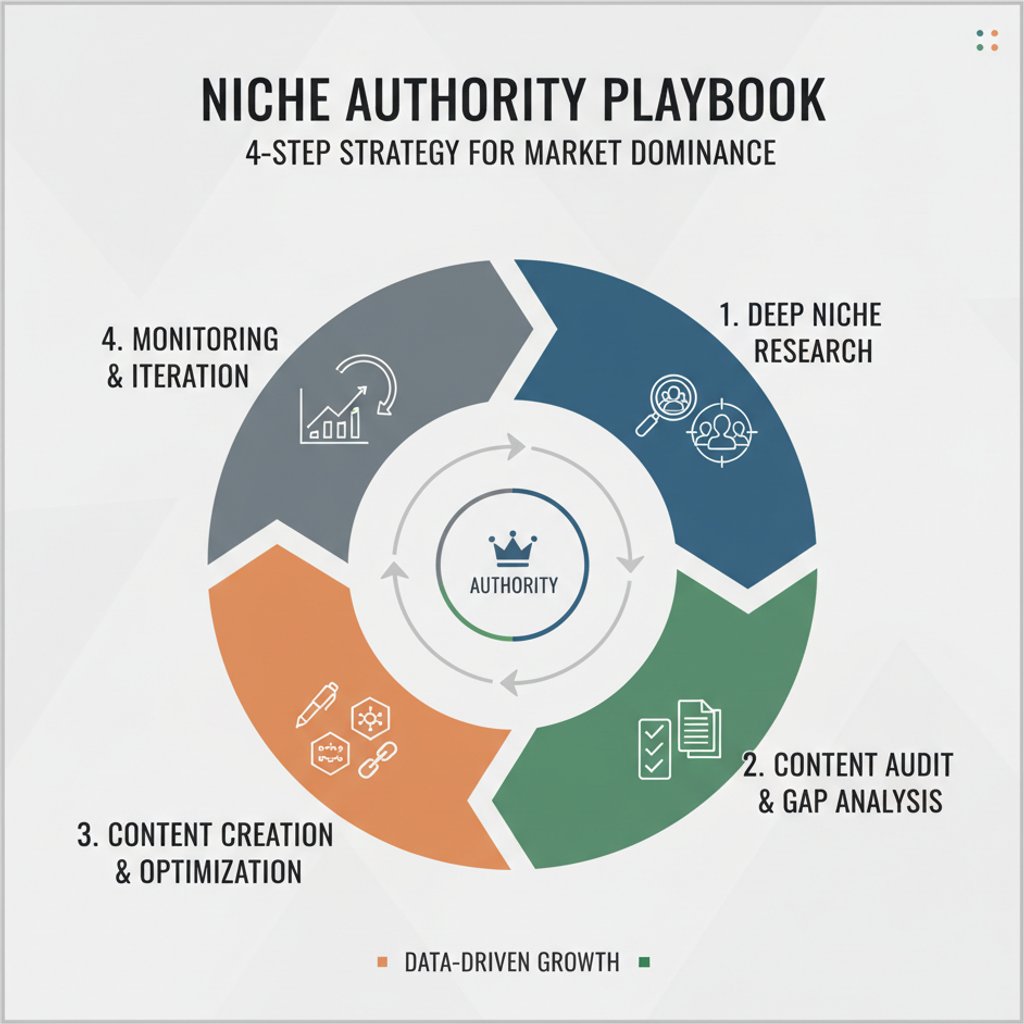
Practical Implementation: Your Niche Authority Playbook
Okay, so here’s where it gets interesting. How do you actually put this all into practice for your specific micro-audience? It starts with a deep understanding of your niche and then systematically applying the principles we’ve discussed.
1. Deep Niche Research & Audience Understanding
Before you write a single word, you need to become an anthropologist of your niche. What are the specific pain points, jargon, and unanswered questions of your micro-audience? Use forums, social media groups, customer support logs, and direct interviews. What terms do they use that general searchers might not? What are the common misconceptions? This isn’t just keyword research; it’s intent research. The real story here isn’t just what they search for, but why they search for it.
2. Content Audit & Gap Analysis
Review your existing content. Does it meet the AI SEO, AEO, and GEO standards? Is it entity-rich? Does it provide direct answers? Is it modular? Identify gaps where you could create new, highly specialized content that directly addresses niche queries. What topics are you missing that would complete your topical authority for your micro-audience? What most guides miss is that this isn’t a one-time thing; it’s an ongoing process.
3. Content Creation & Optimization Workflow
Integrate AI SEO, AEO, and GEO into your content creation process. For every piece of content:
- Identify Core Entities: What are the main concepts, people, and organizations? Define them clearly.
- Anticipate Questions: What questions will your audience (and AI) ask about this topic? Structure headings and introductory paragraphs to answer these directly.
- Modularize: Break down complex information into digestible, self-contained paragraphs.
- Cite Your Sources: Provide verifiable data and attribute it clearly.
- Schema Markup: Implement Q&A, How-To, and other relevant schema to guide AI.
- Internal Linking: Build a robust internal linking structure that connects related entities and topics, reinforcing your topical authority.
4. Monitoring & Iteration
The AI landscape is constantly evolving. Monitor your performance. Are your direct answers being picked up? Is your brand being cited by generative AI? Use tools to track featured snippets, ‘People Also Ask’ appearances, and brand mentions. “Data from SEMrush in 2025 indicated that websites consistently optimizing for AEO saw a 30% increase in featured snippet visibility.” This is a smart move because it allows you to adapt your strategy based on real-world AI behavior and user engagement. What strikes me about this is how quickly the feedback loop can be if you’re paying attention.
AI SEO, AEO, and GEO: A Comparison
To truly grasp the nuances, it helps to see how these strategies complement and differ from one another. They’re all part of the same overarching goal, but each has its own specific focus.
| Strategy | Primary Goal | Key Tactics | Impact on Niche Authority |
|---|---|---|---|
| AI SEO | General discoverability & understanding by AI-powered search engines. | Semantic optimization, entity-based content, topical clusters, E-E-A-T signals. | Establishes foundational relevance and credibility within the niche. |
| AEO (Answer Engine Optimization) | Direct answers for AI assistants, featured snippets, ‘People Also Ask’. | BLUF structure, Q&A format, structured data (schema), concise answers. | Positions content as the definitive, immediate answer for specific niche queries. |
| GEO (Generative Engine Optimization) | Content synthesis & attribution by generative AI models. | Modular content, high contextual richness, verifiable facts, clear sourcing, entity relationships. | Makes content indispensable as building blocks for AI-generated responses, leading to brand citation. |
The Future is Now: Becoming Indispensable to AI
The landscape of information discovery and consumption is undergoing a profound transformation. The days of simply stuffing keywords and hoping for the best are long gone. For businesses targeting niche markets, this shift represents an enormous opportunity to establish unparalleled authority, not just with human users, but with the AI systems that increasingly mediate their access to information. By embracing integrating AI SEO, AEO, and GEO, you’re not just optimizing for today’s search engines; you’re building a future-proof strategy that positions your brand as the definitive, trusted source within your micro-audience. This is about making your content so valuable, so precise, and so well-structured that AI models can’t help but rely on it. And when AI relies on you, your niche audience will too.
The honest answer is that nobody knows for certain what the next iteration of AI will bring, but the evidence suggests that content that is clear, factual, well-structured, and demonstrates undeniable expertise will always win. This is the part that most guides get completely wrong; they focus on fleeting tactics instead of enduring principles. Datanex, for its part, is committed to guiding businesses through these changes with practical, actionable advice.
Frequently Asked Questions
How is AI SEO different from traditional SEO?
AI SEO moves beyond simple keyword matching to focus on semantic understanding, user intent, and the overall quality and depth of content as perceived by AI algorithms. Traditional SEO often prioritized technical aspects and keyword density, while AI SEO emphasizes topical authority, entity relationships, and E-E-A-T signals to satisfy complex AI ranking factors.
Can I achieve niche authority without using AI tools for content creation?
Absolutely. While AI tools can assist with content generation and optimization, the core principles of AI SEO, AEO, and GEO revolve around creating high-quality, authoritative, and well-structured content. A deep understanding of your niche, meticulous research, and human expertise remain irreplaceable for building genuine authority that AI models can trust and cite.
How quickly can I expect to see results from implementing GEO strategies?
Results from GEO strategies can vary widely depending on the competitiveness of your niche, the quality of your existing content, and the frequency of AI model updates. Building true niche authority is a long-term play, often requiring consistent effort over several months to a year. However, initial improvements in AEO (featured snippets) can sometimes be observed more quickly.
Is it possible for AI to plagiarize my content if I optimize for GEO?
Optimizing for GEO aims for AI to synthesize and attribute your content, not plagiarize it. By providing clear sourcing, contextual richness, and strong E-E-A-T signals, you encourage AI models to acknowledge your content as the source of information. While the exact mechanisms of attribution are evolving, the goal is to become a recognized and cited authority within AI-generated responses.
What role does E-E-A-T play in AI SEO for niche markets?
E-E-A-T (Experience, Expertise, Authoritativeness, Trustworthiness) is more critical than ever for niche markets. AI models are trained to identify credible sources. For specialized topics, demonstrating deep, verifiable expertise and experience signals to AI that your content is reliable and should be prioritized. Without strong E-E-A-T, even well-structured content may struggle to gain traction with AI systems.
Should I focus on AI SEO, AEO, or GEO first?
It’s best to approach them sequentially, building upon each other. Start with strong AI SEO fundamentals to ensure your content is broadly understood by AI-powered search engines. Then, layer in AEO tactics to capture direct answers and snippets. Finally, integrate GEO strategies to make your content modular and verifiable for generative AI synthesis. They are interconnected, and a holistic approach yields the best results for niche authority.
How can I measure the success of my AI SEO and GEO efforts?
Measuring success involves tracking traditional SEO metrics like organic traffic and rankings, but also new indicators. Monitor featured snippet appearances, ‘People Also Ask’ visibility, and brand mentions within AI-generated content. Look for increased direct answers in search results, higher engagement from your niche audience, and ultimately, improved conversions that stem from your enhanced authority. “A 2024 report by Search Engine Journal highlighted that tracking non-click search result features (like direct answers) is becoming a primary KPI for advanced SEO strategies.” This is a smart move because it allows you to adapt your strategy based on real-world AI behavior and user engagement. What strikes me about this is how quickly the feedback loop can be if you’re paying attention.
Last updated: July 17, 2026