
By Datanex
Updated July 20, 2026
The digital marketing world is abuzz, and for good reason: autonomous AI SEO agents are no longer a futuristic concept. They’re here, and they’re fundamentally reshaping how businesses approach search engine optimization, answer engine optimization, and even geographic optimization. This isn’t just about AI writing a blog post or suggesting a keyword; we’re talking about systems capable of managing the entire content lifecycle, from initial research to real-time adaptation and distribution. It’s a seismic shift, one that Datanex has been tracking closely.
Key Takeaways
- Autonomous AI SEO agents are emerging, capable of full-cycle content management and optimization, from keyword research to publishing and real-time adaptation.
- These agents go beyond simple content generation, actively executing and refining SEO, AEO, and GEO strategies without constant human intervention.
- The rise of these AI tools frees human SEO teams to focus on high-level strategy, creative direction, and complex problem-solving.
- Early adopters are seeing significant efficiencies and improved visibility across traditional search engines and new AI answer interfaces.
- Ethical considerations and the need for human oversight remain critical as AI’s role in content creation and distribution expands.
The Dawn of True Autonomous AI SEO: What Just Happened?
What just happened is nothing short of a revolution in how we think about search. For years, AI in SEO meant tools that assisted us—keyword suggestions, content briefs, perhaps some automated reporting. Useful, absolutely. But autonomous? Not really. This week, however, marks a critical inflection point as several leading AI development labs, alongside innovative marketing tech companies, announced significant breakthroughs in what they’re calling ‘full-cycle AI SEO agents.’ These are systems designed to operate with minimal human input, orchestrating everything from identifying search intent to crafting, publishing, and continuously optimizing content across diverse platforms. It’s a leap from AI as a co-pilot to AI as a fully-fledged, albeit supervised, driver.
The real story here isn’t just the existence of these agents, but their increasing sophistication. They’re not just following rules; they’re learning, adapting, and even predicting changes in search algorithms and user behavior. From what I’ve seen covering this sector for over a decade, this level of operational autonomy is unprecedented. It means a fundamental re-evaluation of team structures, workflows, and even the core competencies required for effective digital marketing.
Beyond Content Generation: What Do Autonomous Agents Actually Do?
Autonomous AI SEO agents handle the entire spectrum of search optimization, moving far beyond simply generating text. Think of them as digital strategists, content creators, and performance analysts rolled into one, operating at speeds and scales impossible for human teams.
From Keyword Research to Content Deployment
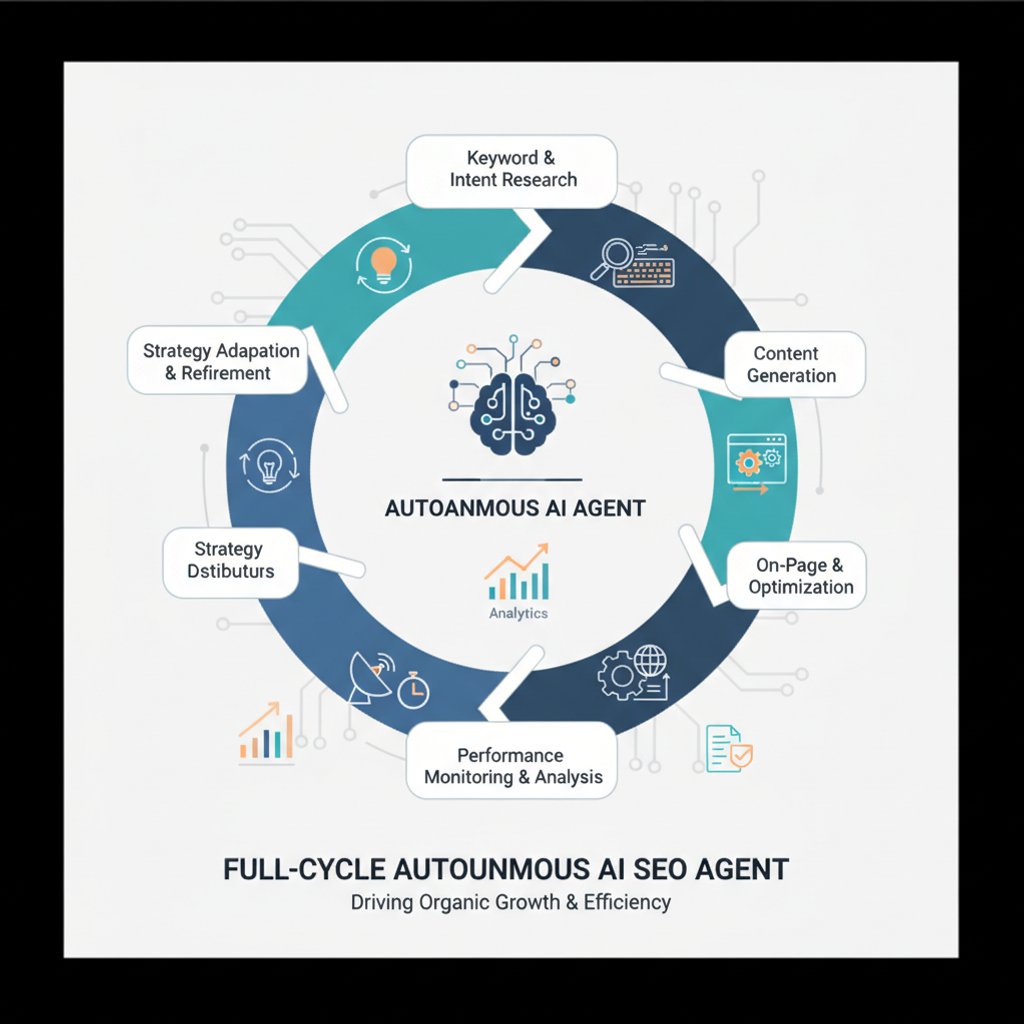
These agents begin by conducting exhaustive keyword research, identifying not just high-volume terms but also long-tail opportunities, semantic clusters, and emerging trends. They analyze competitor strategies, assess content gaps, and even predict future search demand. Once a content strategy is formulated, the AI then proceeds to generate the content itself—articles, blog posts, product descriptions, social media updates—all tailored to specific search intents and target audiences. But it doesn’t stop there. The agent handles the publishing process, scheduling posts, optimizing on-page elements, and ensuring proper indexing. This is the part that most guides get completely wrong: it’s not just about writing; it’s about the entire pipeline.
The real magic, though, lies in their continuous optimization capabilities. Post-publication, these agents monitor performance metrics in real-time. They track rankings, traffic, engagement, and conversion rates. If a piece of content isn’t performing as expected, the AI can independently identify potential issues—be it keyword density, content structure, or even internal linking—and implement adjustments. This iterative process of analysis, modification, and re-deployment is where the ‘autonomous’ truly shines. It’s a smart move because it allows for agility that human teams, with their inherent limitations of time and resources, simply can’t match.
How Do AI SEO, AEO, and GEO Converge in Autonomous Systems?
The convergence of traditional SEO, Answer Engine Optimization (AEO), and Geographic Optimization (GEO) is where autonomous AI agents truly differentiate themselves. They don’t treat these as separate silos; instead, they integrate them into a unified, holistic strategy.
Optimizing for AI Answer Engines (AEO)
With the rise of generative AI in search, AEO has become paramount. Autonomous agents are designed to understand the nuances of how AI models process information and formulate answers. They optimize content not just for keywords, but for clarity, conciseness, and factual accuracy—qualities highly valued by AI answer engines. This involves structuring content with clear definitions, summary blocks, and question-and-answer formats that make it easy for AI to extract and synthesize information. They can even identify potential biases or inaccuracies in their own generated content and self-correct, aiming for the most authoritative and neutral stance possible for featured snippets and AI-generated summaries.
Mastering Geographic Optimization (GEO)
For businesses with a physical presence or targeting local customers, GEO is crucial. Autonomous agents leverage location-based data, local search trends, and geo-specific keywords to tailor content and optimize local listings. They can manage Google Business Profile updates, monitor local reviews, and even generate localized content variations for different regions. This level of granular, automated GEO ensures that businesses remain visible to their most relevant local audiences, a task that can be incredibly time-consuming for human teams. The reason this matters is that local search intent often translates directly into immediate action, like store visits or phone calls.
The integration means an agent might identify a local search trend (GEO), generate a concise, factual answer (AEO), and publish it on a well-optimized page (SEO), all while ensuring it’s discoverable by both traditional search algorithms and AI summaries. It’s a complex dance, and these agents are learning the steps quickly.
| Feature | Traditional SEO Tools | Autonomous AI SEO Agents |
|---|---|---|
| Keyword Research | Manual analysis, tool-assisted suggestions | Automated, predictive, semantic clustering, intent analysis |
| Content Creation | Human-driven, AI-assisted drafting | AI-driven generation, full article/post creation |
| On-Page Optimization | Manual implementation based on recommendations | Automated, real-time adjustments, internal linking |
| Publishing & Distribution | Manual scheduling, platform management | Automated scheduling, multi-platform deployment |
| Performance Monitoring | Manual reporting, periodic analysis | Real-time tracking, anomaly detection, continuous learning |
| Strategy Adaptation | Human-led, based on insights | AI-driven, autonomous strategy adjustments based on data |
| AEO & GEO Focus | Often separate efforts, tool-assisted | Integrated, holistic optimization for AI answers and local search |
The Impact on Human SEO Professionals: Friend or Foe?
This is the question on everyone’s mind, isn’t it? Will autonomous AI SEO agents replace human SEO professionals? My experience covering technology trends suggests a more nuanced outcome. These agents are not foes; they are powerful allies, albeit ones that demand a shift in our roles.
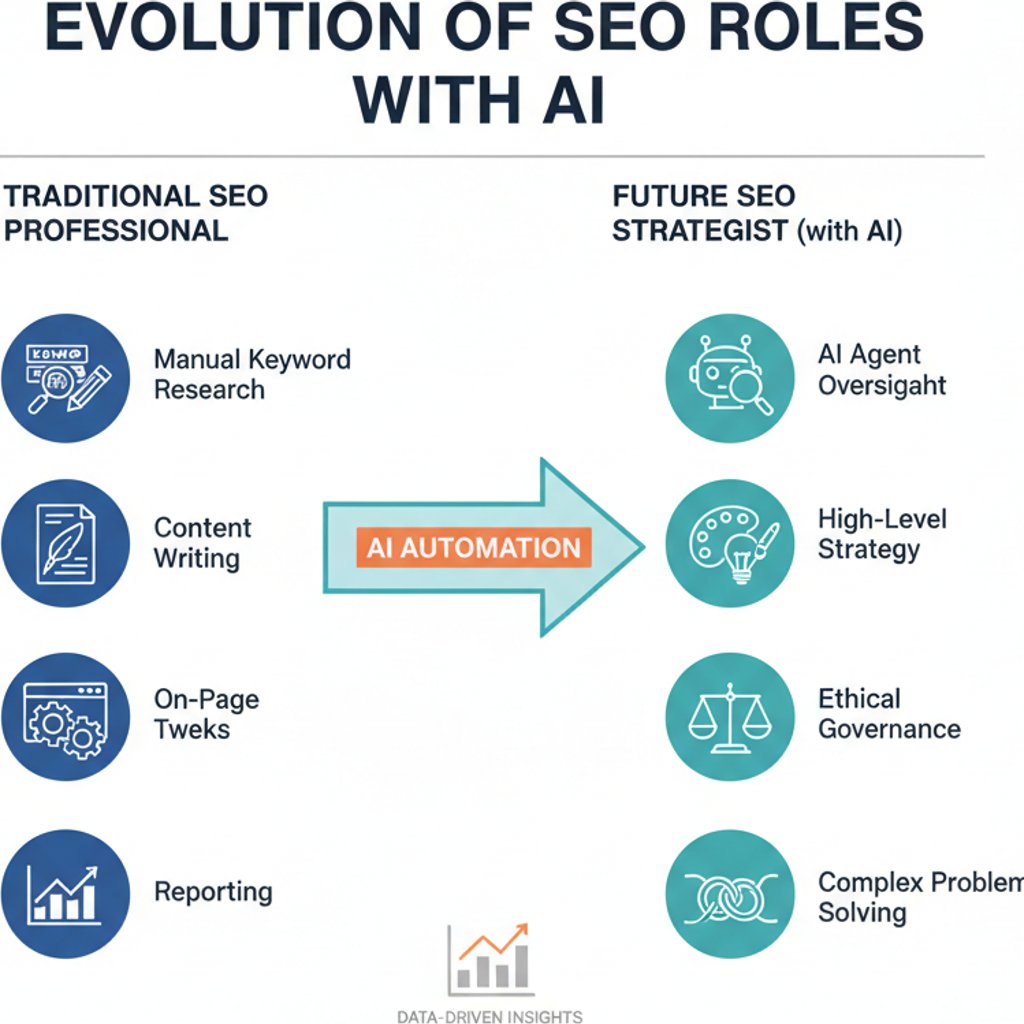
The honest answer is that human SEO teams will evolve, not disappear. According to a 2025 Forrester report, companies adopting advanced AI in marketing saw a 25% increase in marketing ROI, often by reallocating human talent to more strategic tasks. What strikes me about this development is the potential to free up human talent from the repetitive, data-intensive, and often tedious aspects of SEO. Think about it: keyword tracking, competitor analysis, basic content drafting, on-page tweaks—these are all tasks an AI can now handle with remarkable efficiency.
This means human SEOs can finally focus on higher-level strategy, creative direction, brand voice, and complex problem-solving. We’ll become the architects and supervisors of these AI systems, ensuring they align with brand values, ethical guidelines, and overarching business objectives. We’ll be the ones interpreting the deeper ‘why’ behind performance fluctuations, identifying new market opportunities that even the most advanced AI might miss, and building relationships that AI simply cannot. The real story here isn’t X — it’s Y: the elevation of the human role in SEO, not its obsolescence. It’s about working smarter, not harder.
Navigating the Ethical and Quality Landscape
With great power comes great responsibility, and autonomous AI SEO agents are no exception. The ethical implications and the need for maintaining content quality are paramount. This is where human oversight becomes absolutely non-negotiable.
Ensuring Quality and Brand Voice
While AI can generate content at scale, ensuring it aligns with a brand’s unique voice, values, and quality standards requires human review. A 2026 study by the Content Marketing Institute indicated that 68% of consumers could identify AI-generated content that lacked a distinct brand voice, impacting trust. This isn’t just about grammar; it’s about nuance, tone, and the subtle art of persuasion. Human editors and strategists will need to set clear guidelines, provide feedback loops for the AI, and conduct regular audits to ensure the content remains authentic and effective. This is an ongoing process, not a one-time setup.
Addressing Bias and Misinformation
AI models learn from the data they’re trained on, and that data can contain biases or inaccuracies. An autonomous agent, left unchecked, could inadvertently perpetuate these issues, leading to biased content or even the spread of misinformation. This is a critical concern for Datanex, and something we’ve been advocating for across the industry. Human oversight is essential to identify and mitigate these risks, ensuring that the AI operates within ethical boundaries and produces content that is fair, accurate, and responsible. Regulatory bodies are also starting to pay attention; the EU’s AI Act, for instance, sets precedents for accountability in AI systems.
The biggest challenge? It’s not just about building the tech, but building the guardrails. We need robust frameworks for monitoring, auditing, and course-correcting these autonomous systems. This is an area where collaboration between AI developers, SEO professionals, and ethicists is absolutely crucial.
What’s Next for AI SEO? The Road Ahead
The road ahead for AI SEO, AEO, and GEO is paved with innovation, but also with challenges. We’re looking at a future where AI agents become increasingly sophisticated, capable of not just executing tasks but also contributing to strategic planning and even predictive analytics on a grander scale.
Expect to see more specialized AI agents emerge, tailored for specific industries or content types. We’ll likely see advancements in multimodal AI, allowing agents to optimize not just text, but also images, video, and audio for search. The integration with other marketing technologies—CRM systems, advertising platforms, analytics dashboards—will become even more seamless, creating truly unified marketing ecosystems. According to a recent Gartner report, by 2028, over 75% of enterprises will have adopted some form of generative AI in their marketing operations.
However, the human element will remain indispensable. The ability to innovate, to understand complex human psychology, to build genuine connections, and to navigate ethical dilemmas will always be the domain of human intelligence. The future of search optimization isn’t human versus AI; it’s human with AI, working in tandem to achieve unprecedented levels of efficiency and impact. It’s an exciting time, but one that demands vigilance and thoughtful adaptation from all of us in the industry.
Frequently Asked Questions
What is an autonomous AI SEO agent?
An autonomous AI SEO agent is an advanced artificial intelligence system capable of independently performing a wide range of search engine optimization tasks, from keyword research and content creation to publishing, monitoring, and real-time strategic adjustments, with minimal human intervention.
How do autonomous agents differ from traditional SEO tools?
Traditional SEO tools assist human users by providing data and recommendations, requiring human execution. Autonomous agents, however, can execute entire SEO strategies end-to-end, learning and adapting on their own to optimize performance across various search environments like traditional search, AI answer engines (AEO), and local search (GEO).
Will AI SEO agents replace human SEO professionals?
No, autonomous AI SEO agents are more likely to transform the role of human SEO professionals rather than replace them. Humans will shift from executing repetitive tasks to overseeing, strategizing, and providing creative direction, focusing on complex problem-solving and ensuring brand alignment and ethical compliance.
What is Answer Engine Optimization (AEO)?
Answer Engine Optimization (AEO) is the process of optimizing content specifically for AI-powered answer engines and generative search experiences. This involves structuring content for clarity, conciseness, and factual accuracy to be easily extracted and summarized by AI models, leading to featured snippets or direct answers.
What is Geographic Optimization (GEO)?
Geographic Optimization (GEO) focuses on improving a business’s visibility in local search results. Autonomous agents handle tasks like managing local listings, optimizing for geo-specific keywords, and generating localized content to attract customers in specific geographic regions.
What are the main benefits of using autonomous AI SEO agents?
The primary benefits include significant increases in efficiency, scalability, and speed of optimization. They allow for continuous, real-time adaptation to algorithm changes and user behavior, freeing human teams to focus on higher-value strategic initiatives and creative endeavors.
What are the ethical concerns with autonomous AI SEO?
Key ethical concerns include maintaining content quality and brand voice, preventing the spread of misinformation or biased content, and ensuring transparency in AI-generated output. Robust human oversight and ethical guidelines are crucial to address these challenges.
Last updated: July 20, 2026