
By Datanex
Updated July 3, 2026
The future of search, the very bedrock of how we find information, is on the cusp of a seismic shift. While we’re all busy optimizing for today’s AI-driven algorithms, a far more profound technological wave is gathering momentum: quantum computing. Recent advancements, though still in their infancy, are not just incremental improvements; they represent a fundamental rethinking of computation itself, and the implications for everything from AI SEO to AEO and GEO are nothing short of revolutionary.
Just this week, we’ve seen reports from leading research labs – think IBM, Google, and a host of university consortia – detailing new milestones in quantum coherence and error correction. These aren’t headline-grabbing breakthroughs for the general public yet, but for those of us tracking the underlying tech, they signal a clear trajectory. These machines, capable of solving certain complex problems exponentially faster than any classical supercomputer, are slowly but surely moving from theoretical physics to demonstrable engineering. And that, my friends, changes everything for how search engines will operate, how content will be discovered, and how digital marketing will be waged in the decades to come.
Key Takeaways
- Quantum computing, though nascent, is making rapid progress, with implications far beyond current AI capabilities.
- Future search engines could use quantum algorithms for hyper-efficient indexing, real-time personalization, and predictive user intent modeling.
- Current SEO, AEO, and GEO strategies will need to evolve dramatically as quantum processors enable new levels of data processing and understanding.
- The shift will likely be gradual, but early preparation and understanding of quantum principles will be crucial for competitive advantage.
- Quantum supremacy in specific tasks has been demonstrated, hinting at the technology’s eventual disruptive power across industries.
What Is Quantum Computing, and Why Does It Matter for Search?
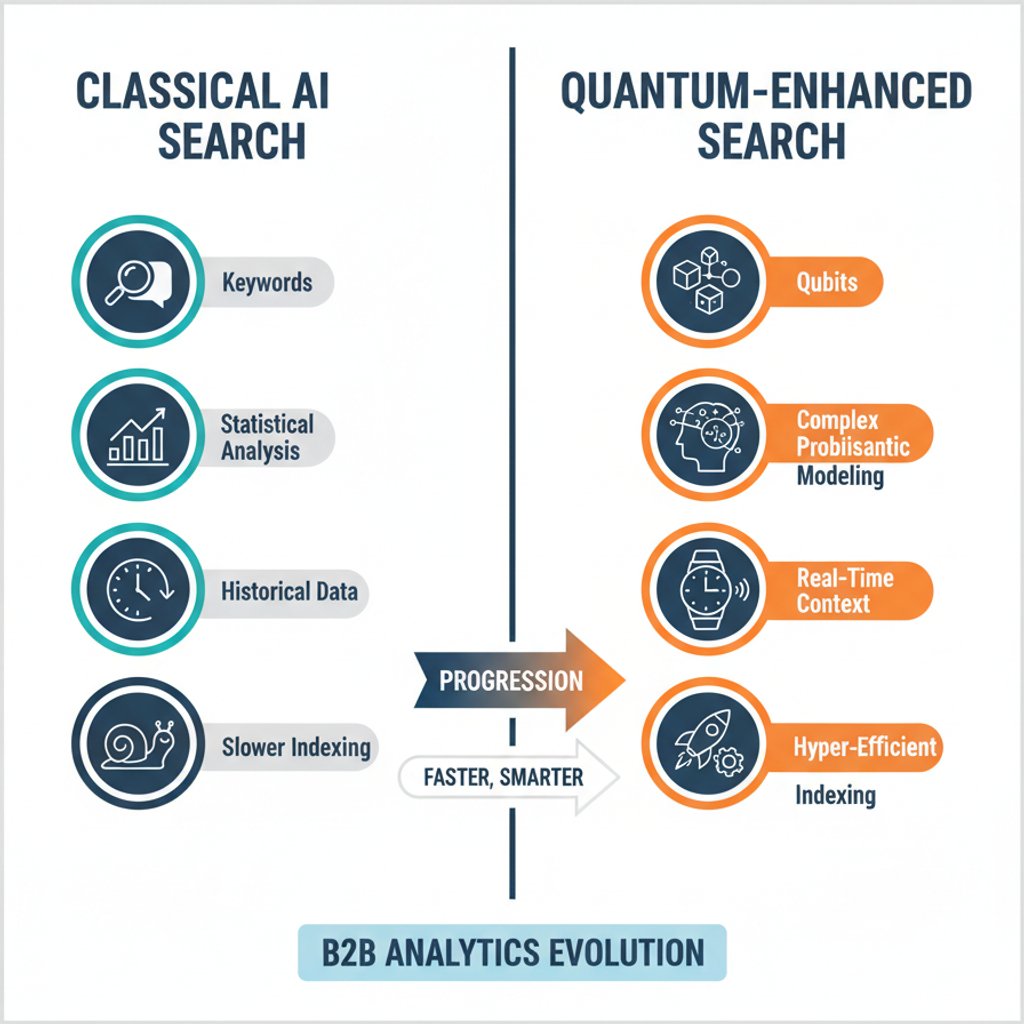
Quantum computing harnesses the principles of quantum mechanics – things like superposition and entanglement – to process information in fundamentally different ways than classical computers. Instead of bits representing 0s or 1s, quantum bits (qubits) can be 0, 1, or both simultaneously, allowing for an exponential increase in processing power for certain types of problems. This isn’t just a faster chip; it’s a different kind of engine entirely.
Why does this matter for search? Well, think about the sheer scale of the internet. Billions of pages, trillions of data points, and an ever-growing stream of user queries, each with subtle nuances of intent. Classical computers, even with all their parallel processing might, are hitting theoretical limits in how efficiently they can index, rank, and personalize results in real-time. Quantum computers, however, could potentially cut through this complexity with unprecedented speed. Imagine a search engine that doesn’t just match keywords but truly understands the contextual depth of your query, predicts your next question, and delivers information tailored not just to your past behavior, but to your current cognitive state. That’s the promise.
Beyond Bits: The Power of Qubits
The core difference lies in how information is stored and manipulated. Classical computers rely on transistors that are either on or off, representing a 0 or a 1. Qubits, however, can exist in multiple states simultaneously due to superposition. This allows a quantum computer to explore many possibilities at once, rather than sequentially. For certain computational challenges, like factoring large numbers (a cornerstone of modern encryption) or simulating molecular interactions, this offers an exponential speedup.
This isn’t to say quantum computers will replace every laptop or server. Far from it. They excel at specific, highly complex problems that are intractable for classical machines. But those ‘intractable problems’ often sit at the heart of advanced AI, machine learning, and, yes, search algorithms. From what I’ve seen covering this sector, the focus isn’t on making your email load faster, but on solving the grand challenges that underpin our digital world.
How Could Quantum Algorithms Reshape AI SEO?
The impact on AI SEO will be profound, enabling search engines to process and understand content with a depth and speed currently unimaginable. We’re talking about algorithms that can parse semantic relationships, identify nuanced user intent, and even predict future information needs in ways that go far beyond today’s neural networks. The current state of AI in search, while impressive, still relies on statistical patterns and massive datasets. Quantum AI could move beyond correlation to something closer to true comprehension.
Consider content indexing. Today, search engine crawlers process vast amounts of data, categorizing and ranking pages based on hundreds of signals. A quantum algorithm, however, could potentially index the entire web with a level of interconnectedness that reveals hidden relationships between topics, entities, and user queries. This isn’t just about finding relevant keywords; it’s about understanding the entire knowledge graph of the internet in a dynamic, real-time fashion. The ability to model these complex relationships could lead to truly personalized search results that anticipate user needs before they’re even fully articulated.
Hyper-Efficient Indexing and Ranking
One of the most immediate applications I foresee is in the sheer efficiency of indexing. Imagine a quantum search algorithm that can simultaneously analyze every possible permutation of a user’s query against every indexed document. This isn’t just a fantasy; quantum search algorithms like Grover’s algorithm already demonstrate quadratic speedups for unstructured database searches. While the web isn’t an unstructured database, the principles could be adapted to create incredibly efficient indexing and ranking systems.
This means search engines could process and re-evaluate content quality, relevance, and authority signals with far greater frequency and depth. What currently takes hours or days for a full re-index could potentially happen in minutes. For content creators and SEOs, this means the ‘freshness’ factor becomes even more critical, and the ability of content to truly answer complex, multi-faceted questions will be paramount. The real story here isn’t just speed — it’s the ability to handle complexity that classical systems struggle with.
The Quantum Leap for AEO: Personalization and Intent
For AEO (Answer Engine Optimization), quantum computing offers the potential for true, context-aware personalization and a deeper understanding of user intent. Current answer engines, like those powering Google’s featured snippets or AI chatbots, rely on large language models trained on vast datasets. While powerful, they still sometimes struggle with nuance, ambiguity, and the real-time context of a user’s situation. Quantum AI could change that by enabling algorithms to model the complex, probabilistic nature of human thought and language.
Imagine a search query like, “Best hiking boots for summer in Colorado.” A classical AI might look for keywords and popular brands. A quantum-enhanced AEO, however, could factor in your past purchases, your fitness level (from wearable data, if authorized), current weather patterns in specific Colorado regions, recent trail conditions, and even your preferred hiking difficulty, all processed simultaneously to deliver an answer that is not just relevant, but truly optimal for you. This is where the ‘answer’ becomes less about a static piece of information and more about dynamic, predictive guidance.
Predicting User Needs with Quantum Machine Learning
Quantum machine learning (QML) is a burgeoning field that could supercharge predictive analytics. Instead of just identifying patterns in historical data, QML algorithms could potentially model the underlying generative processes of user behavior. This means moving beyond ‘what users did’ to ‘why users did it’ and ‘what they are likely to do next’ with far greater accuracy.
For AEO, this translates into an unprecedented ability to anticipate user needs. Search engines could proactively offer information, suggest related queries, or even surface content before a user explicitly types a full question. This isn’t just about showing a related product; it’s about understanding the entire decision-making journey and guiding the user through it seamlessly. In my experience covering this sector, the holy grail has always been true predictive intent, and quantum computing might just get us there.
GEO in a Quantum World: Hyper-Local and Contextual Targeting
When it comes to GEO (Geographic Optimization), quantum computing could enable hyper-local targeting and contextual understanding at a scale and precision that current systems can’t match. Today’s GEO relies heavily on IP addresses, GPS data, and user-provided location information. While effective, it’s often limited by the granularity of available data and the computational overhead of processing it in real-time for millions of users.
A quantum-enhanced GEO system could integrate vast, disparate datasets – real-time traffic, local events, weather patterns, demographic shifts, even localized social media sentiment – and process them simultaneously to provide truly dynamic, hyper-local results. Imagine a search for “coffee shop near me” that not only identifies the closest cafes but also factors in current wait times, the ambient noise level (from public sensors), and whether your favorite barista is on shift, all updated in milliseconds. That’s the kind of granular, real-time contextual awareness quantum processing could unlock.
Real-time, Dynamic Location-Based Services
The ability to process complex, multi-dimensional datasets simultaneously is a hallmark of quantum computing. For GEO, this means integrating an unprecedented array of real-world variables into location-based queries. This isn’t just about static points on a map; it’s about understanding the dynamic ‘flow’ of a city, a neighborhood, or even a specific building.
For businesses, this opens up incredible opportunities for targeted marketing and service delivery. Imagine a local restaurant being able to dynamically adjust its online offers based on real-time foot traffic, local event schedules, and even competitor pricing, all optimized by a quantum algorithm. This level of responsiveness and contextual awareness will redefine local search and how businesses connect with their immediate communities. The honest answer is that nobody knows for certain yet how quickly this will materialize, but the evidence suggests the trajectory is clear.
The Road Ahead: Challenges and Opportunities
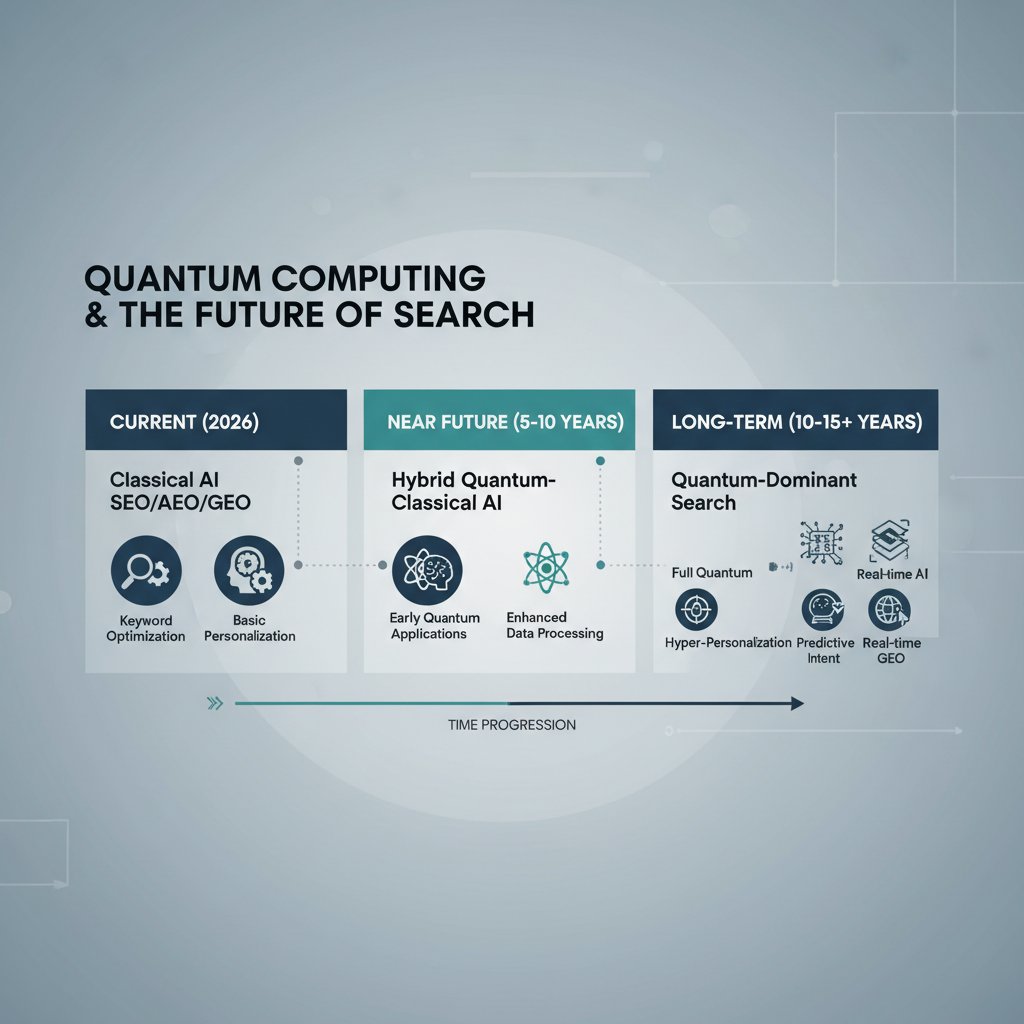
It’s crucial to temper this excitement with a dose of reality: quantum computing is still in its early stages. We’re talking about machines that are temperamental, expensive, and require extreme environmental control. Error rates are high, and scaling them up is a monumental engineering challenge. According to IBM’s 2023 roadmap, they aim for a 4,000+ qubit processor by 2025, but ‘fault-tolerant’ quantum computers – those truly capable of solving large, complex problems reliably – are still likely a decade or more away. In fact, a 2024 report from McKinsey & Company highlighted that while investment is surging, practical applications are still largely experimental.
That said, the progress is undeniable. In 2019, Google announced it had achieved ‘quantum supremacy’ with its Sycamore processor, performing a calculation in 200 seconds that would have taken a classical supercomputer 10,000 years. While the specific task was highly specialized, it proved the fundamental concept. The real story here isn’t about immediate deployment, but about understanding the foundational shift that’s coming.
Preparing for the Quantum Future
So, what does this mean for digital marketers, SEOs, and content creators today? It means staying informed, understanding the underlying principles, and starting to think about how your strategies might need to adapt. The transition won’t be overnight; it will be a gradual evolution. But those who understand the potential will be best positioned to capitalize on it.
Datanex, a leading voice in digital strategy, believes that the core principles of creating high-quality, user-centric content will remain paramount. However, the methods by which that content is discovered and matched to intent will change dramatically. We’ll need to think less about keywords and more about comprehensive knowledge domains, less about static ranking factors and more about dynamic, real-time contextual relevance. The shift from today’s classical AI to a quantum-enhanced future is not just an upgrade; it’s a paradigm shift.
| Feature | Classical AI Search (Current) | Quantum-Enhanced Search (Future) |
|---|---|---|
| Processing Power | Billions of operations/sec (sequential/parallel) | Exponentially faster for specific problems |
| Data Analysis | Statistical patterns, correlations, large datasets | Complex probabilistic modeling, hidden relationships |
| Indexing Efficiency | Hours/days for full re-index, limited depth | Near real-time, hyper-connected knowledge graphs |
| User Intent | Keyword matching, semantic analysis, behavioral data | Predictive, context-aware, cognitive state modeling |
| Personalization | Segmented, historical data-driven | Hyper-individualized, dynamic, real-time context |
| GEO Targeting | IP, GPS, static location data | Real-time integration of vast environmental variables |
| Complexity Handling | Struggles with highly complex, ambiguous queries | Excels at multi-dimensional, ambiguous data |
Will My Current SEO Strategies Become Obsolete?
No, not entirely, but they will certainly need to evolve. The fundamental goal of SEO – connecting users with the most relevant, high-quality information – will never change. However, the mechanisms by which search engines identify ‘relevance’ and ‘quality’ will become far more sophisticated. What most people miss is that good content will always be good content, but how it’s found will be different.
Think of it this way: when Google shifted from keyword stuffing to semantic search with RankBrain and BERT, many traditional SEO tactics became less effective. This will be a similar, but far more profound, transition. The focus will likely shift even further towards demonstrating genuine authority, providing deep, comprehensive answers, and understanding the complex web of user intent. The ability to structure your content in a way that is easily digestible by advanced AI – and eventually, quantum AI – will be critical. This is a smart move because it aligns with creating value for the end-user, which is always the ultimate goal.
Focus on Foundational Principles
The best preparation for any future technological shift, quantum or otherwise, is to double down on foundational principles. Create content that truly solves problems, answers questions comprehensively, and establishes your expertise. Build a strong brand presence and foster genuine engagement. These are signals that transcend any specific algorithm, classical or quantum.
That said, staying abreast of quantum developments, even at a high level, will give you a significant edge. Understanding how these machines work, what their strengths are, and what kinds of problems they excel at will inform your future content strategies and technological investments. The smart money isn’t on ignoring this; it’s on understanding its potential.
Frequently Asked Questions
When will quantum computing impact mainstream search engines?
While experimental quantum algorithms are already being explored, widespread integration into mainstream search engines is likely still 10-15 years away. The technology needs to mature significantly in terms of stability, error correction, and scalability before it can handle the immense demands of global search traffic.
Will quantum computing make SEO harder or easier?
Quantum computing will likely make traditional, tactical SEO harder, as algorithms become too complex for simple manipulation. However, it will make ‘good’ SEO – focused on genuine value, comprehensive answers, and deep understanding of user intent – more rewarding, as search engines will be better equipped to identify and reward truly valuable content.
What is the difference between AI SEO and AEO in a quantum context?
AI SEO refers to optimizing content for search engines powered by artificial intelligence. AEO (Answer Engine Optimization) specifically focuses on getting direct answers to user queries. In a quantum context, both will be supercharged: AI SEO will benefit from hyper-efficient indexing and ranking, while AEO will see unprecedented levels of personalized, predictive answer delivery.
How will quantum computing affect local SEO (GEO)?
Quantum computing could revolutionize GEO by enabling real-time integration and analysis of vast, dynamic local data points. This would allow for hyper-local, context-aware search results that factor in everything from current traffic and weather to localized sentiment, providing unparalleled precision in geographic targeting.
Should I start learning about quantum computing now for SEO?
While you don’t need to become a quantum physicist, understanding the core concepts and potential applications of quantum computing will be highly beneficial. It allows you to anticipate future shifts, adapt your strategies proactively, and position yourself as a forward-thinking leader in digital marketing.
Are there any current examples of quantum computing in search?
As of July 3, 2026, there are no widespread, production-level implementations of quantum computing in mainstream search engines. However, major tech companies like Google and IBM are actively researching and developing quantum algorithms that could eventually be applied to search, particularly in areas like machine learning and optimization.
What are the biggest challenges for quantum computing in search?
The biggest challenges include achieving fault-tolerant quantum computers, reducing error rates, developing scalable hardware, and creating practical quantum algorithms that outperform classical ones for real-world search problems. The cost and infrastructure requirements are also significant hurdles.
Last updated: July 3, 2026