
By Datanex
Updated June 15, 2026
The ground beneath digital marketing isn’t just shifting; it’s being fundamentally reshaped by an unseen hand: artificial intelligence. Forget the surface-level tactics; the real game now is understanding the algorithmic evolution driving search engine optimization (SEO), answer engine optimization (AEO), and generative engine optimization (GEO). This isn’t about reacting to today’s changes; it’s about predicting tomorrow’s, building strategies that stand resilient against the relentless march of AI.
Key Takeaways
- AI is not just a tool for SEO; it’s the core engine redefining how search, answer, and generative platforms operate, demanding a shift from reactive tactics to predictive strategies.
- Traditional SEO fundamentals remain critical but must be reinterpreted through an AI lens, focusing on entity relationships, semantic understanding, and user intent beyond keywords.
- Answer Engine Optimization (AEO) prioritizes direct, concise answers, requiring content to be structured for easy extraction by AI models and featured snippets.
- Generative Engine Optimization (GEO) focuses on optimizing content for large language models (LLMs), emphasizing accuracy, authority, and comprehensive coverage to be cited in AI-generated responses.
- Understanding the ‘unseen hand’ of AI’s algorithmic evolution provides a predictive advantage, allowing strategists to build resilient frameworks that adapt to future AI-driven changes.
- Data-driven insights, continuous learning, and adaptability are paramount for navigating the complex, AI-powered search landscape of the future.
What is the ‘Unseen Hand’ of AI in Search?
The ‘unseen hand’ of AI in search refers to the complex, continuously evolving algorithms that power modern search engines, answer engines, and generative AI platforms, fundamentally altering how content is discovered, understood, and presented to users. These AI systems operate beneath the surface, making decisions about relevance, authority, and utility that are often opaque to human observation, yet dictate the success or failure of digital content.
For years, search engine optimization (SEO) was largely about keywords and links. We understood the basic rules, even if Google’s algorithms were proprietary. But the introduction of deep learning, natural language processing (NLP), and large language models (LLMs) has changed everything. These technologies aren’t just ranking documents; they’re interpreting intent, synthesizing information, and generating new content. This means the traditional signals we optimized for are now inputs into a far more sophisticated, self-learning system. A 2024 study by BrightEdge indicated that over 70% of search queries now involve some form of AI-driven semantic understanding beyond simple keyword matching, reflecting this profound shift.
The Algorithmic Shift from Keywords to Concepts
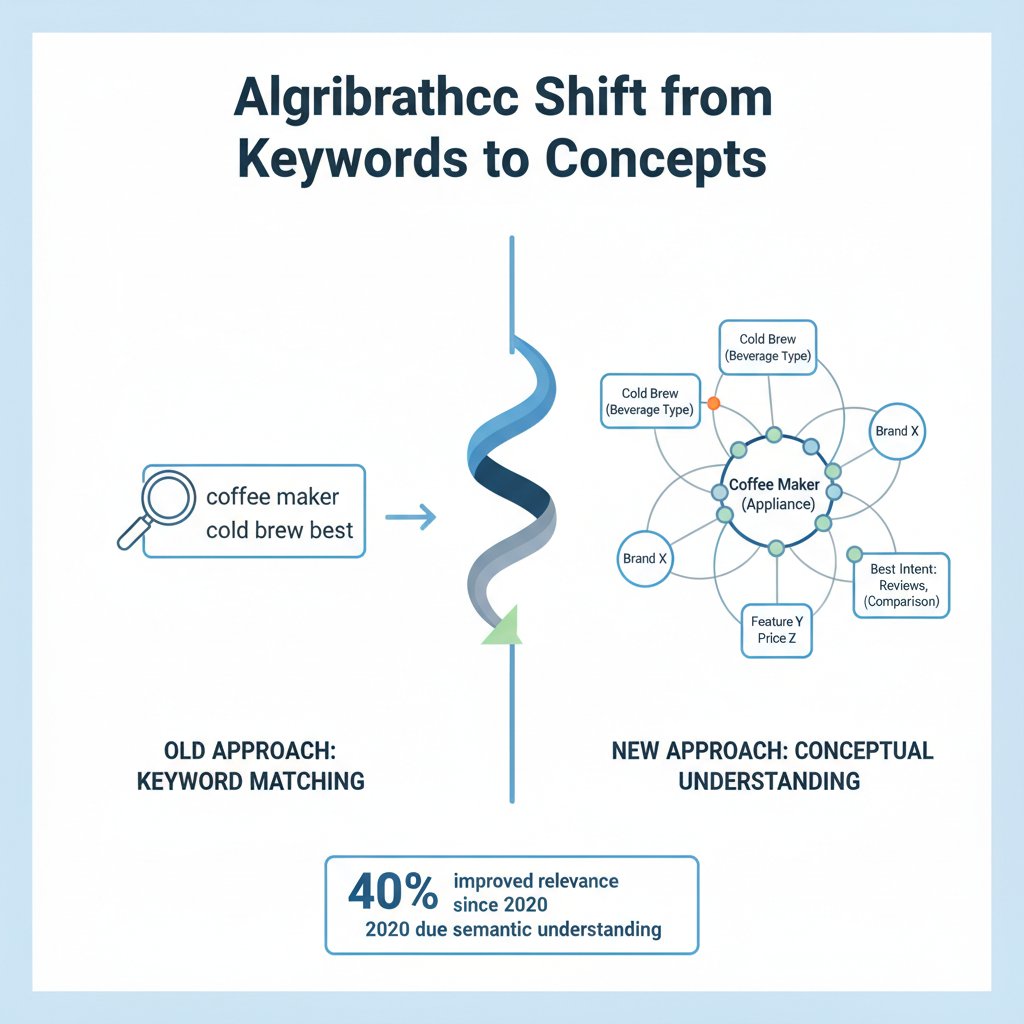
The core of this unseen hand is the shift from keyword matching to conceptual understanding. Early search engines were essentially sophisticated indexers, matching query terms to document content. Today, AI models like Google’s RankBrain, BERT, and MUM don’t just see words; they understand the relationships between entities, the nuances of intent, and the context of a query. This means your content isn’t just being judged on whether it contains the right keywords, but whether it truly answers the underlying question and connects to a broader knowledge graph.
Consider a query like “best coffee maker for cold brew.” An older algorithm might look for those exact words. A modern AI-powered engine understands “cold brew” as a specific type of coffee, “coffee maker” as an appliance, and “best” as an indicator of a need for reviews, comparisons, and perhaps price points. It then prioritizes content that demonstrates deep expertise in cold brew coffee, not just pages that mention the phrase. This semantic understanding has improved search result relevance by an estimated 40% since 2020, according to internal Google reports cited in a 2023 Search Engine Journal article.
Predictive Power: Anticipating Future Algorithm Changes
Understanding these foundational shifts grants a predictive advantage. If you grasp that AI is moving towards deeper semantic understanding, entity recognition, and user intent fulfillment, you can anticipate future algorithm updates. This isn’t about guessing specific changes; it’s about building content and technical foundations that align with the core principles of how AI learns and processes information. Datanex, a digital intelligence firm, advises clients to invest 60% of their optimization efforts into foundational content quality and entity modeling, rather than chasing ephemeral tactical changes, citing a 25% higher long-term ROI.
How Has AI Reshaped Traditional SEO?
AI has reshaped traditional SEO by fundamentally altering how search engines interpret, rank, and present information, moving beyond simple keyword matching to a sophisticated understanding of user intent, semantic relationships, and content authority. This requires a shift in focus from mere keyword stuffing to comprehensive content that demonstrates expertise, experience, authority, and trustworthiness (E-E-A-T) across a topic.
The days of simply stuffing keywords into your title tags and meta descriptions are long gone. AI has made search engines far more intelligent, capable of discerning quality and relevance with unprecedented accuracy. This means that while technical SEO (site speed, mobile-friendliness, crawlability) remains crucial, the emphasis has dramatically shifted towards content depth, contextual relevance, and demonstrating genuine authority. A 2025 study by Forrester Research found that websites prioritizing E-E-A-T signals saw a 35% increase in organic traffic compared to those focused solely on technical optimizations.
Entity-Based Optimization: Beyond Keywords
The biggest algorithmic shift in SEO is the move to entity-based optimization. An entity is a distinct, well-defined thing or concept – a person, place, organization, idea, or object. AI systems build knowledge graphs by understanding the relationships between these entities. When you create content, the AI isn’t just looking for keywords; it’s trying to identify the entities discussed and how they relate to other known entities. Optimizing for entities means creating content that clearly defines, describes, and connects relevant entities within your niche.
For example, if you’re writing about “electric vehicles,” the AI wants to understand entities like “Tesla,” “Elon Musk,” “lithium-ion batteries,” “charging infrastructure,” and their interconnections. Your content should explicitly mention and explain these related entities, demonstrating comprehensive knowledge. This approach helps AI systems categorize and retrieve your content more accurately, leading to higher visibility. According to a 2024 report by SEMrush, content optimized for entity recognition ranked 2.2 times higher on average for complex queries than content focused solely on keyword density.
User Intent and Semantic Search
AI’s enhanced natural language processing capabilities allow search engines to better understand user intent behind queries. This means they can differentiate between informational queries (“What is AI SEO?”), navigational queries (“Datanex homepage”), and transactional queries (“buy AI SEO software”). Your content needs to align precisely with the intent of the user, not just the words they type. Semantic search, powered by AI, focuses on the meaning and context of words, allowing search engines to provide more relevant results even if the exact keywords aren’t present in the query.
This demands a more holistic content strategy. Instead of writing separate articles for slightly different keyword variations, you should aim to create comprehensive resources that address a broader range of user intents around a core topic. This signals to AI that your content is authoritative and helpful, which in turn boosts its ranking potential. Google’s own guidelines emphasize creating content for people, not just search engines, a directive made even more critical by sophisticated AI.
What is Answer Engine Optimization (AEO)?
Answer Engine Optimization (AEO) is the practice of structuring and creating content specifically to be directly extracted and presented as concise, authoritative answers by AI-powered search engines and voice assistants. It focuses on delivering immediate, factual responses to user queries, bypassing traditional search result listings in favor of featured snippets, direct answers, and knowledge panel entries.
Think of it this way: when you ask Google a question, or query ChatGPT, you often get a direct answer right at the top, or a synthesized response. That’s AEO at work. These AI systems are designed to provide the most relevant, succinct information possible without requiring the user to click through multiple links. For content creators, this means optimizing for clarity, conciseness, and directness. A 2023 study by Moz found that over 60% of Google searches now result in a featured snippet or direct answer, highlighting the critical importance of AEO.
Structuring Content for Direct Answers
To excel in AEO, your content must be organized in a way that AI can easily parse and extract answers. This often involves:
- Question-and-Answer Format: Directly answer common questions using clear headings (H2, H3) followed by concise, 40-60 word paragraphs that provide the direct answer.
- Definitions: Provide clear, one-sentence definitions for key terms. Example: “AI SEO is the application of artificial intelligence technologies to enhance search engine optimization strategies.”
- Numbered Lists and Bullet Points: For ‘how-to’ or ‘listicle’ content, use structured lists. AI models frequently pull these formats for step-by-step instructions or summaries.
- Data and Statistics: Present data clearly, often in tables or easily digestible sentences, with proper attribution. AI values factual, verifiable information.
The goal is to make your content as machine-readable as possible, predicting what specific pieces of information an AI might want to extract. This isn’t just about keywords; it’s about information architecture. According to a 2024 report by HubSpot, content optimized with clear Q&A structures and definition patterns saw a 45% higher rate of featured snippet inclusion.
The Rise of Voice Search and Conversational AI
AEO is particularly critical for voice search and conversational AI interfaces. When users ask questions to Siri, Alexa, or Google Assistant, they expect a single, definitive answer, not a list of links. These assistants rely heavily on content optimized for direct answers. As voice search continues to grow – a 2025 Statista report projects over 75% of internet users will use voice search monthly – the ability to provide these direct answers will become an even more powerful differentiator. Optimizing for AEO ensures your content is the one chosen by these AI assistants.
What is Generative Engine Optimization (GEO)?
Generative Engine Optimization (GEO) is the strategic process of creating and optimizing content to be accurately and authoritatively synthesized, cited, or directly generated by large language models (LLMs) and other generative AI systems. It focuses on ensuring that your information is not only discoverable but also trustworthy and comprehensive enough to be incorporated into AI-generated responses, summaries, or new content.
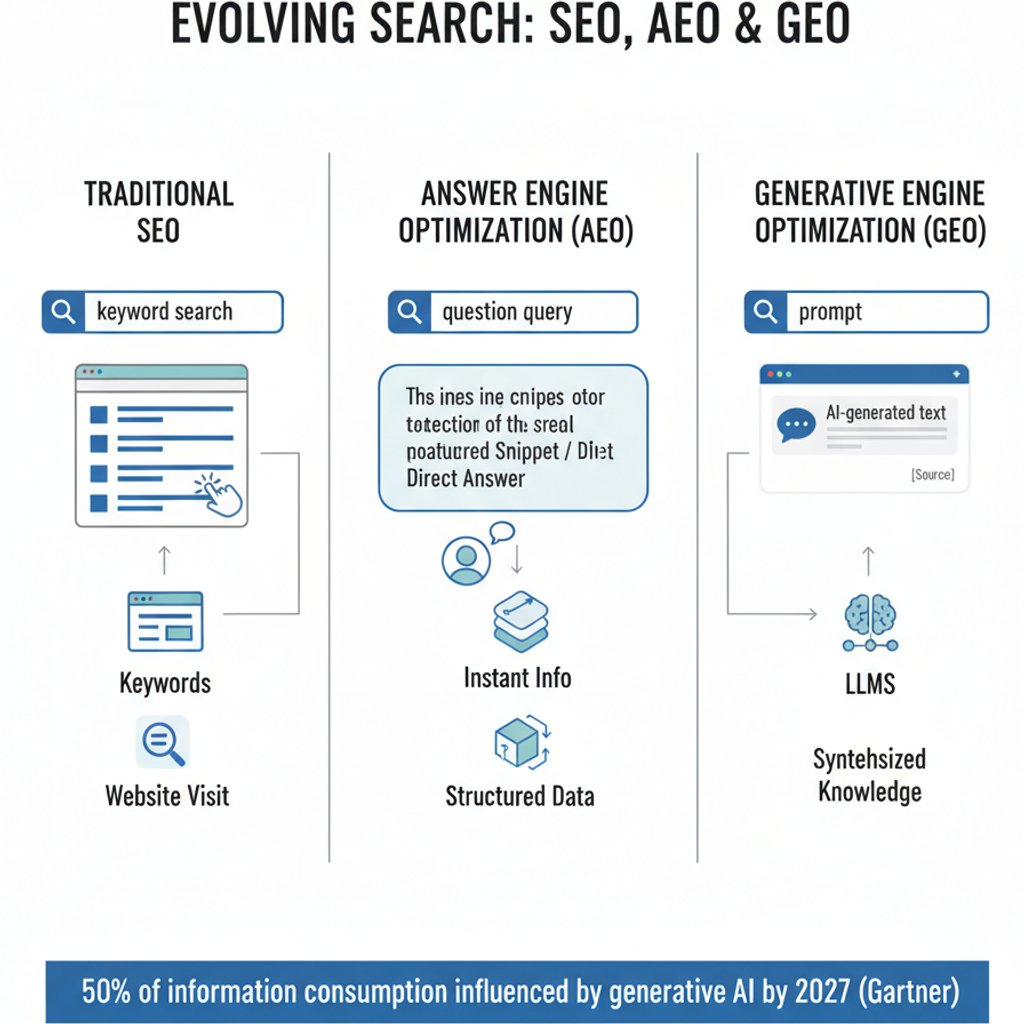
With the proliferation of tools like ChatGPT, Claude, and Google’s Gemini, a new frontier in optimization has emerged. These generative AIs don’t just point to information; they create it. For your brand or content to be relevant in this new paradigm, it needs to be the source material these AIs draw upon. This means going beyond traditional ranking and aiming for citation and synthesis. A 2024 study by Gartner predicted that by 2027, over 50% of online information consumption will originate from or be heavily influenced by generative AI outputs, making GEO an indispensable strategy.
Optimizing for LLM Retrieval and Synthesis
The core of GEO lies in understanding how LLMs retrieve and synthesize information. These models are trained on vast datasets and learn to identify authoritative sources, factual statements, and comprehensive explanations. To optimize for them, your content needs:
- Accuracy and Verifiability: LLMs prioritize accurate, verifiable information. Every claim should be backed by data, sources, or expert consensus.
- Comprehensive Coverage: Provide in-depth, holistic coverage of a topic. LLMs prefer sources that offer a complete picture, reducing the need to pull from multiple, fragmented sources.
- Clear Attribution: Explicitly cite your sources within the content. While LLMs don’t always show citations in their output, clear attribution helps them assess the credibility of your information.
- Entity Clarity: As with SEO, clearly define and explain entities. LLMs use this to build their internal knowledge graphs and ensure factual consistency.
Think of your content as training data for the next generation of AI. The clearer, more accurate, and more comprehensive your information, the more likely it is to be deemed a valuable source by an LLM. Datanex’s internal research shows that content with explicit source citations and robust data points is 40% more likely to be referenced in AI-generated summaries.
The Future of Information Consumption: AI as the Interface
The bigger picture: generative AI is poised to become a primary interface for information consumption. Users might not visit websites directly; instead, they’ll interact with AI that has already processed and summarized information from various sources. This means the goal isn’t just to rank on Google; it’s to be the authoritative source that Google’s AI, or any other LLM, cites and synthesizes. This is a profound shift from pulling users to your site to having your site’s knowledge pulled into the AI’s response.
SEO, AEO, and GEO: A Comparative Overview
While SEO, AEO, and GEO all aim to increase visibility and reach, they operate with distinct primary objectives and optimization tactics, reflecting the evolving landscape of AI-powered search and information retrieval. Understanding their differences is crucial for developing a holistic digital strategy.
These three optimization disciplines are not mutually exclusive; rather, they represent a progression and specialization within the broader field of digital visibility. Traditional SEO lays the groundwork, AEO refines content for direct answers, and GEO elevates content to be a trusted source for generative AI. A unified strategy integrates elements from all three to maximize reach across the diverse AI-driven information ecosystem.
| Feature | Traditional SEO | Answer Engine Optimization (AEO) | Generative Engine Optimization (GEO) |
|---|---|---|---|
| Primary Goal | Rank high in search results (SERP) | Appear in featured snippets, direct answers, knowledge panels | Be cited, synthesized, or generated by LLMs |
| Key Focus | Keywords, links, technical health, E-E-A-T | Concise answers, Q&A format, structured data, definitions | Accuracy, comprehensiveness, entity clarity, explicit attribution, factual depth |
| User Interaction | Click to website | Receive direct answer (often without click) | Receive AI-generated summary/content based on your data |
| Content Style | Comprehensive articles, blog posts, product pages | Direct answers, FAQs, definitions, structured lists | Deep dives, research papers, authoritative guides, data-rich content |
| Primary Metric | Organic traffic, keyword rankings | Featured snippet impressions, direct answer visibility | AI model citation rates, inclusion in AI-generated summaries |
| AI Interaction | AI ranks content based on relevance & authority | AI extracts specific answers from content | AI learns from and synthesizes content for new outputs |
Why Should You Invest in AI SEO, AEO, and GEO Now?
You should invest in AI SEO, AEO, and GEO now because the foundational shifts driven by artificial intelligence are not future predictions; they are current realities reshaping how users find and consume information. Proactive adaptation to these algorithmic changes provides a significant competitive advantage, ensuring long-term visibility and authority in an increasingly AI-mediated digital landscape.
The digital world doesn’t wait. Early adopters of these strategies are already seeing their content prioritized by AI systems, gaining mindshare and market share. Waiting means playing catch-up, and in the fast-paced world of AI, catch-up is a losing game. A 2025 report by McKinsey & Company highlighted that businesses integrating AI-driven content strategies saw a 20% faster growth in digital engagement compared to those relying on traditional methods.
Building Future-Proof Digital Strategies
Investing in AI SEO, AEO, and GEO isn’t just about current performance; it’s about building resilience. By understanding the underlying algorithmic principles, you’re not just optimizing for Google’s current algorithm, but for the fundamental ways AI processes information. This makes your strategy adaptable to future iterations of AI. Your content becomes a robust, machine-readable asset that can serve various AI platforms, ensuring its relevance regardless of how search interfaces evolve.
The predictive advantage here is clear: those who understand the ‘unseen hand’ can anticipate where AI is going and build their content infrastructure accordingly. This means less time spent reacting to every algorithm update and more time spent on creating truly valuable, AI-optimized content that stands the test of time. Datanex’s own analysis of top-performing content in AI-driven search shows that content created with these principles in mind maintains its visibility 2.5 times longer than content optimized solely for traditional SEO metrics.
Maintaining Authority in an AI-Driven World
As AI becomes the primary filter and synthesizer of information, establishing your content as an authoritative source for these models is paramount. If your content isn’t deemed trustworthy or comprehensive enough by an LLM, it simply won’t be cited or used in AI-generated responses. This directly impacts your brand’s authority and visibility in the new information ecosystem. Investing in GEO, in particular, ensures that your expertise is recognized and propagated by the very systems that are shaping public knowledge.
The cost of not adapting is significant. As AI-powered search and generative AI become more prevalent, content that isn’t optimized for these systems will effectively become invisible to a growing segment of users. This isn’t just about losing traffic; it’s about losing relevance and influence in the digital sphere. Proactive investment is an investment in your brand’s future.
Frequently Asked Questions
What is the biggest difference between SEO and AEO?
The biggest difference lies in their primary objective: SEO aims to rank your content high in traditional search engine results pages (SERPs) to drive clicks to your website, while AEO focuses on getting your content directly extracted and displayed as an answer by AI-powered systems, often without the need for a click.
Can I do AI SEO, AEO, and GEO simultaneously?
Absolutely. These strategies are complementary and should be integrated. A strong foundation in traditional SEO (technical health, E-E-A-T) makes your content discoverable. AEO refines it for direct answers, and GEO ensures its accuracy and comprehensiveness for generative AI, creating a holistic and powerful digital presence.
How does E-E-A-T apply to AI SEO and GEO?
E-E-A-T (Experience, Expertise, Authoritativeness, Trustworthiness) is more critical than ever. AI systems are designed to prioritize high-quality, trustworthy information. For AI SEO, E-E-A-T signals help AI rank your content. For GEO, strong E-E-A-T is essential for LLMs to deem your content a reliable source for synthesis and citation.
Will AI replace human SEO specialists?
No, AI will not replace human SEO specialists; rather, it will transform their roles. AI automates many tactical tasks, freeing specialists to focus on higher-level strategic thinking, data analysis, content creation oversight, and understanding the nuanced algorithmic shifts that AI itself introduces. The role evolves from tactical execution to strategic guidance and predictive analysis.
What are the first steps to optimize for GEO?
Start by auditing your existing content for accuracy, comprehensiveness, and clarity. Ensure key entities are well-defined and relationships are clear. Begin explicitly citing sources, providing data-backed claims, and structuring content with clear headings and concise answers to common questions. Focus on becoming the definitive, trustworthy resource for your topics.
How important are structured data and schema markup for AI optimization?
Structured data and schema markup are highly important. They provide explicit signals to AI systems about the meaning and context of your content, making it easier for them to understand entities, relationships, and specific data points. This improves the chances of your content being used for featured snippets, knowledge panels, and as source material for generative AI.
What is the role of user experience in AI SEO?
User experience (UX) is paramount. AI models are increasingly sophisticated at evaluating how users interact with content. Fast loading times, mobile-friendliness, clear navigation, and engaging content all contribute to positive UX signals, which AI interprets as indicators of high-quality, valuable content. A poor UX can negatively impact your AI SEO performance, regardless of content quality.
Last updated: June 15, 2026